




Variety is the spice of life. Almost everyone is on the list this week except Disney and Terrytoons. (Had we been including Genies, even Disney would have made the cut, producing during this period “Pluto’s Dream House”, in which Mickey unearths a magic lamp with a non-PC genie voice inside.) We present for your perusal three Warner episodes, an expensive-looking MGM, a cheap-looking Screen Gems, a Walter Lantz from Alex Lovy, a late Fleischer Popeye, and a high-budgeted and fully-entertaining soft-sell advertising film from Jam Handy.
 The Princess and the Pauper (Jam Handy, Nicky Nome, 1/10/39) – If it walks like a duck, and quacks like a duck, it’s usually a duck, right? Not always. This film looks for all the world like a retelling of Aladdin – which would otherwise put it outside the scope of the present article, since we agreed to place a limit on the scope of this subject by means of a “no genie” policy. But this version includes no magic lamp, no genie, and no youth named Aladdin. So it’s in.
This would be the last in a series of about a half-dozen shorts produced by the studio for General Motors, as added attractions for the theater program in a soft-sell ad campaign to push cars. All feature a magical elf-sprite named Nicky Nome. Yet, unless you are already familiar with the series and its starring character, you will not even know the objective is to sell cars until about two-thirds of the way into the film – and even then the subject is raised in continuing entertaining manner without even a verbal mention of the product – just a visual of the car and the company logo on the grill. This is even less intrusive that similar George Pal Puppetoons in Europe for Phillips radios or Horlick’s Malted Milk about the same time. Perhaps GM finally pulled the plug on the project after several years from realizing just how much was being spent on five to seven minutes of fully-animated cartoon before the minute or two of product recognition. Yet, it would seem that most of these films would leave a lasting and favorable impression upon the viewer – even if they (and especially the kids) remembered only the elaborate animation and story-line rather than exactly what was being advertised.
 I wish we had some information on the changing personnel of who worked upon films in this series. The first episode, A Coach for Cinderella, looks like nobody’s style in particular, with the possible exception of some minor Ted Eshbaugh influence, though his studio has never been credited. The second showed some possible Harman-Ising influence, especially in elaborate MGM-style special effects. A few later ones, including Peg Leg Pedro, may also have MGM vibes, similar to the units that for a time handled the “Captain and the Kids” series or who may have later worked on The Lonesome Stranger. This one seems to differ from all the rest, especially in facial designs, and strikes me as including much of the same personnel that Walter Lantz used upon the scrapped advertising film, Boy Meets Dog (maybe a possible Alex Lovy?). But there is one animator, between studio assignments, whose contributions are unmistakable – Jim Tyer. His unique action touches can be seen in animation of the pauper being presented with a magic carpet by Nicky, and in sequences of the wizard’s giant vulture (a character of pure Tyer design, moving in jagged Terry-toon-like struts and leaps, and bursting through a wall with action that is simultaneously electrical and rubbery in appearance), including many scenes of aerial battle, and a final collision that leaves the vulture featherless in a Tyer whirling stumble. You can probably spot additional Tyer shots scattered here and there. If anyone knows further data as to who was assigned to any part of this picture, your contribution would be most welcome.
 In an unnamed Arabian land, a King (though he looks like a Sultan) offers in open competition his daughter’s hand to the wealthiest suitor in all the land. The people of the kingdom raise a quiet uproar amongst themselves that the evil wizard Ali Kazam will undoubtedly win her hand, for to him and his magic, a jewel is a mere grain of sand. Sure enough, Ali shows up at the palace, and a narrator (probably intended to be an imitation of MGM’s Pete Smith – a hard voice to replicate accurately, but delivered in his style of wise-cracking between information) states that all Ali has to do is wave his wand like a swing-band leader, and zingo – a gunny sack of jewels. The impressed King is ready to let “a low diamond take a Queen”, and for Ali to “make a vanishing act out of the castle mortgage.” But wait! Another suitor shows up at the door. A youthful, handsome, but impoverished pauper boy. He and the princess immediately have eyes for one another, but the King, briefly captivated by the boy’s demonstration of yo-yo tricks, asks the all-important question: “Whatcha got? Jewels?” All the boy can show for possessions besides the yo-yo is an old slingshot, a penknife, and about five marbles. “Throw him out”, orders the King, and his slave-guards do just that in nothing flat.
The boy sits at the foot of the palace steps in hopeless despair. Enter by magic apparition “another magician” – “Nicky Nome, at your service”. Nicky hears out the boy’s plight, as the boy brings up Ali’s competing wealth of jewels. Nicky whispers a secret in his ear – Nicky knows where there is an entire valley of jewels. “But how will I go?” asks the boy. A few magical gestures and volts from Nicky’s fingertips, and a magic carpet appears underneath the boy. Nicky hops on, and the carpet takes off, looping between the minarets of the kingdom and off into the far mountains. Sure enough, the valley exists, and the boy leaps and cartwheels for joy, as he begins loading up as many gems as the carpet will carry.
Back at the palace, Ali Kazam is finding only the Princess’s distaste for him as an obstacle to his success. Though he believes, with his wealth, that in time, the Princess will learn to love him, he consults his crystal ball. A small version of himself appears inside the glass, as the foretelling spirit within. Ali asks, “The princess loves me, yes?” The mini-spirit scoffs, “The princes loves you, NO! Look again.” A view of the boy in the valley of jewels is displayed, with the boy somehow aware enough of being observed to make faces at Ali in the curvature of the glass ball. Saddle my magic vulture, commands Ali (though it is entirely unclear how from one view inside the ball, he knows the location of the hidden valley. A massive bird of almost Roc-like proportions is saddled, and Ali hops on. “Open the doors”, he commands of his slaves. Two of them slowly push a pair of towering doors open, but the vulture blasts his way right through the wall on one side of the doorway. The complacent slaves merely push the doors closed again, while the narrator observes that it’s a good thing Ali is only renting the place.
 In flight back toward the palace, the boy, with Nicky still accompanying him, flies with his load of jewels through a rainbow, dolling up both himself and the raw jewels with the bright colors. The narrator remarks that this is not the time for detours, with “a tough citizen heading his way with unkind thoughts”. Ali and the vulture make a dive at the carpet, sideswiping him. The boy and Nicky manage to stay in the driver’s seat, but the jewels go flying. Fortunately, Nicky turns on his magic, and creates a large wooden trunk to catch all the jewels. (If we know the pattern of these GM films, this might be our first tip-off that the sales points of a car are about to be highlighted – large trunk space.) The vulture dives again, magically producing a pair of aerial machine guns from under its wings. Nicky deflects the bullets, by constructing around the boy an armored passenger cab. (What is GM selling? Mobsters’ bullet-proof specials? Today, this might be called false advertising.) Inside the cab, another foe materializes. Call him, if you will, a smog monster, whipped up by Ali. The narrator states that Ali must have been throwing some “smokers”, and “handed out some cheap stogies.” Before the monster can choke off the boy’s air, Nicky creates some louvered side windows for the cab, sucking all the smoke away as the carpet flies forward (a ventilation feature heavily plugged by GM in these films, though such window-glass wings have been generally abandoned over the years as breakage hazards and risk to auto security). The buzzard and the smoke from Ali’s own cigar, for no strategic reason, skywrite the words “Curses, Foiled Again” in the sky, while the narrator observes that Ali is so nonplused, he forgets to dot his “I”s. The carpet passes low over a mass of turbulent clouds, causing the carpet to take “an awful beating” on the cloud’s rises and falls. Nicky creates a quartet of live snakes, who position themselves between the carpet and the metal passenger compartment, coiling as cushioning springs. (See how this vehicle is being built piece by piece? Yet, it still doesn’t look like a car, so first-time viewers still aren’t tipped off it’s a commercial.)
Now the vulture does his worst piece of dirty work, grabbing hold of one end of the thread from which the carpet is woven, and unraveling it. The boy, snakes, chest, and passenger cab all begin falling from the skies – but Nicky once again comes to the rescue, producing under the snakes a quartet of black landing skis, which, once they hit and slide upon the desert sand below, curve around and form into wheels. New propulsion is required, so Nicky extends the metal cab to create a hood, an unseen engine within, and installs a steering system and gearshift inside the cab. NOW it looks roughly like a car, especially when Nicky expands the front windshield for better view, and adds a paint job – converting everything into the latest model Chevrolet. The car overtakes the vulture in a whirlwind, spinning him around until he is denuded of feathers, and the bird crashes into a tall bell tower on the outskirts of the kingdom’s walls. Ali is thrown from his saddle, high up into the air, and crashes through the roof of the bell tower, becoming hopelessly entangled in a web of clanging temple bells. We dissolve to a final victory parade, as the jewels are carried to the palace by elephant, the King rides astride another elephant, happily playing with the pauper’s yo-yo, while the boy and the princess bring up the rear, happy in the cab of their Chevy, with Nicky riding upon the prominent car grill. The narrator observes that a poor-because-honest citizen can almost always marry a princess – if he knows the right people.
A good commercial is one of such appealing quality, you WANT to see it again. This one fills the bill.
 Believe It Or Else (Warner, Merrie Melodies, 6/3/39 – Fred (Tex) Avery, dir.) – Another Avery parade of miscellaneous spot gags, themed around the preposterous in a spoof of the Ripley’s “Believe It Or Not” comic strip and theatrical shorts (which shorts were also produced by Warners, though several years earlier, allowing Avery to perform an internal parody of a studio property). As typical with Avery films around this period, Egghead again makes recurring appearances between gags, scoffing that he doesn’t believe, and that things are not what they seem.
Two gags could potentially have been themed in the Middle East, though Avery chooses to place the first one in India instead, just for variety. A snake charming act is depicted, but, as in Oswald’s “Beau Best”, it is the snake who plays the flute and the human who is charmed out of the basket. The second gag, actually set in Egypt (with the Sphinx visible in the background), is an out-of-left-field legend about a magic wishing well. Anything you wish for is supposed to come true. A native steps up, respectfully bows to the spirit of the well, and declares, “I wish I had a million dollars.” A resonant voice echoes from the well’s recesses: “So do I!” Egghead passes by, carrying a sign reading “It’s a fake.”
The film’s other segments, too numerous to describe here, include building a model ship in a bottle (the maker in the bottle, not the model), a trip to Mars to meet an effeminate doppelganger for Buck Rogers, and the actual “berth” of a baby – a kid riding in a Pullman car. The film ultimately ends on a Vaudeville stage, with a magic act similar to the one in “Hamateur Night”, as a magician prepares to amaze us with his “sawing a person in half” routine. Egghead appears again, claiming it’s done with mirrors. But the narrator challenges the Doubting Thomas to step into the box himself. The magician closes the box and saws away. The door (sawed into two sections) is opened, and Egghead still claims it’s a fake – until his lower half walks away without the rest of him. The curtain closes, but Egghead’s top half (without a visible means of propulsion) pursues his lower half back across the stage.
• “Believe It Or Else” is on DailyMotion
 Arabs With Dirty Fezzes (Lantz/Universal, Baby Face Mouse, 7/31/39 – Alex Lovy, dir.) – Title is a play on Warner’s feature hit, “Angels With Dirty Faces”. I had thought all of the Baby Face Mouse cartoons had at some point made the catalog of Castle Films home movies, and had never gotten around to screening this title until just now. Curiously, this one (which I had incorrectly expected to be a travel spoof) eluded both Castle Films and me. Also of note, this film may mark the earliest appearance in animation of the unmistakable Bill Thompson, who gets to use two of his regular voices from the “Fibber McGee and Molly” radio show – the Old-Timer, and Grecian Nick Depopulis. (Don’t ask for this info from the AI on Google – it’ll incorrectly tell you that Thompson didn’t start in cartoons until Droopy – not even crediting Avery’s “Blitz Wolf”, let alone Warner’s “Little Blabbermouse” and “Shop, Look, and Listen”.)
Baby Face himself plays only a framing role on this tale, asking his Grandpa where he got a swell-looking musket and bayonet hanging on his wall. Grandpa, voiced by Thompson, doesn’t seem so sure of the answer himself, as the very sight of the weapon sends him leaping out of his chair, and climbing to the top of a China cabinet for safety. He covers for his cowardice, by following up with the casual remark, “Oh, that.” He now has his cue to spin one of those tales that only a Grandpa could tell with a straight face – about his exploits in the foreign legion. The story is presented as a flashback with narration – and, just to keep the film eligible for qualification as a starring vehicle for Baby Face, Grandpa explains that in those days, he was just a little shaver, who happened to look exactly like Baby Face does now – allowing Baby Face to play the double role of his own Grandpa. (Sounds like a cue for a song – “I’m My Own Grandpaw”.)
 In the heart of the “Six Delicious Flavors Desert” (a topical reference to the slogan for Jello gelatin), Baby Face (as Gramps) is a frustrated boot-polisher for the General within a legion outpost, never seeing any action outside of that of his polishing rag. The General (Thompson’s chance to insert his Grecian voice), says maybe he will soon be ready for action – in about ten years. While Baby/Gramps tends to his rag, a sentry on the wall calls out that all is well, while a band of Arabs hiding behind the desert dunes respond in unison, “Oh, yeah?” The Arabs begin crawling on hands and knees in a slow, slinking advance toward the fort. “Jeepers, weepers, look at all the creepers!” observes the sentry as he spots sight of them. He races to alert the General, and a call to arms is issued. The General and the men leave the fort in search of the enemy, disappearing over the horizon without even noticing the Arabs – and are never seen in the cartoon again. The only legionnaire who didn’t respond to the call – out of habit at never getting allowed to join the battles, is Gramps. Finishing his polishing job, he runs to deliver the boots to the General’s office, only to find the place – and the fort – deserted. Quiet – much too quiet. Gramps picks up the musket we saw in the opening sequence, and sets forth to investigate if the fort is really empty. The point of his bayonet accidentally picks up the General’s alarm clock as he leaves the office, and a mysterious ticking sound follows Gramps wherever he goes. When the clock alarm goes off, Gramps leaps in the air, dropping the gun, and the surprise is revealed. Gramps can’t seem to shut off the alarm, so tosses the clock over the fort wall. To his surprise, someone tosses the clock back in. He tries again, giving the clock another toss. This time, not one, but about two dozen clocks return, piling atop Gramps in a heap. Gramps is finally convinced that something is indeed very strange.
 Gramps climbs to the sentry railing of the fort, and peers out over the wall. Rows of Arabs duck behind the dunes. Gramps ducks, the Arabs rise. Gramps rises, the Arabs duck. This repeats again and again, until one side or the other finally goes out of sync, and Gramps knows he is not alone. Gramps (present day, that is) resumes voice-over narration, stating that he decided to defend the fort single-handedly. One gag scene of the Arabs has one approach inside a metal turret built upon the back of a camel hump, armed with a high-powered tank gun. Every time the weapon is fired, the camel shoots backwards from the recoil to the horizon, and has to charge forward into camera view again, to allow its driver to take the next shot. The fort wall begins to show craters where enemy fire has been concentrated, and according to Gramps’s narration, after holding off the Arabs for three months (with the wall now reduced to only about four feet by four feet), Gramps was finally captured, and placed before a semicircle of cannons aimed right at him. But was he scared? No, Gramps insists, right up to the moment of the Arab Chieftan’s call of “Ready…Aim…” The scene dissolves back to the present, as elderly Gramps makes the final call of “Fire!” Baby Face reflexively pulls the trigger of the musket, which goes off. Though it was aimed at the ceiling, Gramps isn’t sticking around to make sure, so when the smoke clears, a silhouette hole has appeared in the wall, through which Gramps, who created the hole by busting through it, is seen running away over the horizon, while Baby Face merely shrugs to the audience for the fade out.
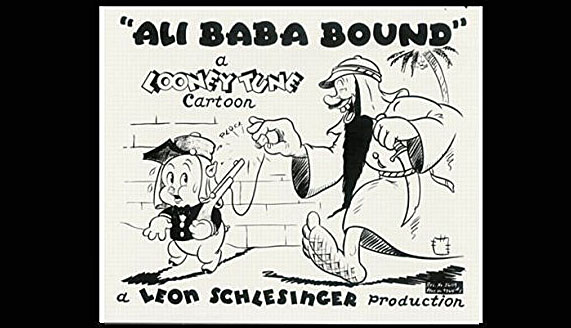 Ali Baba Bound (Warner, Looney Tunes (Porky Pig), 2/10/40 – Robert Clampett, dir.) – The Sahara Desert – where it is so hot, even the fan dancers use electric fans. An oasis updates to modern times, selling gas and soda pop. The Brown Turban restaurant (remember Hollywood’s Brown Derby?) welcomes legionnaires. And we’ll be getting our share of legion action, as another epic battle over a fort unfolds. Porky is one such legionnaire, exiting the restaurant in the evening hours, singing a chorus of the minor pop novelty, “The Girlfriend of the Whirling Dervish” (a musical cue Carl stalling would take to heart in several subsequent pictures). A mysterious figure whispers a beckon to Porky from the shadows of a palm tree. It is a caricature of George Raft, complete with his signature coin-toss, though performed this time by his toes of one bare foot. He reveals a hidden pocket inside his robes, labeled, “Secret messages – Take one”. Porky does, reading from a note headed “Confessions of a Nasty Spy” (play on Warner’s 1939 film, “Confessions of a Nazi Spy” – we weren’t even in the war yet, but distrust of the Nazis was already becoming commonplace.) The note informs Porky that a raid upon a desert fort is planned by Ali Baba and his Dirty Sleeves, and that Porky’s better tip the legionnaires off (signed by the stranger as “Tattle-Tale” Gray).
 Porky needs transportation, so goes to a rent-a-camel lot. Two such steeds are available for rent – mama and child. The mama is touted as the latest model “Humpmobile” (an even-then dated pun upon an early automobile brand, Hupmobile). The baby is rentable as a “Kiddy Kar” – not even requiring pedaling. Porky chooses the smaller one, telling Mama “Blondie” he’ll take good care of her “baby dumpling” (reference to the child character from the Blondie and Dagwood comic strip and current-hit Columbia movie series). Porky rides out to the fort, but finds the place deserted (no pun intended), with a note on the door from General De Livery stating that he and the boys have gone to a legion convention in Boston. (An awful lot of message and sign gags in this one, saving considerably on animation budget – and here comes another one.) As Porky scoffs that he was worried about those guys, he is spied upon by what appear to be a pair of binoculars peering over the dunes, but which is really Ali Baba, peering through the glass bottoms of two beer bottles. A superimposed sign below his face refers to him as the “mad dog of the desert”. Ali peers down at the words on screen, then proves them true by literally “barking” orders to his riffs. The Arabs charge, and Porky and Baby Dumpling take refuge inside the fort.
 Various battle gags ensue. One riff is used as a human battering ram on the front door, being fed a headache pill after every blow (a gag tracing back at least a few seasons before to Fleischer’s “Little Lamby”). Another riff stands upon the teeter-totter of a carnival high striker, while a third hits the other end of the board with a hammer. Every time the 2nd riff rises to the top of the striker and hits his head on the gong, he fires a shot with a rifle over the wall. Another tries to scale the wall with his bare hands, but Porky knocks him back down with a mallet blow. When it looks like he will make a second attempt to climb, he pauses before doing so, and instead pulls out a striker’s picket sign, reading “This fort unfair to Arabs”. A dumb-looking riff with large curved feet rocks like a rocking chair every time he fires a shot from atop the fort wall. Meanwhile, far from the center of the battle, a lonely bench is positioned in the manner of a player’s bench on a football field’s sidelines, reserved for the Suicide Squad – a single midget Arab, with a large military ammunition shell tied to his head. He eagerly awaits his turn to get into the big fray, paying no mind to the effect his destructive weapon might have upon himself.
 Within the fort walls, Ali appears, with no clue given as to how he got over. He discovers Baby Dumpling, and pulls out a small dagger. Dumpling backs away, finding himself cornered against a wall, but spots a bugle hanging on a hook. He inhales to sound a call with the horn, but no musical notes come out. Instead, the bell of the horn reacts like human lips, calling out a loud “HELP!!”. The literal word soars through the air, out of the fort, and back to Mama Blondie. Realizing her baby is in trouble, Blondie gasses up at a local filling station, repeating the old wheezes of auto cylinders in her humps, and cranking up her engine with a twist of her tail. She zooms over the desert, arriving at the fort mere seconds later. She wastes no time in gaining entry, not bothering with the barred door at all, but piercing her own silhouette hole through the stone wall. By now, Ali has both Porky and Dumpling backing away from Ali’s knife-point. A head-butt to Ali’s rear by Blondie sails him over the wall and out of the fort, where he lands prone in the sand before the rest of his riff troops – that is, all except the little suicide goon. “Now’s my big chance”, declares the little Arab from the other side of the fort, and launches himself in a headlong race toward the fort gate. “Outta my way, outta my way”, he calls out, intermittently imitating the loud beeps of an auto horn. Porky looks out a peephole in the gate, and spots the menace about to wreak havoc with his secret weapon. With not a split second to lose, Porky, flings the gate open, allowing the Arab to race inside without impact. On the other side of the fort, Blondie does the same with the fort’s rear gate, letting the Arab sail through and out without hitting a thing. With his head still lowered in his running charge, the little guy has no idea he has missed the fort entirely, and continues running. He runs right into Ali and the other riffs, resulting in a tremendous explosion. Nothing more is seen of the Arabs, but their robes descend and land upon various sticks and poles displaced by the explosion, forming a small community of tents, with a sign appearing before them all from nowhere, reading, “Ali Baba’s Auto Camp – Vacancy”.
Many may remember this film from the more commonly-seen redrawn color version which circulated for years on television. If so, several scenes from the original will feel new and unfamiliar, due to heavy and often seemingly-needless editing/censoring that shortened shots, removed punchlines, and left an already weak title when compared against the likes of “Little Beau Porky” seeming even weaker and senselessly incomplete.
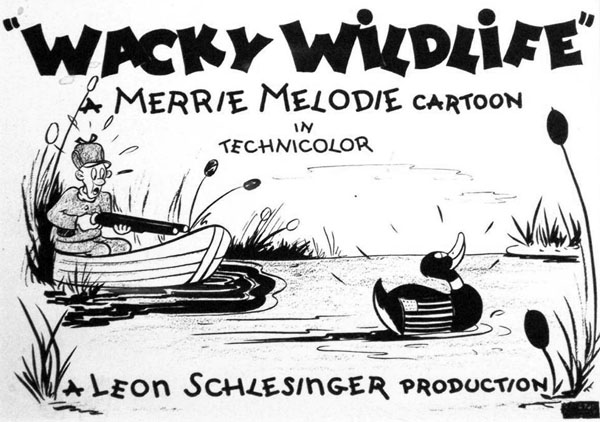 Wacky Wild Life (Warner, Merrie Melodies, 11/9/40 – Fred (Tex) Avery, dir.) – Another spot gag reel, loosely themed around nature studies of wild animals of all kinds. By this time, Egghead had developed into Elmer Fudd, and was no longer making cameos in Avery’s productions. There is also no running gag to frame the reel. The penultimate gag is quite similar to a never publicly screened scene Avery recalled working on as a test gag, which helped to launch a successful series of live-action/animation shorts produced by Jerry Fairbanks (of later Crusader Rabbit fame) for Paramount called “Speaking of Animals”. A camel plods over the sands of the desert, in remarkable smooth and realistic animation that is probably rotoscoped. A narrator yaks on and on about how these animals are known as the “ships of the desert”, able to travel for days on end through the blistering heat without requiring a drink. After a half a minute of this palaver over the ever-repeating walk-cycle of the camel, the animal comes to a stop, looks directly at the camera, and states, “I don’t care what you say. I’m thirsty.” (In Avery’s test shot for Fairbanks, a live horned-toad was seen walking across the screen, then turns to the camera, and with animated lips states. “I don’t care what you say. I’m horny.” The camel scene was probably as close as Avery could get to it without raising the censors’ ire.)
• “Wacky Wild Life” may be viewed on DailyMotion
 Abdul the Bulbul Ameer (MGM, 2/22/41 – Hugh Harman, dir.) – Hugh Harman’s closest effort to turning out zany comedy, taking as its storyline the lyric of an 1855-era song about two warriors, one from the Ottoman empire and one from the Russian forces of the Czar. It is hard to explain how these two wind up in the same vicinity – but then, the original work was a nonsense song. Ivan Scavinski Scavar goes downtown (in what appears to be Russian turf, given the prevalence of snow), and encounters the wide-bodied form of Abdul hogging an archway he wants to enter. A comic-relief Russian sidekick of Ivan’s complains to Abdul that he’s blocking traffic. Without a word, Abdul grabs the little Russian’s nose between his own bare toes, and pushes him aside. Ivan doesn’t take lightly to Abdul’s insolence, and stomps heavily upon Abdul’s toes with his boot. A war of words erupts, each threatening to do the other in. Both produce swords, and Ivan draws a line in the snow to keep them properly spaced on either side. A very-brief clash of steel somehow leaves the snowy surface scarred in the pattern of a tic-tac-toe board, with Ivan claiming three X’s in a row. Abdul plays dirty, and tosses his scimitar in a wild throw at Ivan. Ivan ducks, with the sword hitting the tall cossack hat of his sidekick, and disturbing a nest full of birds from within its material. With Abdul for the moment weaponless, Ivan fairly tosses aside his own sword, and challenges Abdul to put up his hands and “fight”. The magic word has been said, and seemingly an equal number of Arabs and Russians erupt from every building within hearing distance – and some that aren’t – to line the street from all sides, and populate bleachers that are instantly built on the spot to hold the capacity crowd. News also spreads fast, as three odd roving reporters with a newsreel camera, typewriter, and radio microphone show up from nowhere to cover the event. The lead reporter is an obvious tintype to Groucho Marx. The cameraman appears to be Harry Ritz. The third remains an unsettled question mark. Somewhat short and portly, some have speculated Lou Costello, while others lean toward Hugh Herbert – but no mannerisms nor voice of the character seem to match either.
The two combatants face each other in the square, much like two roosters in a cock-fight. For reasons unknown, the writers seem to play their own favorites, drawing more gentlemanliness and sympathy out of Ivan, while playing the portly Arab as a menacing heavy.
 Even at the start of the event, as the little Russian introduces the fighters to the crowd like a boxing-match referee, Abdul has to be physically held back in his corner by an attendant, to keep him from jumping the bell and tearing into Ivan with his bare hands. Abdul begins with a haymaker that misses its mark by a mile, but Ivan approaches the fight with the moves of a dancer, and precision-timed blows that seem to connect with Abdul’s face time and again. Ivan spins with the speed of a whirling dervish, hitting Abdul from every direction, while Abdul spends most of his time trying to keep his guard up before his face, to no avail. Then, Abdul tries another wild swing – and lands it right in the speeding Ivan’s kisser. Ivan goes down, while his little assistant weeps a few tears for his master. But there is no time for sentiment, as the shadow of Abdul looms over them, and the Arab moves in for the kill. Abdul picks up Ivan bodily, slamming him into the frozen ice again and again. Just when it seems Ivan cannot possibly take any more, the Russian’s arm extends like a rigid pole, whamming into Abdul’s jaw with enough force to make the Arab’s eyes roll. Both combatants step back a few paces, and charge each other head on. Their force is dead even, stopping both face-to-face in their tracks, but jarring every building in the area into unconnected rubble, which falls back into place in the buildings’ original shapes. Out battling boys launch at each other again, transforming into a whirlwind of Technicolor streaks. The three reporters get so caught up in reporting things blow-by-blow, they end up inside the whirlwind also, with a punch from Abdul nearly knocking Groucho out. The little Russian adds his own strategy to the mix, approaching the whirlwind carrying a lit cartoon Bolshevik bomb. He reaches into the whirlwind, gets hold of Abdul’s pants, and stuffs the bomb under Abdul’s rear end, then runs for his life. Ivan gets the idea of what has happened, too, and tries to escape the whirlwind, but the arm of Abdul drags him back inside. Then BOOM!!!! The blast is strong enough to disintegrate a tall brick wall brick-by-brick, while the three reporters’ outfits are reduced to tatters. As for Abdul and Ivan, they are blasted high into the air. “The sky’s the limit”, shouts Groucho. The two battlers come down together, shattering a hole through the frozen ice. A wave of ice-cold water erupts from the hole, shooting the drenched combatants out atop it – then everything freezes solid. As Groucho puts it, “Both boys are out – COLD!”, as the camera pans upwards, revealing the two, entirely encased in ice, frozen in a combat position. Rather than chop them out, everyone leaves them there, as a permanent monument to the undying fame of their epic battle.
 The Crystal Gazer (Screen Gems/Columbia, Phantasy, 9/26/41 – Sid Marcus, dir.) – In the wake of Snow White, several studios tried to develop some answer to one or more of the Seven Dwarfs. The Lilliputians of Fleischer’s “Gulliver’s Travels” would draw obvious parallels, especially Gabby, who could be said to be Max’s version of Grumpy. Walter Lantz would make recurring use of a character named Punchy, a speaking Dopey-type who would appear among other places in some travel spoofs, and in the Technicolor “Syncopated Sioux”. Friz Freleng would introduce us to a room full of dwarf-like baking elves in Warner’s “Busy Bakers”. And Columbia/Screen Gems would try it in two directions, first with a pair of cartoons about a group of elves known as the Happy Tots, then with the recurring appearances of a diminutive absolute moron, of no particular name that stuck, who would show up in this cartoon, “The Cute Recruit”, and the Technicolor “The Cuckoo I.Q.” As with most derivatives, none of these dwarf-clones had the same lasting appeal or recognizability of Disney’s magnificent seven, nor generated nearly as many laughs. Not to say that Columbia didn’t try. Though the drawing style and character model are awkward and rudimentary, there is a considerable degree of body-language built into his movements to emphasize his low intelligence and his labored-efforts to solve problems (much more so than Lantz’s Punchy). The talents of Marcus as a director still had a long way to develop, but even at this mid-stream stage, indicate he was trying to rise above the mundane, even when faced with a lack of substantial plot material and small budget. This is exhibited to greater degree in the Egyptian sequences of the second half of this film, which Marcus seems to handle alongside the best of them, coming up with his own rendition of a John Foster nightmare with smoother rendering. This cartoon actually follows a budgetary template that is noticeable in many other studio cartoons of this period: fill and pad as long as possible in the first half, then pack all of your action into a second-half finale. Other examples of this house-style include “The Wild and Woozy West” and “Wacky Wigwams” – all half-resembling a respectable cartoon.
Our moron, here referred to by a broadcast announcer as noted astrologist, Professor Zaza Rajah, wears a turban so oversized, it slips down entirely over his head, right down to his equally-oversized Arrow collar. The announcer touts his abilities to act as guide to your future, and answer any question. After considerable coaxing, the only question for Zaza the announcer can obtain from the audience is a housewife’s inquiry, “Should I put whipped cream in my potato salad?” We can already rest assured that, whatever Zaza’s findings are, they will be of the utmost importance.
 Zaza spends the first half of the cartoon trying to activate his psychic brain, through various facial contortions, self-punishments, pacing, and holding his breath. The announcer (and everyone else) grow impatient for Zaza’s answer, but still Zaza only shrugs his shoulders, having come up with nothing yet. He is forced to employ his means of last resort, exploring the distant past by gazing into a crystal ball. We join him in gazing into the sphere, and see his vision of himself riding atop a camel through the desert of ancient Egypt. The traditional dunes and pyramids are joined by a sign of modern civilization – a directional signpost, pointing to “Murphy’s Split Pea Soup – two miles.” Zaza’s destination is the temple of a Pharaoh who’s name the announcer (Mel Blanc) admits partway through that he cannot pronounce, so he completes the name by slipping in the word “Glendale”. Along the way, he passes the Sphinx – who blows a giant whistle, halting the camel in the manner of a traffic cop at a crossroad, to allow a Gray-hound bus of tourists to pass. Finally arriving at the temple, Zaza looks for an entrance, and stops to observe a large stone tablet on the wall, appearing to be written in Arabic. Much as with Popeye’s menu in “Ali Baba”, this writing is not what it first appears. Zaza finds the tablet to be nailed to the wall by a single centered nail, and pivots the tablet upside down, so that it clearly reads in cursive lettering, “The key is under the mat, Toots. Cleo.”
Thus gaining entry to the temple, Zaza enters a large chamber lined with mummy cases on the walls. Just before he enters, three cases pop open, and three mummies unexpectedly entertain us with a vocal chorus of “She’ll Be Comin’ Round the Mountain”. (Someone’s been watching too many Tex Avery spot gag reels.) The mummies return to their boxes, just as Zaza appears. “Hello…Anybody home?…” calls out Zaza, only hearing his own voice as an echo in response. Zaza whispers to us, “There’s nobody home.” Suddenly, the words are repeated back to him, in a loud yell! Perhaps Zaza is not as alone as he thinks, as a small panel opens in another mummy case, and a bandaged hand emerges, collecting a milk bottle left for him upon the pedestal floor, and substituting for it an empty bottle with a note for the milkman’s next delivery in the morning. In another alcove, two more bandaged hands extend through similar hatches in their respective cases, each engaged in a game of checkers with one another on a board upon a small table between them. From another side of the chamber, a case door opens, revealing a walking Mummy smoking a cigar, who walks briskly across the room to another case, opening it to reveal a telephone booth inside. The mummy deposits a coin in a slot of the phone, and calls his bookie to place a bet of Sea Biscuit in the third race. Finally, a mummy who may or may not be of the opposite gender emerges to strut around effeminately, then wiggle a seductive bandaged shoulder at Zaza in a “come-hither” manner. We never see if Zaza accepts the invitation into “her” case, as the sands of time obscure the view inside the ball, and the Professor’s consciousness (such as it is) returns to the present. The announce asks if he has arrived at an answer to the young lady’s question. Zaza nods his head yes, then answers with a not-surprising, “Noooooo…” After waiting all this time for that, the announcer finishes the broadcast by removing Zaza’s turban, and conking him on the dome with the crystal ball.
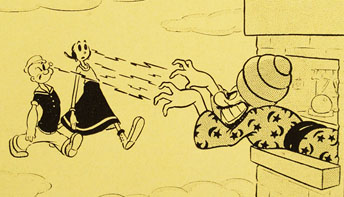 Nix on Hypnotricks (Fleischer/Paramount, Popeye, 12/19/41 – Dave Fleischer, dir., Dave Tendlar/John Walworth, anim.) – Another instance of Popeye meeting up with a “stage” Arabian – another hypnotist, donning a turban for the theater audiences to appear possessed of mystical powers in his act. But this time, it isn’t Bluto. For a change, Popeye has a new adversary – named Professor I. Stare (10¢ a trance). Currently, he appears to be out of work, and spends his time in a brownstone apartment house, trying to keep in practice by practicing his powers upon a goldfish in a bowl. Not the best of subjects, as the fish merely spits water in his eye. He needs a human subject. How to get one in a hurry? Pick up the telephone book, close his eyes, and point at any random number – his finger landing upon the listing for Miss Olive Oyl. Dialing up the number on his old candlestick telephone, he focuses the electrical power of his fingertips upon the telephone mouthpiece, transmitting the impulses to the speaker of Olive’s phone. “Come to me”, he beckons over and over. Olive’s black irises widen three times their normal size (an odd look indeed for the character), and she picks up her hat and exits in a robotic walk from her home, leaving her date Popeye perplexed at her sudden departure. Popeye hears the mystery voice still speaking over the telephone, and when he picks up the receiver, the electricity is so strong that his pipe is almost drawn into the telephone. He deduces in an instant that a hypnotist is on the other end of the line, and that Olive is in trouble.
 Olive’s trance-driven “sleepwalk” allows the writers to rather retrace the steps of the early (and far superior) hit, “A Dream Walking”, with some variations. Olive walks out of the building into the middle of a busy intersection. Popeye tries to follow, but is repeatedly nearly run down, and has to resort to hopping over car roofs, falling into the open skylight of a taxi, which drives him a half-block, then stops to charge him 85 cents. Popeye pays it, telling the driver to use the money to get the hole in his roof repaired. Olive walks onto a window washer’s scaffold at ground level, and is inadvertently hoisted up to the level of the roof of the next building, which she crosses over to in one step. She begins building-hopping, stepping from roof to roof. When a forthcoming gap between buildings is obviously too wide to cross, Popeye pushes one building against another to bridge the gap. Olive walks out onto a phone wire, and the line connection snaps off the corner of the building, taking along a phone from inside an upstairs apartment. Popeye grabs onto the phone, holding onto the building with his toes, and spends several frustrating seconds arguing with a telephone operator about “holding the wire”. Popeye finally pulls the wire as tightly as he can, then lets go, jumping atop it to tightrope walk to the next building faster than the wire can sag and fall. Popeye encounters awnings and an angry flock of birds at the next building, taking some acrobatic bounces upon multiple awnings at different floor levels, getting accidentally beaten by a woman beating a carpet on the wall outside her window, and even taking a jump off another person leaning out a window as if the man were a diving board. Now Olive ventures onto a skyscraper under construction, and the similarities to “A Dream Walking” become all too apparent. Right down to a two-player version of the same sequence where Popeye (and in the original Bluto) gets hit on the head, and walks in a trance together with Olive, each barely missing each other at an intersection of steel girders. Popeye falls into a trash can below full of alley cats, and the resulting catfight awakens him, in time to see Olive marching across window ledges, and the hypnotist at a far window, still beckoning her to come. Popeye downs his spinach, and, in a cross-reference to Fleischer’s Superman series, the “S” from the spinach can label tears off, to apply itself to Popeye’s chest. Popeye zooms up to a flagpole in front of the hypnotist’s apartment. Seeing his approach, the hypnotist turns his attention to Popeye, aiming his electric fingers at the sailor, telling him “Down you go.” Much as Superman handles the mad scientist’s ray in his first adventure, Popeye socks away the bolts of electric current, then lands a sock upon the hypnotist’s chin. “Down is right”, Popeye declares, unraveling the mystic’s turban cloth, and using it to string him to the flagpole like a waving pennant in the breeze. Olive chooses this moment to reach the end of the building’s water tower, and fall. Using more hanging remnants of the turban cloth, Popeye swings like Tarzan, catches Olive in mid-fall, then slides with her down a vertical flagpole into the city park. He tries to revive her, but the only thing that will snap her out of it (as in the previous “The Hyp-Nut-Tist”) is to give her a sock in the face. Unlike the previous cartoon, Olive is no longer cool with this. “You struck me”, she complains, and ends the cartoon beating up on the hapless sailor, whose spinach seems to provide no strength against the fury of a woman.
• “Nix On Hypnotricks” is here on DailyMotion
NEXT WEEK: Some wartime desert antics, and some jazzy curves.
 Charles Gardner is an animation enthusiast who toils by day as a member of LA Law – but by nights and weekends indulges in classic jazz and ragtime as a performer; and studies classic Hollywood cartoons… maybe a little too much.









“The Girlfriend of the Whirling Dervish” is a great song, and I sing it whenever I go riding a camel (which I’ve done maybe five times in my life). But it’s indicative of the geographic ambiguity that pervades all of these cartoons. The song’s intro sets it “in old Bombay,” where the dervish “sets out to make an honest rupee” as he “dreams of a Hindoo honeymoon.” But the whirling dervishes originated in Persia as an expression of Islamic mysticism. I suspect that the confusion will be even more marked next week, when we’re bound to see turbans, Moorish arches, and harem outfits in, of all places… Siam???
Where might Abdul the Bulbul-Ameer and Ivan Scavinsky Scavar have met? Well, given that the Russian and Ottoman empires were at war intermittently for hundreds of years, pretty much anywhere in the vicinity of the Black Sea, I suppose.
I saw “The Crystal Gazer” on one of Steve Stanchfield’s Thunderbean Thursday posts not all that long ago, and I have no desire to revisit it. Not only is it a terrible cartoon, but the idea of putting whipped cream on potato salad is disgusting.
Amazing how many product placement and/or commercial references could be put into these cartoons–gags that might fly over the heads of modern audiences. Not only is “The Princess and the Pauper” an overblown commercial for Chevrolet, but the Jell-o reference in “Six Delicious Flavors Desert” (a play on “dessert”), as well as the Humpmobile and “Tattle-tale Gray”. Some of the ads and slogans persisted into modern times.
I’m amazed that Warner Brothers could get away with references to Blondie and Baby Dumpling, but perhaps Columbia Pictures and King Features Syndicate considered it extra publicity. “Ali Baba Bound” wasn’t the only Warners cartoon to make reference to the Bumstead family.
Sometimes, in looking on the 30’s and 40’s as a simpler era, people today forget that there was a level of sophistication in the sensibilities of those bygone years, such as spoofs of popular commercials. Even Disney’s “Snow White and the Seven Dwarfs” includes a song lyric that parodies a radio commercial of the day. It’s always fun to look for these then-topical references. If you know even a little about the era, it can make the gags more on-point and funnier.
Even though “Abdul the Bulbul Ameer” is one of Hugh Harman’s attempts to make zany fast-paced comedy (which he actually resented and only did it under Fred Quimby’s command), somehow his old habits still sneaked in to attempt to make the cartoon more Disneyesque. Also, around 1939, it was said that Disney was planning to make one cartoon based on the same song, but the idea was eventually scrapped. And since Harman and Ising were freelancing for Disney before that time, I wonder if Harman had this idea when he was doing for Disney, or did he actually learn this idea from Disney and took it.
Also, wasn’t “Busy Bakers” done by Ben Hardaway and Cal Dalton? I don’t know if Friz Freleng had involved in this, though he later did make a few cartoons feature dwarf-like elves, “Holiday for Shoestrings” (with some of elves resembled Elmer Fudd) and “Yankee Dood It” (with Elmer Fudd actually as an elf)
Besides, the Screen Gems goon actually made another couple of appearances, “A Helping Paw” and “Land of Fun”, and Wikipedia credited his name as “Cornelius Van Goon”, wonder where they got this reference.
A minor note: the title “Ali Baba Bound” is a pun on “Alabamy Bound,” a song introduced in 1924 by Al Jolson.
Frederick Weigand: What is the lyric in “Snow White” and what commercial is it parodying?
The lyric is in “The Silly Song” aka “The Dwarfs’ Yodeling Song” and the verse runs thus:
“I used to dance and tap my feet
But they don’t keep in rhythm.
You see, I washed ’em both today
And I can’t do nothin’ with ’em!”
It’s from a shampoo commercial that ran: “I just washed my hair and I can’t do a thing with it.” I don’t remember the product but the slogan was still current when I was a kid.
The line “I’ve just washed my hair and I can’t do a thing with it!” comes from a bestselling novel of 1911 titled A WEAVER OF DREAMS, by Myrtle Reed. It was used in a TV commercial for Twice As Nice shampoo plus conditioner that aired in the late ‘60s and early ‘70s. I’m not aware that it was ever used in advertising prior to that.
Charles Gardner sez:
To quote from the old satire joke on THE LONE RANGER: “Who is ‘WE’ Kemosabe?” I – for one – certainly didn’t agree to leave out something like ALADDIN AND HIS WONDERFUL LAMP (1939) which is one of my all-time favorite POPEYE cartoons and (I think) should surely be part of this group of “Far East” cartoons!
“Abdul the Bulbul Ameer” was a hit Victor record for the veteran Vaudeville performer Frank Crumit in the late 1920’s. The fact that the lyrics are reproduced word-for-word in the cartoon indicates that Hugh Harman and his crew probably had heard the record. This wouldn’t have been surprising, since singer, ukulele ace, and comedian Crumit made the jump to radio in the early 30’s, appearing on a weekly broadcast co-starring his wife, singer Julia Sanderson. So the song was probably performed at least once on their show, and the record was still fairly current at the time.
The problem that Harman faced was, how to stretch a three-minute song into a seven-minute cartoon! I don’t find it very funny, although the effort that went into it shows— maybe just a little too much.
One wonders what Tex Avery might have done with it…
https://www.youtube.com/watch?v=o6vyZ_q-TjA