




One slight backtrack to cover a title I missed, then on into the mid-to-late 1940’s – with no less than three appearances by Popeye, assists from Tom and Jerry, Private Snafu, Bugs Bunny, and Donald and Goofy, and some promised “dangerous curves” from Walter Lantz and Terrytoons.
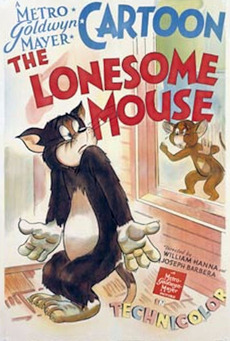 I’ll begin with a bonus extra overlooked during last-week’s coverage. The Lonesome Mouse (MGM, Tom and Jerry, 5/22/43 – William Hanna/Joseph Barbera, dir.) – This unusual episode seems to have been written as if a sequel to the original “Puss Gets the Boot”, to answer the unanswered question, What would happen after Jerry actually succeeded in getting Tom kicked out of the house? That questions like this were approached, especially so early in this series, is a testament to the depth and complexity of personality that was beginning to be imbued in the most popular animated characters since the mid-1930’s – real and lasting identifying traits that could allow both writers and viewers to think like the pen-and-ink characters and empathize with them. Bill and Joe realized as early as their third installment, “The Night Before Christmas”, that Tom and Jerry were not your garden variety cat and mouse – possessing a multi-layered level of love-hate relationship that would continually drive them into the chase and potentially lethal situations – and occasionally over the deep end with rage – but leave them with afterthoughts about it when things quieted down. Beneath it all, each seemed to realize that there was a sort of necessary level of dependency upon each other to fill a day, and that things just wouldn’t feel right were the other to disappear. Is it mere love of chasing that does it? No, something more. Making the chase a mental challenge. Working against a worthy adversary that keeps you on your toes. Something that makes even the most harrowing of days feel in the end like fun, and something you want to repeat again. The difference between going through the motions and an exhilarating thrill. Thus, each would from time to time realize, after blowing off the necessary emotional steam, that they really did not want to bring permanent harm to their opponent, and on special occasions could even muster up moments of tolerance, near-friendship or kindness (as in their seasonal gift-giving after nearly freezing Jerry to death in “Christmas”), and occasional teamwork toward a common goal.
 Teamwork is precisely what this cartoon is about, being the second time the two work together in an elaborate scheme (the first being “Dog Trouble”). The film opens almost as if the middle of a story, or as a recap of the ending of “Puss Gets the Boot”, with Jerry dropping a vase off a mantel atop the head of sleeping Tom. Mammy enters, already set to oust Tom from his happy home for “sabotage” in breaking the crockery, and literally boots him out the front door. Right at the start, we get the one gag that qualifies this film for discussion in this article series. Tom hits a wall, against which rests a mop and a somewhat battered wooden crate. The crate splits in two and the halves invert, assuming the shape of two pyramids laying close to Tom. The mop lands on his head with the cloth strands separating into two bunches on either side of his head, giving the impression that Tom is wearing a traditional sheik’s hat (known as a ghutra – you learn something new every day). Jerry taunts Tom from inside the house’s front window, performing an angled-limb Egyptian dance and punctuating it with shifts of his rear end. Jerry spends the afternoon in solitary celebration, wading and swimming in Tom’s milk, doodling upon his picture on the side of his cat bed (to make him look like Adolf Hitler), and tearing feathers out of Tom’s most comfortable pillow. But by nightfall, jubilation has turned to melancholy, as the voice of his conscience observes, while Jerry watches a lonely sulking Tom out of the window, that “You can’t live with him – but there’s no fun without him.” Jerry’s conscience puts the bee in his bonnet that he could get that guy back in – if he really wanted to. Jerry thus appears outside, waving a flag of truce, and (in rare speaking roles for both the cat and mouse) they conspire a plan, which Tom calls a “LULU!”
Thus, next morning, Jerry terrorizes Mammy in the kitchen, chasing heer up a stool, shaking it until all her belongings fall to the ground (including dice and a straight-razor), then using the razor to chop down the stool. Mammy screams for Tom, who enters from the alley as the returning hero, in an elaborate game of pursuing and catching Jerry (though their scenes of violence are actually achieved behind doors and curtains, with the two playing patty-cake or engaging in percussive jam sessions instead of battling). A squashed tomato under a rug leaves Mammy believing that Jerry is done for, and Tom is rewarded with his old home back, and a great big pie for dessert. Jerry appears after she leaves the room, assuming he is entitled to some of the reward for saving Tom’s home. Showing no continuing gratitude, Tom pushes him away. Jerry’s dander is back up, and he kicks Tom in the rear, leaving him with his face submerging into the gooey pie, while Jerry marches back to his hole, muttering at Tom for being a double-crossing two-timer.
• “The Lonesome Mouse” is at dailymotion.com
 Spinach Packin’ Popeye (Famous/Paramount, Popeye, 7/21/44 – I. Sparber, dir.) – The first of Famous’s many “cheaters” over the years, heavily relying upon reuse of old clips to pad out its running time. This, however, was a little early in the game for such shortcutting, given the fact that Paramount had only within the past season converted to all color production, leaving very little to choose from for past clips to fit into the storyline. So, out of necessity’s sake, two of Fleischer’s Arabian Nights 2-reelers, discussed in preceding chapter of this series, provide the bulk of the footage – “Meets Sinbad the Sailor” (1936) and “Ali Baba’s Forty Thieves” (1937). Not only is no effort made in the continuity to explain Popeye’s switch of uniform in the old clips from modern whites to red, black, and blue, but this marks Famous’s only use of the Fleischer footage making no change whatsoever to the original audio (clearly featuring Gus Wickie as Bluto/Sinbad/Abu Hassan, who hadn’t worked in the series in years). All of this may provide signs that this project was planned and executed rather hastily. Yet, oddly enough, the premise behind the one-third or so of new footage is remarkably clever, making this one of the more enjoyable “cheaters” to grace the screen.
Popeye is doing his bit for the Red Cross – donating a gallon of blood at a blood bank. A nurse warns him that he should lie back on the hospital-style bed and rest, but Popeye, convinced of his usual resilience, states he hasn’t got time for that, as he has a big prize fight scheduled for the evening. He shows up in the ring, still looking chipper, and faces off against Bluto the Bruiser. We only see the action at the arena up to the sound of the bell for round 1 (the bell having a clapper shaped like a gloved fist) – then, we dissolve to the point-of-view of radio listener Olive Oyl, who pantomimes the action of the fight blow-by-blow. The opponents cautiously size each other up, move in for a whirlwind of blows – and one of them goes down for the count. Olive cheers reflexively, until she hears the final call of the announcer – Popeye the sailor – knocked out! Olive’s shock is so great, she kicks the radio set in the receiver, destroying it.
 Enter Popeye at the door, revived and still anxious for his after-fight date, but sporting a black eye with patriotic red, white, and blue circles around it. Olive refers to him as a “palooka” and a “has been”, and announces she’s through with him. She steps behind a dressing curtain, and exchanges a nautical outfit she has worn in support of Popeye for a suit of military khaki, tuning around a framed picture of Popeye on a desk to reveal another portrait of Bluto in army fatigues, with the image slyly winking at her. Popeye insists he’s still strong, and has licked better men than Bluto (although they all look like him), and spends the next four minutes showing us clips from a scrapbook of the Roc sequence from “Sinbad” and the entire final fight of “Ali Baba”. Olive concedes that he WAS strong – then, but he’s just a weakling now. Picking Popeye up with one finger placed under his chin, Olive tosses him across the room, in a prone position upon the couch, and shouts, “GOOD BYE!” Popeye remains reclining and seemingly unconscious, as the scene dissolves back to the hospital bed where the cartoon started. The nurse is arousing him. He had indeed taken the nurse’s advice, and was asleep. Not quite sure if everything was a dream, Popeye races out of the blood bank to Olive’s house, and knocks on the door. When Olive peers out the window, Popeye lifts the whole house off of its foundation, shakes, it, and vibrates Olive put the window, with Popeye catching her in a balance of the tip of her nose on one finger. Popeye asks if he is still Olive’s strong man. Olive replies that he’s about the strongest man in the whole wide world. “That’s all I wanted to hear”, responds a happy Popeye, with a laugh and a pipe-toot for the iris out.
• “Spinach Packin’ Popeye” is also at DAILYMOTION
 Abou Ben Boogie (Lantz/Universal, Swing Symphony, 9/18/44 – James Culhane, dir.) – Well, I promised curves, and here’s where we deliver them, in the next two cartoons. It could have been a trifecta, had we not had a small problem in geography. A past blogger alluded to inclusion of what seems like a sister film to this one from Lantz’s archives, “The Greatest Man in Siam”. However, despite the artists depicting palace life there as if a twin to the Arabian setting of “Abou”, the sad fact of the matter is, even if they’ve got the visual ambience twisted around, and feature the same dancing girl in both films, the earlier film is no doubt nominally located in Siam – not Arabia. Just as Van Beuren’s “Sultan Pepper” seemed more like an Indian maharajah, we defer to the animators’ intention to depict an Arabian when introducing a Sultan, and to be in Siam when they say they’re in Siam. So “Greatest Man” will not make the lineup here.
A cute opening shot has a seemingly inconspicuous sand dune blown away by the desert wind, to reveal the small oasis town where our story takes place. A night spot stands out upon the ancient streets: The Adobe Club (Here’s mud in your eye). We fade inside to a hat check booth. A small man in a turban appears, as a good-looking gal offers to check his hat. She grabs one end of his turban fabric, threads in into a spool, then spins a handle, winding the fabric onto the spool in a twinkling, and spinning the little man like a top. When his skull is revealed, it is nearly as tall and narrow as the spool is wide. Further inside, another man tries out a cigarette dispensing machine, intending to purchase “Camel’s Hair cigarettes – puts a coat on your tongue”. Instead of a soft-pack, the machine coughs out a live, full-size camel. Other smokers prefer the hookah, though one dim-witted one inhales it wrong, filling himself up with tobacco-laden water until it spurts out of his ears.
 The musical festivities begin. A portly Arab unrolls a piece of paper, containing a flat visual image of a piano keyboard. Also opening some sheet music marked “Boogie Woogie in Ten Easy Lessons”, he begins to pound out rhythmic riffs by merely pressing his fingers upon the piano-key drawing. Turning to the audience, the man comments “Uncanny device, isn’t it?” The paper gives him trouble, as it begins to curl up at each end, wrapping itself repeatedly around the man’s arms as he plays. Finally getting fed up with the whole thing, the man crumples the paper, then tears at it – producing a string of paper dolls who continue to kick and sway to the boogie music beat.
A pair of black slaves carry in a large magic lamp. No, there is no genie inside. Instead, it pops open to reveal something better – an ultra-curvaceous harem dancing girl in transparent leggings, known only in internal studio records as “Miss X”. Gaping eyeballs appear in the darkness around the stage from all sides – and it quickly becomes apparent that this film is Lantz’s answer to the provocative pin-up epics of Tex Avery in his string of song-and-dance spectaculars for the character of “Red” from “Red Hot Riding Hood”. As with Avery’s films, most of the remaining action involves a lot of girl-watching reaction gags, with several scenes being almost dead-ringers for lifting Avery poses. A first look by the titular Abou Ben Boogie (the Oriental Rug Cutter – a character design again lifted from “Siam” as the former “fastest man in Siam”) has Abou’s entire face converting into a bugged-out eyeball nearly as tall as his whole body. Abou stiffens into a horizontal point from a wall, nearly identically to the wolf’s horizontal stiff-take in Red Hot Riding Hood. And Abou’s face morphs into that of a wolf, making his resemblance to Avery’s wolf less than purely coincidental.
 There is a lot of vigorous dancing, which an MGM budget could have depicted more smoothly, but which is energetically posed by Culhane. As with its predecessor, the film looks to have gotten in immediate trouble with the censors, with two shots of Miss X’s strutting walk seeming to be artificially zoomed-in to show things only from well-above the waist, removing any sensuality of her swaying hips. (The previous film had also insisted on adding the transparent pantaloon legs instead of showing bare calves, which is retained here.) Fortunately, there are still enough two-shots to show Miss X from head to toe that we don’t lose much of the effect. A running gag, perhaps used to fill a little more time than necessary, has Abou’s efforts to dance with or plant a kiss upon Miss X intercepted time and again by a pesky female camel, who gets into the dancing mood herself, strutting around and then inverting herself, exiting the stage walking upon her humps. Finally, as the title number comes to a close, Miss X re-enters her magic lamp, and pulls the lid closed upon her. Abou opens it again, trying to grab a hug and a kiss, but of course gets the camel again, who bats her lashes flirtatiously for the iris out.
Lantz’s extra efforts met the same television fate as Avery’s, being classified as too hot for the kiddies, and Miss X’s two appearances have been largely banned from TV. Before DVD release, it was only available in a rare black-and-white 16mm sound release from Castle Films (which was all that was available for a Los Angeles County Art Museum screening back around the 1980’s or ‘90’s). It would be nice, for a change, if MeTV might (or has) broken with the past to include the film in some one of their airing schedules, as there is little other than Miss X herself and maybe the incidental smoking gags which would raise eyebrows today.
• “Abou Ben Boogie” is on Vimeo.
The Sultan’s Birthday (Terrytoons/Fox, Mighty Mouse, 10/13/44 – Bill Tytla, dir.) – This film used to get quite a bit of air play on CBS, and later on local stations in my area. Yet, as a kid, it never really caught my attention as a standout. Now, in viewing it as an adult and with more knowledge of the studio’s history and personnel, I recognize it as a little hidden gem among the dusty reels, with some really classy-looking imagery, camerawork, and character animation – in no small part attributable to what in effect amounted to visiting royalty among the Terry ranks – an honest-to-goodness Disney animator, by the name of Bill Tytla. Reasons for his leaving Disney (after notable successes in animating Stromboli for Pinocchio and the satanic spirit for Fantasia’s “Night on Bald Mountain”) are said to have included alienation arising from his participation in the Disney animator’s strike, a prolonged illness of his wife, and a wish to return to his East Coast home. He thus found himself (for altogether too short a time) a director at Terrytoons – a place where he could have made a real difference in quality. But (no doubt contributed to by Paul Terry’s archetypical way of pinching a penny), the gig seemed over in the twinkling of an eye, and he changed his commute to Famous instead, where, despite turning out many notable favorites, he was a little lost in the shuffle of the old Fleischer regulars and the move to formula plots, plus in an environment already used to smooth, slick animation, such that his participation (excepting becoming a bit of the new Willard Bowsky as go-to guy for physical violence) didn’t really seem to make much of a mark on the studio’s reputation at all.

An original background from “The Sultan’s Birthday”
Our scene opens on a minaret-studded Arabian skyline, with the spires swaying in time to atmospheric music. (Even Bill’s tight efforts at quality control can’t quite defeat the shortcomings of the Terry ink and paint department, which louses up the color of one spire in a shot so that its middle repeatedly flashes white on each repeat of the cycle). Crowds (decently animated for the studio’s budgets) cheer their exalted ruler at his balcony on the day of his birthday. A line of bearers carries to his throne room gifts of huge and exotic jewels, and a massive birthday cake. Animation of the Sultan mouse is expertly handled, with great facial nuances and some body language reminiscent of the gyrations of Stromboli (when he dreamed of touring Constantinople). The Sultan’s reactions to the crowd and the cake show genuine delight, and also express some great trepidation when he fears the last candle on the cake may not have been blown out. But he becomes even more expressive as a chaise is carried in, bearing a mystery visitor. While smoking a hookah, the Sultan beckons a royal aide over to find out who might be inside the conveyance, and his countenance beams with anticipation as the aide’s rumor is whispered in his ear. And why not? The chaise’s curtains part, to reveal the charming figure of a shapely harem-style belly dancer mouse – some of the best Terrytoons female animation next to Krakatoa Katie. Not only is her dance equally as seductive as that of Miss X, but the Sultan again exhibits great nuanced reaction, energetically rubbing his no-doubt sweaty palms on the silk garments covering his plump legs, and floating upwards into the air when the girl tickles him under his chin, then dropping with a plop onto his pillows as she removes it. He sways to the beat of the tom-toms (or perhaps tum-tums, with rhythm being pounded out upon a musician’s fat bare belly), with his eyes circling in their sockets as if somewhat disjointed from their normal musculature.
 But, with all this mouse meat for the taking in one concentrated place, who should crash the party but a squadron of Arabian cats, flying in triangle formation upon an armada of magic carpets. Each carpet is equipped with a quartet of machine gun barrels protruding from their forward hems, and joystick controls. At a signal, they swoop down upon the festivities. The Sultan and the girl briefly cower together as they watch internal columns of the palace collapse. But the Sultan remembers who’s supposed to be in charge here, drawing his scimitar, and strides boldly out upon the balcony to address the foe. A look above, however, sends him running for cover again, as a bomb bay door opens in a carpet above, releasing a quartet of aerial bombs that follow the Sultan inside from the balcony. Unable to outrace them, the Sultan ducks, allowing the projectiles to pass over his head. The smart bombs reverse course, and the Sultan repeats the trick by diving into an alcove just before reaching the balcony again, fooling the bombs into exiting over the balcony, knocking out four of the passing cats and their carpets in the process. A fifth cat, however, swoops with his carpet into the palace, and pursues the Sultan with machine guns blazing. The Sultan dives into an urn, but the gunfire splits the urn in two. By now, the entire throne room is swarming with flying cats and carpets. Oddly, the film fails to follow our central Sultan from this point, who is never seen on screen again. Instead, attention shifts to the dancing girl, who is hiding in another jug. The chief of the cats spots her, slams a lid down upon the jug, and makes off with her, pottery and all, aboard his carpet, his army of cats following out the window.
Numerous mice fire at the exiting cats with rifles from the palace windows, and the minarets all pop their tops, and become a battery of anti-aircraft guns. The sky is alive with flying projectiles – but nothing seems on target to bring down any of the cats. Some of the ground fire takes aim so wild, bullets hit the moon and a small star above it. The star bursts apart, to reveal itself as the headquarters for – Mighty Mouse! Mighty leaps into action. First, a head-on hit with the triangle of flying carpets, to the sound of a bowling-pin strike. Various blows to the belly that pile up cats seven-deep for falls from their mounts, and send carpets crashing to the ground in flames. Speaking of flames, Mighty sets fire to one rug, burning it out from under its pilot. The cat chieftain chases the dancing girl around and around the jug on his own command carpet, until Mighty appears. The Chief draws his scimitar, but the sharp blade cracks as if made of glass upon hitting Mighty’s steel chest-muscles. Mighty gives the cat a sock, sending him and his carpet into a free-fall. Mighty uses his red contrail as a rope, to tie the carpet around the Chief into a neat bundle before it hits the ground. (We never do see any form of crash or splat.) Then Mighty, in an unusual look of semi-exhaustion from the grueling battle, looks around, to discover the girl is now in free-fall too. Attempting to build a little drama in what was becoming a pat ending for many a cartoon in the series, Mighty goes into a power-dive, his exhausted eyes visibly watering from the intense speed. (This eyes-watering touch would be re-used later with the volcanic fumes of “Krakatoa”.) Too bad footage budgets and a pre-timed soundtrack didn’t permit a little more lingering on this bit to heighten the dramatic effect – but as usual, Mighty catches the girl in time, and carries her majestically back to the palace, with her throwing kisses while held above Mighty’s head. Fade out.
 Hot Spot (Warner, Private Snafu, 7/2/45 – I. (Friz) Freleng, dir.) – Satan (voiced by Hal Peary of “The Great Gildersleeve”) receives an anonymous phone call in his office in Hades, tipping him off to some stiff competition above ground – a land where temperatures reach 180 degrees. “I’ll be right there”, responds Satan, suddenly appearing in the land of Iran, which the devil’s guidebook refers to as “the furnace of the Middle East”. “Chamber of Commerce stuff”, remarks Satan in disbelief. Satan’s gaze falls upon a camel, whom the guidebook states is the only animal who doesn’t mind the temperature. “I don’t care what you say. I’m hot”, responds the camel. Satan continues to read from the guidebook, loosening his collar and fanning himself, while beads of perspiration dot his brow. The book states that human activity here is reduced to a virtual standstill – until a convoy of ships arrives at ocean’s edge, and a swarm of soldiers begin constructing docks, and unloading cargo vehicles and massive crates at lightning speed. On the deck of one of the ships stands Snafu, responding “Standstill, my foot!” He singlehandedly lifts crates and trucks, then briefly withers from the temperature, replenishing himself with salt tablets. The devil does likewise, adding salt from a shaker to the salt already in the pills. He also remarks at the soldiers’ activity, “Why, they work like the very – – me!”
Most of the remainder of the short follows the transportation of the army cargoes over steep mountain roads and railways to aid Russia. A railroad landslide is averted by Snafu by hanging a Wile E. Coyote-style fake poster of a tunnel over the fallen rocks, then driving the train right through the image and past the slide. The devil meanwhile has reduced himself to underwear, and tries to keep cool in a bathtub with a shade umbrella and electric fan. By the end of the picture, he is dragging himself back to good old Home Sweet Hades, more burnt out than he has ever known. To his surprise, and remark of “What in hell…”, he finds the camel relaxing in his office. “I don’t care what you say. I’m cool”, states the camel for the curtain line.
 The Fistic Mystic (Paramount/Famous, Popeye, 11/29/46 – Seymour Kneitel, dir.) – In the tradition of Mickey In Arabia, Popeye and Olive tour the exotic East by camelback, and enter the walled city of “Badgag”. A town crier emerges from a high minaret, to announce “End of the 8th Inning – Giants 7, Brooklyn 3!” (So we know which way the staff’s betting money was riding.) In the bazaar, Bluto appears as a fakir, performing feats of magic. He stuffs links of sausage into one hand, recites magic words (actually in pig-latin), and produces a live pig. Olive is impressed: “A salami swami!” Bluto produces a snake charmer’s flute, and briefly hypnotizes Olive to wriggle like a snake up to the stage, then brings her onto the stage by playing the last notes in jazz, using his turban as a mute. Introducing himself as the great Bushwa (with a Superman-style “B” tattooed on his chest), Bluto promises Olive riches and love, transforming her clothes into a harem outfit with the passing of a hoop. He lays a kiss on her, and melts her into a yellow flowing mass down the stage stairs. “I’m just butter in his hands.” Popeye spots where Olive has wandered, but while trying to get her to come to her senses, he is hit by one of Bluto’s spells, and his face briefly transforms into the shape of a jackass. Bluto demonstrates his lying on a bed of nails stunt, floating gently down atop the points. Popeye tries a different approach, diving onto them and bending them into bedsprings. “Nothing like spring training when you’re in bed condition.” Bluto charms a cobra with his flute, but tooting through Popeye’s pipe makes the snake dance a hornpipe.
 Bluto has had it with the competition, and hits Popeye with a super whammy. Against the spell, Popeye reaches for his spinach, but an extra zap knocks the can from his hand, and transforms Popeye into a parrot, whom Bluto places into a cage. Olive protests, and Bluto says, “So, you want to get into the act.” He throws her into a wicker basket, and starts pushing swords through it. When he is finally about to plunge in a scimitar, Olive sprouts her legs out the basket bottom and runs for it, kicking up Popeye’s spinach can. She places the can on the bird cage in place of the feeder, and Popeye gets his fill, transforming back to human form. Bluto throws his scimitar at Popeye. Popeye in turn pulls out one of the few strands of hair on his head, and holds it out in the path of the approaching blade. It saws through the blade rather than the other way around, cutting the blade in two. Bluto uses the Indian rope trick and climbs into the skies with Olive, producing at the top a magic carpet for a getaway. Popeye grabs the lower end of the rope and bends it into the shape of a moving department-store escalator to ascend to the top. A wild battle takes place on the carpet, with Popeye and Olive doing circus acrobatic flips to get the jump on Bluto. Once more, Bluto tries a whammy: “You are now a canary bird.” But this time, Popeye socks the bolt back at Bluto, who is transformed into a “hairy canary”. Popeye and Olive sail back to the States aboard the flying carpet, and as they reach New York, Popeye cheers and rises with his arms outstretched and lips puckered. Olive expects a celebration kiss, but is surprised to see Popeye pass her and lay a smack upon the lips of the Statue of Liberty as they fly past. “I just loves that woman”, says Popeye for the fade-out (modified from catch phrase of the maid Beulah from radio’s “Fibber McGee and Molly”).
• “The Fistic Mystic”, time-compressed, is at DailyMotion
 A Hare Grows in Manhattan (Warner, Bugs Bunny, 3/22/47 – I. (Friz) Freleng, dir.) – Mostly off the subject, this film achieves inclusion in out list for one short gag sequence set in the neon canyons of New York’s Times square. The film is principally set as a flashback, with Bugs “giving out” with his autobiography to Hollywood reporter Lola Beverly from his palatial rabbit-hole estate. The action shifts to the East Side and downtown of New York City, where Bugs grows up in a hole within a tenement window planter, to “sturdy young rabbithood”. Dressed a bit like a dude, and tap-dancing a rendition of “The Daughter of Rosie O’ Grady” through the streets, Bugs becomes the target for bullying by a gang of tough street dogs, led by a bulldog in a derby and a turtle-neck sweater (a design Freling would return to for two subsequent shorts, “Tree For Two” and “Dr. Jerkyll’s Hide”). The chase leads them all through Manhattan, including visits to the Stork Club (populated by real storks sipping cocktails) and the Automat (allowing Bugs to borrow a coin from the dog, just to purchase pie to smack him in the face with), and a ride up the unique diagonal-and-sideways elevator system of a tall skyscraper. On the roof, Bugs spots an elaborate Times Square-style animated electric sign, advertising Egyptian Cigarettes (no doubt still lampooning the Fatima brand or its competitors). The light show displays a series of Egyptian hieroglyphic-style images of the ancients smoking – including an Egyptian take-off on a popular slogan for a Pall Mall extra-long cigarettes showing off “My brand’s longer than yours”. As the bulldog finally makes it up the elevator, Bugs leaps into the mechanism of the sign – so that when images on the display pan from one to another, Bugs is suddenly revealed to the dog on the screen. Ad-libbing, Bugs breaks into stilted, angular-limbed dance movements to pretend he is part of the light show (incongruously set to conga music left over from such films as “Hollywood Steps Out” and “Baseball Bugs”), then leaps off the screen, still continuing his joint-twisting moves in an effort to make it to the fire escape. The dog intercepts, but Bugs gets rid of him by tossing a stick to fetch, past the edge of the roof. The dog falls through rows of clotheslines on the way down (how did a skyscraper adjoin to a tenement alley?), undergoes several wardrobe changes on the way, and winds up garbed as a wailing baby in an old baby carriage on the ground. The film ends with Bugs cornered by the dogs in a blind alley, where someone has set up racks for sale of books, newspapers, and magazines. Bugs grabs a hardbound volume to use as a self-defense weapon – but one look at the title, and the smiling dogs race off over the Brooklyn Bridge. The book’s title – of course – “A Tree Grows In Brooklyn” (a popular work of the day). A sale is made, and Bugs walks home in safety, reading the novel that saved his life.
• “A Hare Grows In Manhattan” is on Facebook
 Crazy With the Heat (Disney/RKO, Donald and Goofy, 8/1/47 – Bob Carlson, dir.) – Donald and Goofy seem to have been becoming the go-to guys for travel adventures, somewhat in the style of Bob Hope/Bing Crosby “Road” pictures, with several of their past pairings (such as “Frank Duck Brings ‘Em Back Alive” (1946)) involving a considerable amount of globetrotting. However, this would be their last team-up as a duo. This would also be the only known director credit for Bob Carlson on a short (Carlson normally devoting his time to the feature division). How he got the project rather than one of Disney’s directing regulars is unknown – yet, there were other similar strange things going on in the director’s chairs at the studio for a short time. Jack Kinney had been shunted over to the feature division, including for work on “Mr. Toad”, leaving Jack Hannah to briefly assume his chair for several episodes of the Goofy series in addition to his regular split of Donald Duck duties with Jack King. Clyde Geronimi would fall back into the shorts department for one film to bail out Hannah, on Goofy’s “The Big Wash”. So it can only be surmised that Hannah, shouldering an ever-increasing share of the Donald load, was being overworked in Kinney’s absence, and just couldn’t assume this extra project, despite his successful helming of the duo’s last two appearances together. While Carlson presumably tries his best, this production is unusually short, barely exceeding six minutes, suggesting for a Disney product that it was turned out in a comparative hurry. Its ending also falls rather flat – possibly the reason Carlson never received a return engagement in the shorts department.
Our heroes, traveling tourists, find themselves out of luck in the middle of nowhere. Their jalopy (windshield plastered with travel stickers of the type usually seen on steamer trunks) breaks down in the middle of the Sahara. After virtually dismantling the car to find the problem, Goofy diagnoses the obvious – “She’s just outta gas.” He sets off across the sands in a hopeless quest to “get a few gallons”, with frustrated Donald tagging along. As the baking sun beams down upon them, Goofy reaches for his canteen, and starts gulping down the whole works. Donald grabs the canteen away, capping it. “You gotta ration it”, he warns Goofy, reminding him that they’re lost. Goofy insists that he’s never lost, because he carries a map. He does indeed – a micro-scale “Map of the World”. As Donald watches in helpless disbelief, Goofy tries to read this nearly useless guide in the only way he can – under a large magnifying glass. Glass plus sunlight equals – FIRE!, as the map ignites into flames. In a panic, Goofy grabs back the canteen, pouring out its contents to put out the blaze. Donald goes into hysterics, and on inspecting the canteen, finds left only one drop – which falls into the sand. Donald becomes a human mole, frantically digging an endless hole in a futile attempt to catch up with that last remaining moisture.
 Nonchalant Goofy leaves Donald to his new pastime, and decides to have a look around. He encounters a fade-in image of a surprisingly welcome sight – the “Oasis Soda Fountain”. “Guess I’ll go in and wet my whistle”, says the Goof. He is greeted by a large, seemingly jovial, but transparent Sheik. Goof orders a double ice cream soda, which is slid to him on the bar, complete with cherry on top. Goofy tosses the cherry in the air to catch in his mouth. But the cherry never lands, as glass, bar, and barstool all disappear. “It’s gone!”, says Goofy. “So it is” says the Sheik’s voice, as the bar fades in again. “Woulds’t have another?” Another drink materializes on the bar. Confused Goofy gets the glass in his hand, only to have everything disappear again. “Hey”, says Goofy, opening the fingers of his empty hand wide. “Four more?” says the Sheik’s voice, counting his fingers. “Thou art indeed thirsty!” Four more glasses slide down the reappearing bar. Goofy plays it cool, ignoring the drinks, then suddenly leaping on them, but falls right through the vanishing bar onto his face. As he rises, he hits his head on the reappearing bar counter. “Somethin’ wrong here. I’m gettin’ outta this clip joint.” But the Shiek insists on the small matter of a fee – six bucks. “I won’t pay it”, said Goof. Suddenly a tall stack of dirty plates, cups and saucers materializes in Goofy’s hands, and the Sheik reappears carrying a scimitar. “Thou shalt not break any, now shalt thou?”, he warns.
Back at the sands, Donald has dug himself halfway to China – but no water. Now the desert madness starts to get to him, as he envisions – icebergs! Of course, each one turns out to be a sand dune, a palm tree, and the last one Goofy with the dishes. (By the way, with no water for miles, what did the Sheik expect Goofy to wash the dishes in?) Donald collides with Goofy, and the dishes go flying, landing in a cracked heap around them. “T’is done” says the Sheik, fading in again. “Off comes thy head!” He swipes furiously at our heroes, barely missing Goofy, but connecting with Donald’s hat, cutting the top off it, then swings a fist blow that gives Donald a black eye. “Look out, Donald”, says Goofy, “Duck!” But of course, Donald takes it on the chin again. The writers now seem to get stuck for an ending, and merely have our heroes run, the Sheik disappearing from the action except for his voice yelling “Stop”, and the boys finding a convenient camel at an oasis and mounting up for a getaway, Goofy shouting, “We’re saved.” Just too pat – with no punch line whatsoever. How did this plot hole pass Disney’s keen eye – or was he looking the other way at some feature project, and missed the story session entirely? I guess, what can one expect from substitute help?
 A Wolf in Sheik’s Clothing (Paramount/Famous, Popeye, 7/30/48 – I. Sparber, dir.) – So you say you’ve never seen a perfect-looking print of this title? Welcome to the club, as virtually no one has in living memory! Vault scouring has revealed that the reason for the film’s diminished colors was that one of the three Polacolor separation negatives has been missing ever since the series was sold to television – and all surviving prints have been processed only from the remaining two! (Shades of 1933!) Warner’s DVD restoration has taken pains to attempt to balance and add some hues to compensate for the missing negative, but the result is still decidedly weak on greens – resembling a sort of 1940’s version of an Iwerks’ Comi-Color. But there’s still plenty of gags left in this old chestnut, so grab a flying carpet, and hop along for the ride.
Popeye and Olive just can’t seem to get enough of the Middle East, and return aboard a camel, this time equipped for passenger comfort with the attached chassis of an old jalopy. Popeye raises the hood at an oasis service station. Underneath, the camel’s hump features an easy-open screw-off lid, where an attendant fills the camel with water from a gasoline-stye pump similar to one used in Fleischer’s “Popeye Meets Ali Baba’s Forty Thieves”, measuring supply by number of days, but with added readings, “Belly Full” and “Belly Ache”. Popeye uses the “little men’s room”, which is quite deluxe. Instead of a washroom, it includes a full-size harem-style swimming pool for freshening up. Olive waits outside in one of her usual fickle man-crazy moods, dreaming the dream of all star-struck females when in the desert – that a dashing sheik would come to carry her away. In one of those rare instances where the animators decided to draw somebody different for a change, an original sheik design is opted for instead of Bluto. He is of apparently questionable motivations, spending his idle time reading the racing form, and seems to have an eye more for prospective greenbacks than the ladies. But he knows how to exploit their weaknesses, and, overhearing Olive’s self-musings, sets up with the aid of a small assistant a kissing booth at $1.00 a smack. The assistant plays a snake charmer flute to draw attention, and a gag is repeated from “A Balmy Swami” with Olive briefly hypnotized and drawn to the Shiek with the movements of a snake.
“Oh br-other! A hubba-hubba-hubba”, Olive comments when she sees the setup, and lays on the counter a pile of George Washingtons that probably amount to her entire life savings. The sheik pockets the loot, and gives Olive an obligatory pucker on the forehead. Olive pops into the air, propelling herself skyward by flapping her feet, saying “Looka me! I’m a lovebird!” Whether the Sheik really wants her or smells more dough, he gives her the usual line about a life of fine clothes and precious jewels, and before we know it, Popeye emerges to find Olive being carried off into the desert on the Sheik’s semi-decrepit taxi-stallion, “Just like in the movies.”
 Popeye pursues into the desert. As in “Ali Baba”, he is forced to stop in the middle of the desert for a traffic signal, where cross-traffic includes an Eskimo and sled dogs with sign reading “South Pole or Bust”. Popeye’s camel develops a blowout (a flat foot), and Popeye becomes a desert pedestrian (his shadow having the good sense to carry a shade umbrella). Olive has meanwhile arrived at the Sheik’s tent – quite small on the outside, but one look inside the tent flap reveals a gigantic layout the size of a palace within. Olive cranes her neck clear around the small outside perimeter, and comments “I don’t believe it!” (Attention Harry Potter fans: would J.K. Rowling confess to having seen this cartoon in her childhood, considering that she used the same tent-with-endless-space-inside idea during the group’s trip to the Quidditch World Cup?) Placing in front of the tent a sewer-worker’s railing and sign reading, “Sheik at work”, the Sheik provides Olive with harem pants and arms full of bracelets. Popeye hears the doings within and enters, making challenge. The Sheik plucks out one of Popeye’s hairs and slices it in two with his scimitar. Popeye removes the threat of the weapon by blasting it with flame from his pipe, melting it into a giant safety pin with which he fastens the Sheik’s flowing robes around him like a diaper. Olive tries to make peace between them with a “piece of pipe”, shoving the mouthpieces of a hookah water pipe into their mouths. The Sheik blows into his end and inflates Popeye. Popeye counters by inhaling, sucking the Sheik into the hookah bottle.
 A completely ripped-off gag is borrowed from Fleischer’s Popeye Meets Sinbad the Sailor, with the Sheik releasing his equivalent of the giant Roc bird – and Popeye returning with it steaming on a platter: “Your goose is cooked.” Not only has the Sheik’s tent got room for the giant monster, but for a cannon as well, as the Sheik catches Popeye in a lasso-end of a strip of bandage, and winds him into a mummy, then cannon-fires him into the mouth of the Sphinx, inside of which Popeye bounces like a pinball machine down to the deepest chambers, with a “Tilt” sign lighting up on the Sphinx’s forehead. Olive is chased around the perimeter of the image-frame of the projected film, then falls into yet another secret room of the Sheik’s tent, where she dangles by her spread-eagled legs over a crocodile pit. In the Sphinx, Popeye wishes for some spinach about now. A convenient ancient can on a nearby shelf, with label design in human-figure hieroglyphics, reforms its figures into the word, “spinach”. Say no more. Popeye is out of the Sphinx lickety-split, blowing its head and shoulders clean off. He zippers up the mouth of the crocodile, and socks the Shiek flat into a wall, where he also becomes one of the hieroglyphics. The final scene has Popeye and Olive flying home aboard a magic carpet piloted by the Sheik’s assistant, with Popeye producing a magic divider curtain from nowhere to pull down between himself and the driver, so that he can smooch with Olive on the trip home without interruption.
• “A Wolf In Sheik’s Clothing” is at DailyMotion
NEXT WEEK: Finishing the 40’s and into the ‘50’s – with one side trip to a notable omission from the 1930’s.
 Charles Gardner is an animation enthusiast who toils by day as a member of LA Law – but by nights and weekends indulges in classic jazz and ragtime as a performer; and studies classic Hollywood cartoons… maybe a little too much.







For Bill Tytla, taking a director’s position at Terrytoons (and later at Famous) might have seemed like a good career move during the war years, when Disney was focused on turning out training films and propaganda for the War Department, but it didn’t work out for him in the long run. Over the ensuing years he wrote literally hundreds of letters to various people in the Disney organisation, trying to get his old job back, all to no avail.
I agree that the animation of the dancing girl in “The Sultan’s Birthday” is of exceptionally fine quality — so much so that it was later reused in two other Mighty Mouse cartoons, “The Trojan Horse” (1946, d. Mannie Davis) and “Law and Order” (1950, d. Eddie Donnelly). Both show her without her veil, which greatly improves her appearance; and in the latter cartoon, her name is given as “Lulu”! And ain’t she a Lulu!
The image shown here of Mighty Mouse getting kissed by the harem girls isn’t from “The Sultan’s Birthday”, it’s from “The Trojan Horse”. The “King of Trojan mice” (Priam?) is a dead ringer for the Sultan.
Slip of the keyboard department: I’m sure you meant “The Fistic Mystic” when you wrote that the snake charmer gag in “A Wolf in Sheik’s Clothing” was “repeated” from “A Balmy Swami”. “A Balmy Swami” wasn’t released until 1949, and we haven’t covered it yet. Also, Olive doesn’t slither like a snake in that one, though she does reprise the old sleepwalking-at-a-construction-site routine.
Every time I think I’ve seen the worst Bela Rieger MGM poster possible, along comes an even worse one. What’s with Tom’s hands? He seems to have a bad case of edema.
Now I’m going to have Bugs singing the Daughter of Rosie O’Grady stuck in my head all day.
Oh, drat! I wish you hadn’t typed that. “She’s the daughter of Rosie O’Grady, a regular old-fashioned girl”…
By the way, Paul Groh’s comment about the Tom & Jerry poster: I thought the same thing. Why couldn’t they find artists who could draw the characters properly? I’ve seen some really crummy Warners cartoon posters.
Glad they fix colors in “A Wolf in Sheik’s Clothing” – back when it air at Cartoon Network in the 90’s, the Spinach Popeye finds in the Sphinx was purple… ummmm….