




Advance apologies, as I alluded to some “jazzy curves” for this week’s column, yet discovered some additional titles to be included in this week’s coverage, that will delay the “curves” until next week. Instead, we’ll ping-pong around with some brief Arabian references from Disney, Tex Avery, and Screen Gems, more-extended excursions with Superman, Private Snafu, and Gandy Goose, and a double dose of the rarely-discussed “Speaking of Animals” series from Paramount.
 The Art of Self Defense (Disney/RKO, Goofy, 12/26/41 – Jack Kinney, dir.) – A montage of sequences begins this film, showing the development of fighting down through the ages, punctuated by Goofy as Father Time, riding more and more modern conveyances as the years progress. One brief stop shows us Ancient Egypt, inside a pyramid next-door to a Goofy-faced Sphinx. Typical paintings inside the pyramid, of flat-looking Goofy Egyptians with angled-limbs, demonstrate the Egyptians’ discovery of how to “open one’s eyes” to the possibility of defending oneself with the hands instead of a cave-man’s club. Two images on the wall take alternating turns, in repeating three-cel cycles, trying to poke each other’s eyes out with their fingers.
No other Egyptian material appears in the picture. Instead, we are shown the scientific training methods employed by the modern pugilist, with the Goof as usual lousing-up every step of the way – including loss of an epic battle against his own shadow. When fight night arrives, he emits a Tarzan yell (borrowed from the soundtrack of “Mickey’s Garden”), then races headlong into the extended fist of an unseen opponent, with an arm displaying a tattoo of a sailor’s anchor. The self-inflicted blow sprawls Goofy on the canvas, while images of transparent Goofy cuckoo-birds circle and tweet around his head.
• “The Art of Self-Defense” is at DailyMotion.
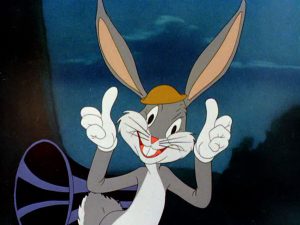 Crazy Cruise (Warner, Merrie Melodies, 2/28/42 – No director credit (begun by Tex Avery, finished by Robert Campett) – Perhaps the last – and one of the weakest – of Avery’s spot-gag travelogues. There is no unifying theme, and no specific geographic direction, to coordinate the random gags which appear. One may wonder if several were assembled from outtakes of past productions in the can, as a shot of an Alpine goat is abruptly followed by a pan through the Sahara Desert, featuring a dated gag of a pair of pyramids shaped like the Trylon and Perisphere centerpiece of the 1939 New York World’s Fair (which had closed two years before). We dissolve to a seemingly-still image of the Sphinx, in a shot that may have been initially rejected for an animation error (the Sphinx’s lips, drawn on a separate layer of cel, do not appear at the beginning of the dissolve, leaving the face looking abnormally blank). The narrator rambles on about the Sphinx sitting there, century after century, motionless and quiet. A typical Avery payoff comes when the Sphinx’s lips finally move, declaring, “Monotonous, isn’t it?” The film may be best remembered for its final gag, probably from Clampett, which shows a nest of helpless-looking baby bunnies turning a hidden machine gun upon a marauding vulture with Japanese flag insignia on his wings. The rabbit in charge of the gun crew turns out to be Bugs Bunny in a surprise cameo. “Eh, Thumbs up, doc. Thumbs up”, he says to the camera as the vulture falls, Bugs’s ears protruding from the iris-out in the shape of a V for Victory.
• “Crazy Cruise” is on DailyMotion
Road to Morocco (Paramount, 11/10/42) – What’s a Bob Hope/Bing Crosby road picture doing on this list? Those who have seen it may remember some incidental scenes involving talking camels. This was a case of Paramount using to best advantage a property they already had under contract to liven up a picture, and possibly call more attention to the related shorts. Jerry Fairbanks had been producing a long-running series of shorts in which Tex Avery lent an initial creative hand, called “Speaking of Animals”. Rarely seen today, these shorts combined live-action views of various animal species with well-coordinated overlaid animation effects, in particular a specialty for synchronized and well-shaded lip movements, to make the live animals appear to be speaking (long before Disney’s aggravating recent habit of similarly making live animals talk in “Homeward Bound”, “The Lion King” remake, etc., where it somehow seems more artificial, robotic, and out-of-place). Having this ability available in-house, Paramount commissioned Fairbanks to put words in the mouths of the camels observing Bob and Bing’s hijinks, for a few well-placed comments on the whole affair, such as “This is the screwiest picture I was ever in”, and “When I see how silly people behave, I’m glad I’m a camel.” A 10 or so minute digest of the film, well-colorized by some fan and including the camel scenes, is embedded below.
 The Mummy Strikes (Famous/Paramount, Superman, 2/19/43 – I. Sparber, dir.) – A famous Egyptologist is found dead inside the museum replication of the tomb of King Tush he created, with a needle wound and a partially-empty syringe of unknown fluid on the floor near his hand. His assistant, Jane Hogan, discovers the corpse, and picks up the syringe, placing her fingerprints upon it. A D.A. uses this as incriminating evidence to send her up for the murder of the scientist, though she denies using the needle.
Clark Kent receives a telephonic hot tip from another professor at the museum of a discovery which might free Hogan. He makes excuses to leave the Planet office in front of Lois Lane, claiming a doctor has called him in for an examination. “Doctor, my eye” says a suspicious Lois after he leaves, and trails Clark to the museum.
Much of the film saves considerably on animation budget by allowing the second professor to ramble at length about the murdered professor’s past history of exploration of King Tush’s tomb. A legend of the boy king has it that he died young, and several giant guards took poison, so that they could join him in the tomb and guard him in the next world. A tablet found in the tomb declares death to anyone who disturbs the remains of King Tush, and the professor is insistent that the murdered scientist must have indeed attempted to violate the sarcophagus. Clark attempts to press a latch upon the lid of the mummy case, and narrowly avoids being pricked by a needle which springs out next to the latch. But what of the syringe? Records of the deceased scientist indicate he was experimenting with an ancient formula called the fluid of life, which was supposed to bring the mummies of the giant guards back to life. However, inoculations had no effect. So the mummy case delivered the fatal needle injection, while the syringe only included the scientist’s failed experimental fluid. It appears that Hogan will leave incarceration a free woman.
 But of course, there are mystic complications. The lid of the mummy case creaks slowly open, and beams of light stream off a large jewel on King Tush’s chest. The beams strike the cases of four giant guards nearby, and somehow trigger their lids to open. And the fluid of life finally takes effect, as the guards pupil-less eyes awaken, and they rip themselves out of their wrappings with concealed swords within. One of the giants advances on Clark, while others take after the shrieking Lois (hidden in the shadows) and the professor. Clark allows himself to be grabbed, and tossed into an empty mummy case. While Lois and the professor are otherwise engaged, Clark bursts through the ancient wood of the case as Superman. Superman swoops upon one of the guards, preventing him from tossing Lois and the professor into sacred flames. Brief fisticuffs, and Superman slams all four guards into pillars of the tomb replication, bringing massive stones down upon them. Clark gets the exclusive story on Hogan being set free, while Lois has to sit things out from writing, with both of her injured arms wrapped in casts. Clark asks how she knew he was at the museum, and Lois quips, in paraphrase of the hit tune “Blues in the Night”, “My mummy done told me…”
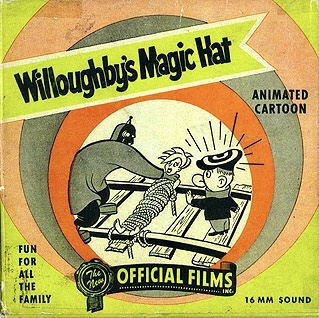 Willoughby’s Magic Hat (4/20/43) – Following in Screen Gems’s ground-rule of “pad for the first half, save the good stuff for last”, this otherwise superior Columbia outing saves on budget by presenting what amounts to a slide-show (partially in Egyptian style) for about the first two minutes, setting up the situation. The story of a magical cap giving super-strength to its wearer. But where did it come from. Trace backwards in time to the mighty Samson, who wowed everyone with publicity stunts like pushing pillars apart. His hair was the magic to his strength, but a trimming from Delilah sapped him of his power. What became of Samson’s hair? Delilah (the hussy) had a boyfriend in Greece named Hercules, and knitted Samson’s hair into a cap to send to him. Hercules, upon donning the cap, grew his splendid muscles, and took top billing as strongest man for years, until he lost the cap in a gin rummy game to Atlas, who used it to pull off his stunt of holding up the world. But an unknown hand reaches out from the planet to swipe the cap away, causing Atlas to abandon the globe and leave it spinning – and no one is quite sure what became of the cap since (through rumors persist that it may have passed down through Richard the Lion Hearted, Henry the 8th, and others). It somehow winds up in the rack at a second-rate haberdashery, where a mild-mannered chap named Willoughby Wren purchases it. Things begin to noticeably change once Willoughby puts it on. The doorknob crumbles as he tries to exit the shop. The door is ripped off its hinges. A gum machine Willoughby tries to use rips right off the wall from sticking his finger in the slot. And a telephone pole he leans upon cracks off at the base.
 Uncertain of what is causing these phenomena, but somehow compelled by a spirit to do good, Willoughby hears the screams of a woman down a darkened alley. There he finds an attractive young blonde caught in a stranglehold by – of all things – Frankenstein’s monster (depicted in mechanical man style). Possessed with unexplained courage, Willoughby taps the monster on the leg, and assumes fighting pose to prompt the monster to “put ‘em up.” The monster gestures to the woman as if to inquire, “someone you know?”, in response to which she just shrugs her shoulders in non-recognition – then the strangling commences again. Willoughby persists, but fails to note that his cap has fallen off behind him. The monster applies a stranglehold on Willoughby, uses his head like an axe to knock holes into the walls and pavement, then hurls Willoughby onto the climbing step of a telephone pole. Fortunately, he also tosses the hat after him, which lands on Willoughby’s head, returning his strength and fighting will.
When Willoughby returns to the crime scene, the culprit and victim are gone – but tell-tale screams direct his attention to a high railroad trestle, where the monster is seen tying the damsel to the tracks. With a powerful leap, Willoughby is jet-propelled up to the trestle, and begins working on the ropes. His boy scout training isn’t what it should be, and in a blur of activity, the girl is somehow set free, while Willoughby is left securely tied to the tracks! Along comes a locomotive right on schedule. As Willoughby struggles to free himself of the ropes, he succeeds in releasing one hand, from which he raises a fingertip in the direction of the locomotive – stopping the train’s progress cold, as the engine wheels strain and scrape against the tracks to fight the force of Willie’s finger. But trouble can’t be avoided this easily, as Willoughby observes that the monster has caught up with the damsel again, and now has her tied to another railroad tie a few feet down the track – with a second locomotive approaching in the opposite direction. With a mighty inhale, Willoughby expands his chest, breaking through the ropes. He gives a firmer push on the train he’s been holding back, causing it to slide backwards a few feet, while he hops over the damsel to perform the same feat of train-stopping with the second locomotive. The first locomotive regains traction, and proceeds forward. Willoughby pushes locomotive 2 backwards, hops over the damsel, and holds locomotive 1 again.
 The process repeats, with Willoughby playing the role of ping pong ball back and forth over the damsel to keep the two trains from meeting – finally leaving Willoughby with both hands outstretched between the headlights of the two engines, as each engine strains with full steam to crush him and the damsel below. The vibration nearly causes Willoughby to lose the cap again, but he manages to save it from falling by grabbing it with his teeth. With a final mighty shove, he forces both locomotives apart at the same time, giving him a split second to unravel the damsel’s bonds, then jump through the gap in the trestle ties as the locomotives collide above them. Below in the valley, Willoughby meets the monster again. Now with cap secured firmly on head, another finger push from Willoughby sends the monster slamming into a brick wall, disassembling him into component parts. But the parts are somehow programed to self-regenerate, and reform into a monster tank, firing at Willoughby with a barrage of shells. With one hand, Willoughby blocks off the impact of shell after shell, finally reaching the tank for another finger-blow upon its chassis. With a tremendous explosion, the tank is again disintegrated to shrapnel, and does not reform. Willoughby plants a sign on the heap reading, “Salvage for Victory”, then returns to the arms of the sweet young heroine, where he is covered with kisses for a happy fade out, while the narrator hurriedly recaps about the cap just to make sure none of the audience missed anything.
There were two Willoughby sequels, Magic Strength and Carnival Courage, which repeat much of the same introductory slide-show. I will not discuss these separately in this article series.
 Somewhere in Egypt (Terrytoons/Fox, Gandy Goose, 9/17/43 – Mannie Davis, dir.) – Why do we get the feeling we’ve done all this before – except this time in Technicolor? Easy. No one could have written this drivel but John Foster, falling back on his same old haunted pyramid gags dating back to the Van Beuren days. A few scenes look like he kept old drawings from such productions and transported them to Terrytoons for new verbatim tracings. The Gandy cartoons were beginning to fall into a rut that would last until nearly the end of the series. One was lucky if one in four Gandys would be about actual events or situations – the rest were all surreal dreams. Did the Terry boys think this format had actual audience appeal? Or were they just filling script quota to keep the studio property alive? With attention refocused upon rising star Mighty Mouse, Gandy, Terry’s first new certified star since the silent days, fell to the status of second-class citizen (after already being saddled with playing second-fiddle to Sourpuss), and would feel like a mere “added-attraction”, of no greater stature than Little Roquefort or the Terry Bears, for the rest of his film career.
This one is set in wartime, with Gandy and Sourpuss on assignment in Egypt, guarding what appears to be a peaceful post (except for a nearby sign, which may be the only instance in animation of specific reference to the campaigns of Germany’s “Desert Fox” – a seemingly bombed-out structure displays the sign “Rommel slept here” – a gag which I believe was cut from conventional TV prints). A goony-looking cross-eyed Sphinx overlooks a small fortification, in the midst of which soldiers Gandy and Sourpuss have set up army cots to lounge upon. Gandy passes the time with a native flute, playing a tune from sheet music titled “Song of Egypt”. (To show just how unimportant Gandy was becoming, his voice talent doesn’t even show up for the recording session, so Sourpuss gets all the dialog.) Sourpuss, nearly asleep, tells him the tune is lovely, and to play it again. The visible notes from the flute enter Sourpuss’s ears, and in a dissolve, his cot is flying, and transformed into a magic carpet, with Gandy fading in from nowhere, along for the ride. The carpet approaches the Sphinx, which opens its mouth wide to swallow them. The carpet sails down a huge throat, into the subterranean temples below. The first thing to attract the boys’ attention within is the figures painted on the walls. One is notable for depicting a bird and a basket. The bird lays an egg, then disappears into the basket. A smaller bird hatches, lays a smaller egg, then disappears into the basket. And so on – and so on. Next, a floating mummy case drifts across the room – twice – then settles against one wall. Gandy pushes a button in its center, and a cross between a woodpecker and a cuckoo bird emerges, pecking Sourpuss in the nose. For no connected mechanical reason, a trap door opens under our heroes, dropping them to a next level. A golden idol with a long goatee is discovered. Dipping all the way back to Foster’s “Gypped in Egypt” for Van Beuren, we get the same bit with the pulled whiskers causing the idol’s face to emit a fire siren, followed by a fire department skeleton in a chariot drawn by Egyptian cats racing helter-skelter around the temple, spilling water on Sourpuss, and briefly leaving its skull atop Gandy’s head.
 Sourpuss places Gandy in the lap of a seated sculpture, ordering him not to move from the spot. But the sculpture comes to life, remaining in seated posture to carry Gandy while still chasing Sourpuss with its legs. Sourpuss jumps into a tall urn – but the vessel has no bottom, leaving him falling down a long hole below it, into a room with a large internal pool. Gandy follows down the hole, knocking Sourpuss into the water. When they rise from the pool’s depths, they are amazed to find themselves surrounded by a cat harem, with a bevy of beauties diving into the pool. Sourpuss tries to keep up with one of the swimmers, matching her stroke for stroke. But these felines are phantom-like, and can disappear at will – along with the water – leaving Sourpuss swimming in thin air and right into a wall. Sourpuss sulks – but just as quickly finds himself seated on a plush pillow and garbed as a sultan, applauding as a group of the felines materializes to beat out rhythms on a double-row of tom-toms (a seating arrangement we’ve also seen before in a prior Foster film). From out of a sarcophagus, another female unwraps herself and performs a sensuous dance (no doubt with steps choreographed by Terry’s dance expert, Carlo Vinci). Sourpuss joins in – despite the girl’s aggravating habit of disappearing and reappearing at will. From out of nowhere, three giant palace guards appear with scimitars. The girl drags Sourpuss away from them – then suddenly, the background changes from palace interior to exterior desert, with the three guards replaced by palm trees. The girl is still there, and leaps off a cliff into an oasis pool, with Sourpuss following. She descends deeper and deeper into the water, then disappears again – and Sourpuss awakens to find himself performing his swimming moves atop his army cot. But is Sourpuss even phased by this rude awakening? No. With a smile, he simply asks Gandy to play the tune again, goes back to sleep, and is last seen dancing with the maiden again, for the fade out. Colorful – yet not very filling.
 Booby Traps (Warner, Private Snafu, 1/10/44 – Robert Clampett, dir.) – The enemy has fled from a desert campaign. But anything left behind might be a booby trap for the unwary. “If you are a boob, you will be trapped” says the narrator. Snafu just wishes “the hell” he’d shut up, determined to prove “I ain’t no boob, and I won’t be trapped.” Traps are designed to be inviting, such as a cooling shower, with the water knob tied to the trigger of a machine gun. A sign placed next to a live camel offers cool fresh camel milk free. (Wouldn’t milk be warm coming directly out of the animal? Ah, well, we’re only trying to fool boobs.) Snafu seats himself on a stool next to the beast, and attempts to tug at the camel’s “udders” – actually, a spiked naval mine strapped under the camel’s belly. When no milk comes out, Snafu wonders if this could be one of them there booby traps. The camel, absolutely complacent about the fact that he stands to be blown up too, answers Snafu with the catch-phrase, “Umm…could be.” A cautious Snafu slowly lets go of the mine, letting it settle back in position, then zips away.
Snafu passes a sort of mini-palace in Arabian style, from the windows of which appear the motionless but beautiful faces of many women. Snafu stops in his tracks, returns to the door of the structure, and looks in with goggling eyes. Oddly, it is not the women who draw his attention, but the fact that the place has “a pianna!” From this sequence, a classic musical gag is first born, later adopted at least twice by Friz Freleng for “Ballot Box Bunny” and “Show Biz Bugs”. The piano has sheet music atop it, for the old tune “Believe Me If All Those Endeaing Young Charms”. The piano key for the last note of the first few bars is wired with a mini-plunger and a stick of TNT. However, Snafu just can’t figure out where that last note is, and keeps missing the intended key – then says to hell with it – he could never play that tune anyway.
 His attention (though again at first appearing directed toward one of the babes within the structure) turns to a hookah. “I haven’t had a good smoke in years.” He attempts to light a wick – connected to another cache of TNT hidden within the water pipe – but only has his match burn his finger. Finally, he notices one of the girls – who have all remained motionless, being only mannequins. “Hiya, toots”, says Snafu, provocatively attempting to slap the girl on the rump. Oddly, he hears a metallic clang, as the mannequin’s bottom consists of two side-by-side cartoon bombs. In the style of Jerry Colonna, Snafu remarks, “Ah, something new has been added.” Then, the bra falls off the mannequin’s chest, revealing two more cartoon bombs. Snafu stammers, “B-b-BOOBY TRAPS!” He zips out of frame, trying to find the nearest exit. Opening one door reveals a giant, snapping mouse trap. Another room has him traversing a floor full of opening trap doors. Exiting through the outer archway produces a spring-loaded reveal of eight bayonet points. But, finally outside, Snafu believes he is safe at last. Out of the wall upon a platform emerges a miniature doll resembling Adolf Hitler, carrying a musical triangle. Like a miniature figure in a carved German clock, the figurine softly plays in Snafu’s ear the correct notes of “Those Endearing Young Charms” (no small feat, since a triangle should be capable of producing only one tone). “Yeah, that’s it”, says Snafu, and races back into the building, passing the bayonet points as if they were swinging doors of a saloon. He sits at the piano again, and gets the notes right – with the resulting KABOOM! When the smoke clears, Snafu is seen as an angel reclining upon a cloud, carrying a sall harp. At least here, he claims, he won’t have to worry about no more booby traps. On his harp, he again plays “Those Endearing Young Charms” – and gets blasted again upon hitting that troublesome note.
 In a Harem (Jerry Fairbanks/Paramount, Speaking of Animals, 7/14/44 – Lou Lilly, dir.) – I have no idea if camels made additional appearances within the regular episodes of this live-action/animation series (those with the patience to explore can browse through the collection of surviving episodes on Internet Archive), but here’s one with most of its action set in the Middle East, with no camels. A number of the late installments produced by Fairbanks return to the formula of Jules White’s “Dogville” shorts for MGM, relying entirely on trained (and probably wired) dogs in costume for their cast, allowing for various period pieces and cinematic settings while adding the series’ trademark synchronization of animated lips and effects to the live-action footage. Not only did such move allow for more variety of storyline, but freed up reliance upon standard wildlife photography to provide the basis for the animation overlays. It perhaps seemed a little different than the fare audiences had come to expect of the series, but to a degree, it often supplied more laughs – which can’t be a bad thing.

Paramount trade advertisement for the series.
• “In a Harem”, albeit with time codes, is on Archive.org
NEXT WEEK: Quite a bit of Popeye action – and the promised curves.
 Charles Gardner is an animation enthusiast who toils by day as a member of LA Law – but by nights and weekends indulges in classic jazz and ragtime as a performer; and studies classic Hollywood cartoons… maybe a little too much.








Drivel? DRIVEL??? What’s all this drivel about drivel, son? Criticising John Foster for reusing gags from his surrealist masterpieces at Van Beuren is like complaining that Dali painted too many clocks, or Chagall too many donkeys. The dream format for the Gandy Goose cartoons was hardly a “rut”, as literally anything can happen in a dream. Also, Gandy was not Terry’s first new star since the silent days; Puddy the Pup and Kiko the Kangaroo both preceded him, each with his own theme song. There’s so much great stuff in “Somewhere in Egypt” that Heckle and Jeckle would revisit much of it a few years later, as we shall see.
The bird pictured in the frieze is an ibis, and the “basket” is a clay jar. In the Late Period (c. 664-332 B.C.), millions of ibises were sacrificed as offerings to Thoth, the ibis-headed god of wisdom and learning, and their mummified remains placed in clay jars exactly like the one shown in the cartoon. When the ibises hop into a funerary jar immediately after hatching from their eggs, they exemplify the Egyptian belief that life is fleeting, but death is permanent; and the grave, contrary to Longfellow, really is its goal. This sort of smart writing is typical of John Foster cartoons. There are plenty of cartoons that consist of wall-to-wall drivel, but Foster had nothing to do with them.
There’s another clever bit in the opening scene, when we see a “For sale” sign hanging on an obelisk. Several obelisks were indeed sold to Western countries in the late nineteenth century, when few Egyptians cared for the relics of antiquity. One of them, known by the misnomer “Cleopatra’s Needle”, stands in New York’s Central Park behind the Metropolitan Museum of Art. Terry’s artists were no doubt familiar with it, and also with the Met’s Egyptian collection.
There’s also a bit in “Road to Bali” where Bing and Bob sing the “Whiffenpoof Song” to a flock of sheep, who respond with a chorus of “Baa! Baa! Baa!” But I don’t think their lip movements were animated, just artfully edited. My father once told me that the Crosby/Hope “Road” pictures got by far the biggest laughs from the audience of any movies he saw when he was growing up, but like many comedies, they haven’t aged well.
John Foster is at least trying to control the animation quality even if it always wasn’t the best. Seems like Paul Terry the manager of the studio seemed to never cared about that.
Foster only wrote the script on this one. The nuts and bolts directing went to his long-time Van Beuren pal Mannie Davis, who was the best on quality that studio had before Burt Gillett stepped in. Davis deserves any credit for this film’s visual appeal.
“The Road to Utopia” features a few more talking animals. Bing is having all the luck when he and Bob are fishing. When Bing leaves a talkative fish pops up, wanting to know where Bing went. Later, after bear trouble in a cabin, a bear turns to the camera and complains that the fish got lines and he didn’t.
Maybe Warren Foster should have deserved this credit, too? He worked on story of all of these shorts. (The gag would used once again by Bob McKimson in Rushing Roulette in 1965, though it wasn’t written by Foster)
“Hullaba-Lulu” (Paramount/Famous, Little Lulu, 25/2/44 — Seymour Kneitel, dir.) deserves mention here for one scene. At a circus sideshow, a turbaned fakir is demonstrating his ability to walk across a bed of nails with bare feet. So far, so good; but when he steps off the nails and onto the peanut shells that Lulu has strewn across the stage, he cries out in pain: “Allah! Allah! Allah!” Lulu then pronounces the fakir a “Faker!”
In 1943, the British government commissioned the newly established studio of Halas and Batchelor to produce a series of anti-fascist, pro-British propaganda cartoons in Arabic for distribution in the Middle East. These featured a boy named Abu and his donkey. There were four titles in the series: “Abu’s Dungeon”, “Abu’s Poisoned Well”, “Abu’s Harvest” and “Abu Builds a Dam”. The cartoons were made in black-and-white, and excerpts on the official Halas and Batchelor website show them to be quite well-made. Apparently they have never been dubbed into English or any other language.