




On the very first episode of Walt Disney’s Wonderful World of Color, which aired on September 24, 1961, Walt introduced a guest by saying, “He’s a renowned scientist, lecturer, psychologist, and world traveler. My old friend,” (he then reached into his pocket and pulled out a piece of paper to remember the name) “Professor Ludwig Von Drake!”
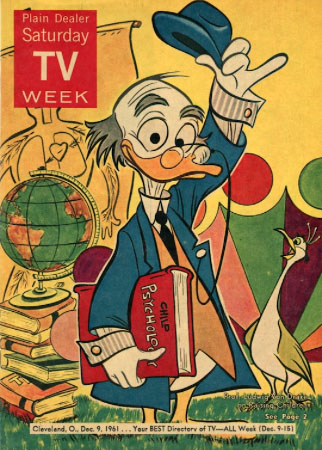 And with that, audiences were introduced to the first Disney animated character created specifically for television, who celebrates his 65th anniversary this month.
The anthropomorphic duck, Ludwig Von Drake, was a professor (and an absent-minded one at that, with a Disney lineage, as he was Donald Duck’s Uncle) who was a self-proclaimed authority on almost every subject. He was dressed in an ill-fitting jacket and shirt, with glasses precariously perched on his beak, and sporting a shock of hair on the back of his head. Seven of Walt’s famed Nine Old Men animated Ludwig in his debut. They were – Ollie Johnston, Eric Larson, Ward Kimball, Les Clark, Frank Thomas, John Lounsbery, and Milt Kahl
Walt had moved his weekly show from ABC to NBC, specifically for color television. NBC was the first television network to broadcast its programs in color (the network’s parent company, RCA, was, of course, looking to sell color television sets).
“Walt was particularly eager to strike the deal to move his weekly series to the NBC network and color,” said Disney historian Jim Fanning, author of the book, Drawing 100 Years of Disney Wonder. “Creating a new and exclusive character that would generate publicity and excitement was a sure way to sweeten the deal.” Jim also added, “Ludwig combined the roles of narrator and a central funny figure, especially as he was designed to be an expert – no matter how eccentric and absent-minded—on every subject. Therefore, he could give background on any topic without necessarily having another character to interact with. Although he was given Herman, a bottle-beetle-type character to bounce off, and Walt Disney himself sometimes acted as a straight man.”
 On the debut episode of Wonderful World of Color, after he was introduced, the good professor gives a humorous “lecture” on how color and color television work.
His quirky persona is displayed as soon as he is introduced, as he thinks that the stage’s spotlight is a motorcycle coming at him. “This whole program is being seen in color,” the Professor goes on to say, “and that’s a lie! You know that’s a lie, because only the people with color TV sets is seeing it in color.”
Ludwig performs two songs: “The Green with Envy Blues,” and “The Spectrum Song,” all about the colors of the spectrum. The Sherman Brothers wrote both songs specifically for the show. At the end of the performance, Ludwig even interacts with an animated version of the network’s logo, the NBC Peacock.
Ludwig also “takes phone calls from viewers at home,” from a table full of phones that ring off the hook, followed by a demonstration of how color television works. This then segues into the theme song of Wonderful World of Color, (“The world is a carousel of color”), also by The Sherman Brothers, and a montage of live-action scenes that highlight different colors.
Afterward, Walt returns to introduce the episode’s second half, the 1959 theatrical featurette Donald in Mathmagic Land.
 The Austrian-accented voice of Ludwig Von Drake was provided by the ubiquitous, legendary voice actor Paul Frees, who did extensive work for Hanna-Barbera, Filmation, DePatie-Freleng, and Rankin/Bass. He is best remembered for voicing Boris Badenov on The Rocky and Bullwinkle Show and for his other work with Disney, including voicing The Ghost Host in The Haunted Mansion attraction.
“When the new color version of the show was created, Walt said he had been trying to come up with a character that would use Paul Frees’ many talents for some time, and the time was now right,” said Jim. “This fed into the whole idea of creating a new character for the show. A brilliant ad-libber, Frees was given free rein to riff on the prepared dialogue during recording.”
 Ludwig Von Drake appeared in seventeen episodes of Wonderful World of Color and on numerous pieces of merchandise at the time, including comic books, records, and dolls, to name a few. He also appeared in the 1962 theatrical featurette, A Symposium in Song.
The character would also later guest star in some of Disney’s animated TV shows, such as the original Duck Tales, House of Mouse, Quack Pack and the 2017 re-boot of Duck Tales – as well as in the new Paul Rudish Mickey Mouse Cartoon shorts (2013-2019).
As both Ludwig Von Drake and Walt Disney’s Wonderful World of Color celebrate their 65th anniversary this month, the character continues to serve as a symbol of Walt’s early decades expanding into television, and Ludwig’s unconventional style has endeared him to audiences for over six decades. After all, who else would dare tell viewers at home of the NBC peacock: “Confidentially, he dyes his feathers.”
 Michael Lyons is a freelance writer, specializing in film, television, and pop culture. He is the author of the book, Drawn to Greatness: Disney’s Animation Renaissance, which chronicles the amazing growth at the Disney animation studio in the 1990s. In addition to Animation Scoop and Cartoon Research, he has contributed to Remind Magazine, Cinefantastique, Animation World Network and Disney Magazine. He also writes a blog, Screen Saver: A Retro Review of TV Shows and Movies of Yesteryear and his interviews with a number of animation legends have been featured in several volumes of the books, Walt’s People. You can visit Michael’s web site Words From Lyons at:



There really have been “colour organs” like the one Professor Von Drake plays in “The Spectrum Song”, using a keyboard to activate, not musical sounds, but lights of various hues. P. T. Barnum had one at his home in Bridgeport, Connecticut, until it was destroyed along with many other rare oddities in a fire. The Russian composer Alexander Scriabin called for a colour organ in the score to his symphonic poem “Prometheus: Poem of Fire” (1910) for solo piano with very large orchestra. The light show is almost never included in modern performances of the work, as it complicates an already difficult piece, and it’s distracting to the musicians.
I never cared much for Ludwig Von Drake. He could be funny, thanks to Paul Frees’s delivery and adlibs, but this tended to undercut his effectiveness as a pedagogue, as did the misleading generalisations and outright misinformation that peppered his lectures, in common with much of Disney’s “educational” material. Even as a small boy, I was aware that some of the things he said (about dinosaurs, for example) were just plain wrong. His explanation of how colour television works is just a stream of meaningless gobbledygook about differently coloured wires. He also had a smug vanity that I found off-putting. As far as I’m concerned, when it comes to cartoon intellectuals of the 1960s, Professor Von Drake fell far short of the high standard set by Tennessee Tuxedo’s incomparable Mr. Whoopee, the man with all the answers.
I never, ever thought that I’d find a reference to Alexander Scriabin on a cartoon-oriented website! One of my favorite eccentric composers, Scriabin wrote a fine piano concerto in a conventional late-romantic style before going on to explore the far edges of music (or the far edges as they existed in the early 20th century).
Unfortunately, he developed some kind of God complex and came to think of himself as a musical Messiah. Then he died suddenly of an infection at the age of 43, which makes him one of the “what if?” composers who died too young, and that’s quite a long list.
I highly recommend his piano concerto and his early sonatas to fans of traditional classical music— but what came later defintely isn’t everyone’s cup of borscht.
Who else but Walt Disney would introduce an animated host to take over some of the hosting chores on a weekly TV series? Ludwig Von Drake became practically synonymous with “Walt Disney’s Wonderful World of Color.” An eccentric, egotistical character with more ignorance than knowledge on any given subject, yet with a winning personality and a never-say-die spirit.
Ludwig was not the first Disney character to serve a quasi-educational purpose. For years, Jiminy Cricket had been teaching kids about safety, hygiene, animals, and how to use an encyclopedia (including how to spell it!). The prime difference was that Jiminy’s dissertations for the most part were delivered straightforwardly, while Ludwig’s presentations included a hefty dose of comedy with the lecturer himself often serving as the fall guy for his own gags.
It took a lot of years before I realized that Ludwig was voiced by the same artist who had given us Boris Badenov, Morocco Mole, and Burgermeister Meisterburger. Since in those pre-Roger Rabbit days, studio crossovers were rare, I didn’t think of a Disney character’s voice “moonlighting” anywhere else. Paul Frees, however, could do it all. As an adult, I can appreciate the artistry of his voice work, and this appreciation grows with each fresh viewing or listening.
Frees recorded a record album titled “Walt Disney Presents Professor Ludwig Von Drake,” containing comedy and song elements similar to what was heard on the TV show, as well as some material that was unique to the album. A few years later, Frees recorded more Von Drake material to go with a talking Ludwig doll. These mainly consisted of fairy tale retellings. Though his voice had aged a little in the interval, his delivery in character was crisp and clear.
Ludwig appeared in a four-issue comic book series from Dell Comics shortly before the transition to Gold Key. His arrival in the first story is accompanied by much fanfare from the rest of the Duck clan. However, their enthusiasm soon tarnishes over the remainder of the series. These are, I believe, the earliest examples of the Professor’s shenanigans outside of his role as TV host.
There is the question of how exactly Ludwig is related to Donald. Walt Disney mentioned that the Professor is related through Donald’s father’s side of the family, which would make him either a brother, half-brother, or possibly uncle of Donald’s father (a great-uncle is often referred to as an uncle). One suggestion was made that he would have to be related by marriage, but this seems a bit far-fetched, as Von Drake frequently refers to himself as a bachelor.
Regardless of how he is related, he does not supplant Donald’s more famous uncle, Scrooge McDuck. In fact, though their design is a bit similar, Ludwig and Scrooge appeared together frequently in the Donald Duck comic strip. I recall one Sunday episode that featured the two of them as the only characters. And though comic book (as opposed to comic strip) team-ups were rare, the two elder statesmen of the Duck family did occasionally cross paths there as well.
One thing Disney fans of today will never know is the thrill of turning on the TV on Sunday night to see Tinker Bell flying across the castle and a chorus singing “The Wonderful World of Color” theme song. Then to be introduced to “Your Host, Walt Disney” or “Your Host, Ludwig Von Drake.” The anthology series had been great before, but it is my conviction that “Walt Disney’s Wonderful World of Color” was its fullest flowering.
One of my favorite Disney characters.
Just don’t ask Ludwig what he was doing during the war
He was recruited by the US Government via Operation Paperclip! LOL! 🤣
I’ve been trying to recall such a strip. Ludwig invents a robot and shows Scrooge how it can build an identical robot. Soon they have enough bots to “man” an assembly line. “Ah, the first car off the line!” exults Scrooge. Ludwig prosits that robots will replace all workers in umpty years and Scrooge asks, “Then who will buy the cars?”
If anyone can tell me when this ran I’d appreciate it. (’67, ’68?) Amazing that we didn’t learn anything in the interim.
Paul Frees didn’t work at all for Filmation,as I know,due to his royalties..he did do a lot of work for some others including Jay Ward besides the above-mentioned Boris,and Walter Lantz,too, and one major for Warner Brothers-INCREDIBLE MR.LIMPET as Crusty, the cranky (and appropriately named!) hermit crab.
Nice article!
Stevem aka Coop
Only 17 episodes? Even allowing for reruns, felt like he was a bigger presence than that on the show. Then again, look what Davy Crockett did in just five episodes.
A year ago acquired a Mickey Mouse Club lunchbox tied to the 1960s syndicated reruns, with Von Drake among the characters tossing Mickey in the air, although I don’t remember him appearing on MMC at all.
Is there anyplace one can hear those story tapes? I remember coveting the doll in ads and catalogs; now it seems underwhelming since he didn’t move and had to be close to a big reel-to-reel player. But I do want to hear Frees at work.
I have a hunch that Von Drake was modeled after Sid Caesar‘s professor character in Your Show of Shows.
I’ve long felt that Ludwig Von Drake would’ve been done even more justice with at least 15 more episodes of the Disneyland anthology series staring him.
“Just don’t ask Ludwig what he was doing during the war.”
—Alexandra Rut
Indeed. I can’t help but wonder if Walt’s idea to create a Germanic duck was inspired by the presence at the studio of the ex-Nazi rocket scentists Wehrner Von Braun, Willy Ley, and several others, during the time when Ward Kimball was directing the “Man In Space” series a few years before Ludwig’s debut.
The fun-loving Disney staffers were probably ALL talking with stage-German accents for a while after that!
Do we have go through this stupid rabbit hole?
There’s nothing stupid about what I said. Watch the first episode of “Man In Space,” and you’ll see that the German scientists are prominently featured, especially Wernher Von Braun, who developed the V2 rockets that devastated London and other parts of England during the blitz, and killed thousands of innocent British civilians. The people of London were forced to hide in the London Tubes (subways) in order to escape the bombardment and save their lives. When they emerged, nothing but smoking rubble awaited them. Their homes, local shops, and workplaces were all gone.
On the show, Von Braun explicitly describes the the workings of the V2 (complete with diagrams!) and is visibly proud of his achievemant— he’s even a bit of a ham whan he’s on camera.
What he doesn’t tell his American audience is, what the V2 was FOR, and what it did…
https://en.wikipedia.org/wiki/Wernher_von_Braun
One of the “Ludwig Von Drake” episodes was on a color TV in a motel – possibly in Springfield, Illinois – when my father got his license to practice law. According to my late grandfather, I was so entranced with Ludwig Von Drake’s antics that Grandpa was trying to figure out how our family could have afforded to buy a color TV set – which no family in our neighborhood couild afford. It was several years before one of our neighbors got such a TV set and one of the few shows in color that we kids in the neighborhood were invited to see was – of course – “Walt Disney’s Wonderful World of Color” and the recent movie “premiere” of THE THREE LIVES OF THOMASINA.
My parents bought me the LP Disney record album of Paul Frees playing the character, who not only “explained” how things worked but sang songs about himself as well. One I remember went something like: “I am Professor Ludwig Von Drake! I take the cake! Make no mistake! I am a GENIUS, make no mistake! Ludwig Von Drake, that’s me! I think I still have the worn-out LP sleeve, but I’ve never found the LP that went with it! Any Disney LP collectors know where I can find a copy – or even a release on CD?
First time I saw good ol’ Von Drake, it was “Disney’s Sing Along Songs”. I had no idea that the segments were clips from the Disney shows redubbed by Corey Burton. He’s excellent!