




Let’s move right along into the second installment about cartoons where characters move – not just shift into motion, but change address. We hope the experience will “move” you, as in setting your funny bones into motion.
 Let’s Get Movin’ (Fleischer/Paramount, Popeye, 7/24/36 – Dave Fleischer, dir., Willard Bowsky/Orestes Calpini, anim.) – What more natural a setting for pitting two lifelong rivals against one another than an exhibition of brute strength in the challenge of moving Olive’s furniture? De facto director Willard Bowsky is on hand for his signature style of animated brawling, so you can be sure we’ll get a healthy dose of the rough stuff. This cartoon was enough of a popular hit that it nearly set up a sub-genre for the super-strength sailor – a setting to which he would return at least four more times in his film career.
Olive is busy packing in her elevator apartment (walk up five flights). She hasn’t told the landlord, but she’s moving today. (Rent dodging was such a pastime in the 1930’s!) She quickly takes care of the last of her linens, utilizing a vacuum cleaner to suck up stray articles of clothing carelessly draped over nearly every object of furniture in the apartment, then opening the vacuum bag to reveal all the clothes automatically folded and bundled into two neat piles. A knock at the door announces the arrival of Popeye, who volunteers for the task of helping Olive with the move. But Olive is less than cordial, and in one of her periodic fickle moods today, laughing at the thought of Popeye assisting. She’s already hired a professional, STRONG moving man. Popeye is quite disgustipated at the thought, and decides to hang around in one of Olive’s easy chairs to see just who this hired he-man is. Well, we all could have predicted it – Bluto, of course. Though Bluto’s raw romantic instincts are somewhat in check for this episode, keeping the flirtations down to picking up Olive by the chin on one finger, he is far from resisting the urge to show off his skills – and Olive is eating it up, just “CRAZY about strong men.” Bluto begins by picking up a heavy chest of drawers, with one arm supporting the furnishing on only one of its legs. He then grabs for the chair in which Popeye is seated, pulling it out from under him while he is not looking. “I wonder if he meant that?” mutters Popeye – and soon finds out he did, when Bluto also yanks a sofa from under him. Olive and Bluto share a demeaning laugh at Popeye’s expense, as Bluto takes downstairs his first load.
 Now it’s time for Popeye to get into the act. His first trick is to grab up one dining room chair in each hand, then balance a large round dining room table upon his rear end, for a descent downstairs. Bluto counters by lifting one loaded barrel in each hand, hooking each foot into the loop of rope securing two loaded packing crates, then marching downstairs with all of them at once. Popeye has to think of something better, and does so by dumping a grand piano out the window, then outracing the force of gravity by zooming downstairs, and catching the instrument before it hits the ground. Olive is impressed, observing that Popeye is stronger than the real moving man. Bluto’s not going to put up with this, and begins tossing everything in the apartment out the window at Popeye. The super-speed sailor manages to catch each item one-by-one before they can be dashed to the ground, so that, when Bluto again arrives at ground level, the entire yard in front of the apartment house appears to be decorated as a new home away from home with Olive’s entire furnishings. Bluto grabs a pivoting full-length mirror and gives it a twirl, causing it to deliver repeated blows to Popeye’s jaw. Popeye staggers backwards into the side of the piano, having the lid of the instrument fall on his head. When Popeye extracts his noggin, Bluto traps it again between the halves of an expandable dining room table. Popeye delivers a kick to Bluto’s face as he frees himself, but Bluto slams a kitchen cupboard into him, flattening him against the building wall. The cupboard doors swing open, finding Popeye with his arms trapped, but a can of spinach on an interior shelf within jaw’s reach. Play that theme music!
 Now charged with his vegetarian secret weapon, Popeye reverses the impact of Bluto tossing down a wardrobe closet upon him, smacking Bluto and the closet across the yard. Bluto emerges from the closet dressed in one of Olive’s dresses (larger size than usual – must be one she uses only when she is binge-eating, as in the television episode “Weight For Me”). Bluto casts off the embarrassing getup, and throws to sofa at Popeye. Popeye withstands the blow, and holds the sofa up sideways with cushions facing Bluto. The cushions sprout springs from the damage of the impact, delivering painful blows to Bluto from head to ankles. Bluto disappears behind a stack of furniture, and Popeye dives in for more unseen fisticuffs, depicted only by vibrations, fight clouds, and furniture flying at regular intervals from the site. Olive ducks in the building front doorway, dodging three items of flying furniture, then laughing at the way she avoided them – only to get hit by a metal pail, which sticks upon her head. Popeye and Bluto have now taken their battle inside the kitchen stove, and play a game of peek-a-boo punch from under the respective stove lids. Popeye pours some extra coal on to make things hot for Bluto, then vigorously massages Bluto’s face inside the stove with a pushing and pulling of the handle for the coal grating. A final blow by the sailor sends Bluto flying, right into a combination sofa/retractable bead, where Bluto is left unconscious and comfortably tucked in under a blanket for the night. The final shot shows the aftermath – as Popeye moves for Olive what is left of her furnishings – a single small vase with a flower within. “And now I have proven no one can do movin’ like Popeye the Sailor Man. (Toot Toot!)”
• “Let’s Get Movin’” is on Dailymotion.
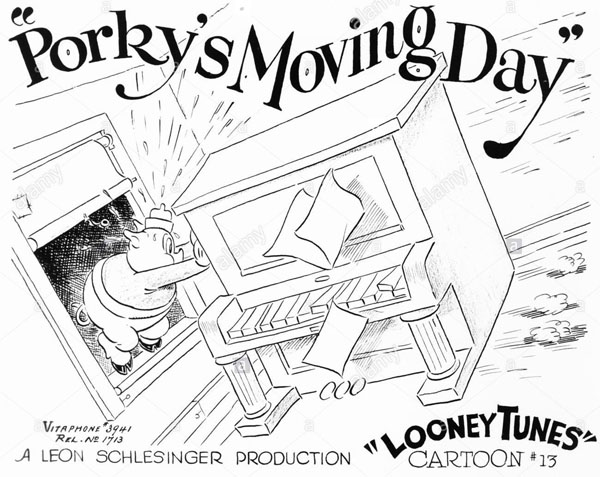 Porky’s Moving Day (Warner, Looney Tunes (Porky Pig) , 10/7/36 – Jack King, dir.) – Miss Cud (the bovine schoolteacher who first introduced Porky Pig in a school musicale in “I Haven’t Got a Hat”) has an emergency. Ocean high tides are threatening to wash out the underpinnings of her elevated cottage on a cliffside by the bay. As her whole house shifts angle with the rise and fall of the waves below, she places a frantic call to “Bunion 0-0-0-OOOOHH!”, the number of Porky’s Moving Company, calling for him to rescue her furniture. (The pig presumably has graduated by this time, and entered the business world.) Porky’s crew consists of a simian named “Dopey” who provides the brawn – an ex-prize-fighter, as indicated by boxing posters on the wall above his bunk, with a habitual reflex of coming out swinging every time he hears a bell. Conk him on the dome, and he snaps out of it, repeating his only line of dialogue: “Okay, boss.” Porky’s second assistant is an ostrich, first seen in “Porky’s Ostrich”, who eats anything, and serves as steed to pull Porky’s van.
Upon arriving at the house, Dopey gets things off on the wrong start, ringing the front doorbell for entry, failing to realize that the sound will bring on his pugilistic impulses. When Miss Cud answers the door, she receives a sock on the jaw. She retaliates by smacking him on the head with a mallet, knocking what sense Dopey has back into his meager brain. Porky starts tossing furniture out a window. A tip of the house rolls an upright piano into his chest. Fearing that it is not wise to merely toss outside such a heavy item, Porky tosses out the window first a spring mattress for the instrument to land upon. The piano does land there when tossed – however, it is so heavy, it takes the mattress right with it, as it creates and disappears into a rectangular crater in the yard. Another house tip causes Porky to ride a runaway kiddie car through the house, while Dopey lifts by brute force an entire stone fireplace and its chumney from the wall (a gag closely resembling a similar scene in Disney’s “Mickey’s Fire Brigade”, though taken to further extremes).
 Porky does some fancy rug rolling, riding the rolling carpet like a lumberjack rides a log, and zig-zagging through the house, taking up random scraps of carpet from various corridors as he rolls across them. The ostrich chooses this moment to wander into the house, and gets caught up in the carpet roll, so then, when Porky reaches the front door, the protruding head and feet of the ostrich make the roll too wide to fit through. Porky is thrown off, and the carpet rebounds backwards, unrolling back upstairs and releasing the ostrich, who wobbles around in dizzy spins. (Watch for an animation error as the carpet unrolls upstairs, showing the roll spinning with the ostrich inside, but no carpet being re-deposited upon the staircase steps. Someone probably figured they could get away with it in a black and white cartoon, it being hard to distinguish one shade of light gray for the carpet from another shade of light gray upon the stairs.)
 Dopey stacks a set of five nested tables, then tries to carry them all out, his hands only gripping the largest topmost one. The smaller nested tables fall out, forming a progression in Dopey’s path resembling a staircase, which Dopey climbs, whapping his head on the window frame when he rises too high. Next, he packs a load of dishes in a barrel, then finds they are still on the floor when he lifts it, as the barrel has no bottom. He picks up the dishes alone, only to walk into a room where the ostrich is proceeding to swallow an alarm clock. The alarm bell sounds – resulting in all the dishes being broken as the ape reverts to boxing punches again. A mishap between Porky and Dopey with a bedspring and an extending table places Porky out the window, hanging on to the table end, while the steam from a tugboat’s smokestack in the bay below the house elevates Porky into the air and heats his rear end. Finally the surf rises to flow headlong into the window. Porky and his pals swim against the tide in the living room, but the waters prevail, washing everything remaining out the front door – and neatly into the confines of Porky’s van. The film ends with another bell ring from the clock inside the ostrich, and another bop on Dopey’s head to stop his punching, irising out on his “Okay, boss.”
 It’s striking to compare this film with Disney’s “Moving Day” reviewed last week, as a comparison of the general state of development of non-Disney animation at the time. I had at first assumed, given my recollections of the style of artwork in the Porky film, that said film had been made at least a year or two earlier than the Disney. But no! Despite being directed by a future Disney director, who would become one of the studio’s two masters for Donald Duck, Jack King’s production, while smooth and complex in some spots, is riddled with awkward animation on-the-2’s, ink and paint errors, some instances of poor posing, irregular timing of movement with many scenes seeming to register too quickly for comic or dramatic effect, and characters with little change of expression. The Disney film, on the other hand, while perhaps a bit pokey in timing in places, is live-action smooth in execution, rich in character expression, nuance, and posing, flawlessly inked in extreme detail, and tops it all with a rich rainbow of color. Though the Warner film might have held its own in competition with anyone else other than Fleischer, it is left at the post looking downright primitive when compared side-by-side with contemporaneous Disney. It would be at least a few years yet before Warner could truly catch up and develop a genuine house style that could begin to rival Disney’s work, if not in quality, at least in popularity.
• “Porky’s Moving Day” is on ok.ru.
 Porky and Gabby (Warner, Looney Tunes, 5/15/37 – Ub Iwerks, dir.) – The first contract film made by Ub Iwerks for Warner Brothers, after cessation of production of the “ComiColor” series – with a healthy amount of assistance by Bob Clampett and Chuck Jones. Gabby Goat is Iwerks’ new addition to the Porky Pig universe – an irascible complainer with a fiery temper, apt to run off at the mouth and pick a fight on the slightest provocation. Today, he is Porky’s companion on a camping trip into the great outdoors. Things start on the wrong foot, with a bump in the road throwing all of the camping gear in the rear seat of Porky’s jalopy flying into the air, then landing back in the seat, excepting a frying pan, which lands on Gabby’s head. Then the road ahead is blocked by the slow progress of a large moving van. Gabby leans repeatedly upon the bulb of the claxon horn in Porky’s auto, yelling to the other driver, “Get that big crate off the road. Move over. We ain’t got all day.” Porky’s car turns out into the opposite lane, trying to pass, as Gabby keeps yelling that the driver must be deaf at not responding to his horn. As Gabby comes up even with the cab of the van, the driver pulls on a string, activating by pulley a pivoting wooden pointer stick designed for signaling left turns, and catches Gabby in the midriff with it, spinning the goat around the stick. The laid back, easy-going driver tells Gabby, “Take it easy, mister. Don’t get excited.” Instead, Gabby’s temper flares, and he responds screaming with the catch-phrase of Tommy Mack from radio’s “Community Sing”: “EXCITED! Who’s excited? I’M NOT EXCITED!” The wooden arm swings down, and dumps Gabby in a large mud puddle in the road. Porky, who has by now passed the van, notices Gabby is missing, and shifts into reverse, passing the van in the process, and being also conked by the wooden arm. He runs over Gabby, stopping the car directly over him, then runs over the goat again trying to pull the car forward. “That’s what I get for trying to help a pal”, sputters Gabby.
 The film follows the characters through various camping mishaps. A stall of the car on a steep hill, and a runaway of the car when they try to push. An effort by Gabby to pull down the camping gear with a rope, that tips the whole vehicle onto him. Violent encounters with a stinging insect while attempting to pitch the tent. Finally, Porky finds that his tent rope won’t reach the stake he’s planted into the ground, and hollers to Gabby for another piece of rope. Gabby tugs at the only strand of rope he can find, which happens to be wound around the starting cylinder of an outboard motor. The motor chugs to life, and in an extended sequence, flies through the air with its propeller, untethered to any boat. Porky and Gabby are eventually forced to flee for their lives, jumping in the car and putting pedal to the metal, with the motor close behind. Who should our heroes encounter on the road but the moving van again, still moving ever so slowly. Panicked Gabby again leans on the horn. “Get outta the way! We’re comin’ through!” There is little choice for the boys, as the outboard motor collides with them and shoves the car right into the back of the moving van. As the dust clears, the boys and the van driver are all seen seated on the ground, the van largely a wreck, and one of its tires whirling around the neck of its driver. Gabby is at least happy to see this change of fortune for his previous nemesis, and begins to laugh uproariously. The driver finally becomes peeved, and yanks once again upon the string tied to his turn signal, smacking Gabby in the face with it and shutting him up, for the iris out.
 Little Lambkins (Fleischer/Paramount, Color Classics, 2/2/40 – Dave Fleischer, dir., Dave Tendlar/N. Demorset, anim.) – Perhaps this is one of the worst of the Color Classics. Perhaps it only seems like one of the worst because the colors on most circulating prints are so bad. And perhaps it is one of the worst because its star character is such a jerk. Lambkins is not a lamb, nor has the disposition of one. He is a little boy who loves to misbehave and disobey his parents, and seems to enjoy nothing but swiping watermelons from the garden, and splitting them with his only friends, a neighborhood raccoon and squirrel. But this day will be different that his usual routine. His mom calls for him, places on his head a traveling hat, and announces that this is the day they move to the big city. Lambkins immediately starts bawling that he doesn’t want to move. Maybe it’s because he’ll miss his two animal friends. Or maybe its just because he wants to be naturally obstinate. Nevertheless, he gets carried off under mom’s arm, as Papa takes the wheel of the family car, to follow a moving van with the family’s belongings toward the beckoning heights of the big town.
 Lambkins’ new abode-to-be is a modern art-deco apartment in a high-rise building, with doorman at the lobby door. None of these plush surroundings have any positive effect upon Lambkins, who again bawls his head off to Papa that he doesn’t want to live here. Papa puts his foot down – and Lambkins too, into a portable walker which fits around his waist – and insists that this is where they’ll live, whether Lambkins likes it or not. Papa leaves the room to carry the suitcases to the master bedroom, leaving Lambkins pacing the living room floor in his walker, wondering what to do next. He is attracted by a doorway, and finds himself in the modern kitchen, which includes a control panel of three buttons for custom appliances. One raises a washing machine from a panel in the floor. Another lowers a set of wringer rollers from a wall panel, while a third button raises an ironing board and releases from the wall a pivoting mechanical arm controlling two alternating flat irons for ironing clothes. If Lambkins were more verbal when not throwing a tantrum, he might have commented, “These things have got possibilities”, and proceeds to search for and open a panel below the push buttons, containing the master electrical wiring. Pull some plugs here, reinsert them there, and cross up a few other wires – a recipe for destructive alterations. Not content to settle for electrical chaos, Lambkins ventures under the sink, finding a large plumber’s wrench in the cabinet below the basin. He begins twisting at every pipe in the place – not only under the sink, but connections to the stove and refrigerator too. When he is just through retightening in a new position the last of the pipe, he hears his mom call, and hops back into his walker. The minute mama enters, Lambkins goes into his familiar act – bawling because he is allegedly hungry. He then settles back to watch the fun. Mom opens the refrigerator door to get him a bite to eat – and finds the interior of the box on fire, as if from the flames of an internal oven, roasting the chicken and boiling anything in a bowl.
 Mama screams, and runs to the sink for a pail of water (though there is no explanation why she turns the water handle marked “Hot”). Instead of water, her bucket is quickly filled with ice cubes from the pipe. Mama begins to slip and slide upon ice cubes spilling over and falling to the floor, and progresses backward to fall onto the stove – which does not burn her as expected, but instead spouts streams of water out of the stovetop gas jets. Papa enters to find Mama floating helplessly atop the fountains of water, and himself begins to slip on the ice cubes. Lambkins knows this is the perfect moment to throw some power switches on and activate the appliance buttons. Papa thus goes through the wash cycle, is put through the wringer, and flattened with the searing irons. He leaps from the ironing board to the ceiling, grabbing hold of the chandelier, and is immediately electrocuted, his rear end transforming into the form of a glowing light bulb. He drops from the chandelier onto a stool, and remains electrically charged, sending the stool into the spin of a top. Mama picks up the phone to call for help, and is squirted in the face with water by both ends of the receiver. Mom grabs Lambkins’ hand, yanking him away and out of the kitchen, stating, “Come on, we’re going home.” Papa, still spinning, follows as the parents whirl up all their portable luggage, exit the door, and head for the car outside. Papa finally stops spinning when in the driver’s seat, and yells to the apartment doorman, “This is a crazy house! We’re going home!”. A quick step on the accelerator, and the car disappears down the road from whence it came. Fortunately, no one has yet rented their old country home, so everyone winds up back where they started. Even Lambkins, who whistles for his animal friends in animation identical to that seen at the start of the film – although the raccoon and squirrel surprise Lambkins by stealing a watermelon themselves and presenting it to him to share. “This is where we came in, fellas”, says Lambkins for the curtain line, as the iris closes upon them eating melon and spitting the seeds in the air. A brat who doesn’t get his come-uppins? No wonder this cartoon doesn’t work – who were we supposed to root for?
 Room and Bored (Screen Gems/Columbia, Fox and Crow, 9/30/43 – Bob Wickersham, dir.) – Here’s another cartoon that doesn’t quite work. Normally, we enjoy Crow’s antics because he is lovably crafty and devilish, a con man whose schemes almost succeed, but who often gets his just desserts when Fox gets wise. This time, he seems to lose all his likeability, becoming in essence the tenant from Hell – and not even to the point of being the man you love to hate. Worse yet, Fox never wisens up in the end, and falls for his worst pranks hook, line, and sinker. This disrupted formula seems to throw the mood off substantially, to the point where we don’t really get enjoyment from seeing Fox so brow-beaten. And yet, this episode was curiously chosen to be the official introduction of Fox and Crow as their own stand-alone series of starring cartoons, separate and apart from the Color Rhapsodies. Probably more a matter of poor timing of available scripts rather than selective choice. However, it didn’t substantially hurt the series, which continued on for several years without abatement, still presenting the duo as the studio’s most reliable characters of the 1940’s.
Fox is the peace-loving, mild-mannered and cultured proprietor of an apartment house. He sits quietly in his study, wearing a smoking jacket and playing a classical favorite upon his violin, while a sign posted outside advertises for him the availability of an apartment for rent, adding, “Quiet, refined tenant preferred.” An overloaded moving van chugs down the street, its windshield plastered with wartime priority stickers for gasoline rationing, as well as other labels such as army rating “4F”. The driver is Crow, dressed like he just arrived from the bad streets of the gashouse district in some big city. Spotting Fox’s sign, Crow backs his van to the front porch (knocking a parked sedan out of his way in the process), and pulls a lever to dump all his furnishings into Fox’s door. Without particularized introduction or haggling over terms, Crow abruptly announces, “I’m movin in!”, and tosses into Fox’s arms an upright player piano and assorted bundles and suitcases, while Crow marches upstairs. Crow is first to open the apartment door, and is shocked to find a neat, tidy, wallpapered flat furnished with grand piano, paintings, and furnishings that spell culture. First thing to do – toss all that unneeded junk out the window, including the grand piano, and tear out the wallpaper. By the time Fox makes it upstairs with Crow’s piano, Crow has completely redecorated – with pin up pictures, a park bench, a fun house mirror, wagon wheel chandelier from a saloon and the bar and barstools, a construction sawhorse, a section of picket fence, all manner of traffic road signs, football pennants, and a small theater billboard for coming attractions. Fox faints dead away, while the player piano drops on top of him, activating to jangle Fox with a roll of boogie woogie music.
 When Fox revives, he walks outside, observing how his advertising sign said plainly in black and white “quiet” and “refined”. “Is he quiet? Is he refined?”, asks Fox to the audience, looking upstairs, where Crow fills the night air with raucous boogie music from both his player piano and a variety of instruments he plays himself. Fox takes his sign upstairs to the door of Crow’s apartment, and knocks. “Can you read?”, Fox questions him, holding up the sign. “Can you?”, retorts Crow. When Fox responds yes, Crow continues, “‘Den read ‘dis”, and places his own sign on the door, slamming it in Fox’s face. The sign reads in large red letters, “Do Not Distoib”. The music continues all night, and the rocking of the jivey piano shakes the ceiling over Fox’s own bedroom. Fox moans as to how he will ever get any sleep, but has the answer quickly, when the light fixture above is vibrated loose from the ceiling, knocking Fox unconscious for the night.
An intertitle reads, “Came the Dawn”, depicting the sun rising with an exhausted, dour expression on its face and a cloth wrapped around its temples, as if suffering from a hangover. A weary Fox trudges to the hall bathroom the two apartments share, finding the door locked from the inside. Fox knocks for admittance, but Crow’s voice is heard, stating he’s busy taking a bath. Inside, Crow is still dressed while in the tub water, but playing with a toy battleship, on the side of which is painted the rising sun emblem of Japan. Crow’s play gets serious, when he pulls out a pistol, and shoots holes through the enemy battleship’s side, causing it to sink into the tub. The bullets also cause the tub to spring severe leaks, flooding the bathroom with tub water. Fox finally gets the bathroom door to open, to be greeted by a wall of water, and Crow riding the bathtub as if on a joyride, through Fox’s corridors, down the stairs, and driving Fox through the front door. Fox has reached his limit, yet tries to remain polite, as he climbs back up the stairs
to Crow’s again-closed apartment door. He asks if Crow will be so kind as to pack his belongings and leave, yet Crow asks why, as if nothing at all had happened. “Because I hate you, hate you, hate you!” Crow responds, “Well, you’re not the apple of my eye either, bud”, then blows a puff of smoke from his cigar into Fox’s face, and slams the door again.
 Fox fiercely pounds again on the door, shouting “Get out! Get out! Get out!” Crow finally states that he will leave quietly, but closes the door briefly as he prepares for his exit. When the door reopens, Crow has changed outfits, now looking like a tramp beggar with bindle stick over his shoulder, and wearing snowshoes, and a heavy coat. He meekly asks if Fox is sure he wants him to go – considering the blizzard outside, making it not a fit night out for man nor beast. “Blizzard??”, responds Fox, looking out the window at thickly falling snow. An exterior view from the camera, however, reveals a mechanical contraption installed on the wall just above the window, vibrating into free fall the contents of a box of Jivory (play-on-words of well-known brand Ivory) Soap Flakes before the window. Crow notes that he’ll probably freeze to death, and if anyone should find a little body outside, please send it to his mother. Fox falls for the “soft soap”, and relents, consenting for Crow to stay. Crow is immediately back to his old raucous habits and music, while Fox mutters to himself, “I’m so confused.” He spots a wall calendar, observing the month. “Blizzard…in July?” But another look out the window still confirms the freak of nature. “Blizzard in July!”, repeats Fox, this time matter-of-factly. A montage of shots follows, in which Fox begins vigorously stoking the basement furnace with coal. The temperature in the basement reaches 200 degrees, bursting the wall thermometer, yet Crow seems impervious to the building heat, as raucous as ever, while Fox continues to view the never ceasing snowfall at the window. “I’m going mad…I’m just a bundle of nerves…” mutters Fox, checking out his tongue for coating in a mirror. The music continues to pound, and Fox’s coal shovel continues to stoke, until Fox finally takes a time-out to sooth his nerves with some boiling coffee. Instead of drinking it, he pours a whole cup into one of his large ears, letting the brew stream out the other, with a sappy smile on his face, to indicate that he’s finally cracked up, for the abrupt iris out.
A Technicolor print of “Room and Bored, sadly out of sync and a bit splicy, is below:
 Moving Aweigh (Famous/Paramount, Popeye, 9/22/44 – Dan Gordon, dir. (uncredited)) – Already Popeye returns to the moving world, this time without Bluto to quarrel with, and aided (???) by an assist from his three-time seafaring shipmate, Shorty. Olive is again the one who needs assistance in a move, and Shorty volunteers to “help” Popeye with the task, liking moving furniture more than moving pictures. As usual, his help is really a hindrance right from the start. Pulling the rented moving van up in front of Olive’s apartment house, Shorty not only parks in front of a hydrant, but smashes the rear fender of a police car parked just ahead. As the officer approaches the van door, limbering up his ticket-writing hand, Shorty opens the van door in his face, then darts past him unseen. The cop puts all the blame on Popeye, and writes ticket after ticket. Shorty meanwhile is sliding his first item down the stairs inside – a large wardrobe closet. The closet rolls on its own wheels once reaching the ground floor, uncontrolled by Shorty, and crashes into the cop, trapping him inside. The cop’s muffled voice concludes, “For the last time, GET THAT TRUCK OUTTA HERE!” “It’s as good as done”, responds Shorty, darting away.
 Popeye goes inside, not knowing what Shorty is up to. Shorty jacks up the truck’s rear, removing the left rear tire. He then ties a rope around the exposed wheel rim, hooked through a pulley from the building roof, and looped back down to tie around the chassis of the van itself. Shifting the transmission into gear, Shorty gives it the gas, letting the truck serve as its own winch, to lift the vehicle into the sky by the rope winding around the wheel rim. The cop finally extracts himself from the wardrobe closet, and fails to observe the truck high above. Once at window level with Olive’s apartment, Shorty climbs in the window, and starts to loop rope around every item of furnishings in the room. Popeye is about to lift a barrel of dishes onto his shoulders, and does not notice Shorty attaching a hook onto the rim of the barrel behind his back. Shorty returns to the truck, again attaching rope end to the exposed wheel rim, and puts the truck in gear. The rope begins to haul out the window all the furniture Shorty hooked it to. The last two items in line are a bedspring frame (which gets caught upright within a doorway), and Popeye’s barrel, dragging the sailor back into the apartment. Popeye and the barrel get caught in the bedspring, just as the hook loosens its grip upon the barrel, causing Popeye and the dishes to be catapulted by the springs across the apartment, and straight through the closed doors of Olive’s China cabinet. Olive races in to open the doors, finding her dishes and cups arrayed in their usual places upon the shelves inside, but all broken. Popeye emerges with proverbial egg on his face, but burps up from his throat one last large China plate, still intact. He hands the plate to Olive with a smile, but Olive smacks it across his head, breaking it into a thousand pieces upon his cranium.
Shorty is now inside a closet, emptying it of miscellaneous items, including an old roller skate. (Is this Olive’s souvenir from “A Date To Skate”?) Popeye of course slips on it, while trying to move a piano. He tumbles backwards downstairs, and the piano rolls right into the parked police car at street level, expanding the car’s roof (and the letters “Police” written thereon) into piano shape. The cop crawls out of the car door. “So, it’s music you’re wantin’”, he states in aggressive tone to Popeye. Seated on a stray box, and with a kitchen trash can with foot pedal to open lid also conveniently placed nearby (Where did these items come from? I thought all the moving was taking place at the window upstairs), the cop goes into an elaborate drum solo with two billy clubs, beating out rhythm upon the trash can, his own brass buttons and badge, but mostly on Popeye’s head. Popeye briefly passes out on the pavement.

An ending not unlike the finale of “Seinfeld”.
•A restored print of “Moving Aweigh” is on Facebook.
 A Self-Made Mongrel (Famous/Paramount, Noveltoon, 7/29/45 – Dan Gordon (uncredited)/Dave Tendlar, dir.) – Dog Face is a mutt of the type that belongs in the streets, but in this episode is adopted by a wealthy yet juvenile eccentric millionaire, who drives him by chauffeured limousine to a newly-purchased mansion. Dog Face feels like a veritable fish out of water, and a doorman turns his nose up at the sight of his uncouth form. Worse yet, his owner has chosen a new name for him that just doesn’t fit – “Baby”! Dog Face puts up with various humiliations, including a slide on an overly-waxed tile floor, a bath in a pool of overheated water that turns his rear end into an exploding thermometer (Owner: “Baby, what’s cookin’?”; Dog Face: “Well, it ain’t broccoli!”), and a good-night tuck into bed in a baby carriage and wearing a baby bonnet. Dog Face has had enough of this sissy stuff, and confronts his owner man-to-mongrel. He’s sick of being treated like a baby. He’s a full-grown man-hunter. He begins to boast, pulling out a Sherlock Holmes-style hat and pipe, and claims to have caught public enemies nos. 1, 2, 3,…take a number up to a hundred. His owner (whose facial expressions, round eyes and large cheeks make him in many scenes strongly resemble Gabby the town crier or the average Liliputian, revealing the directors’ Fleischer roots) just doesn’t get the message, and decides that Baby wants to play a game of cops and robbers. The owner darts away to his bedroom, and is observed by Dog Face through a keyhole, dolling up in old clothes and a mask to pose as a robber. Dog Face mutters that he should have kept his own big mouth shut. “Bang, bang”, shouts the owner, play-shooting at his reflection in a mirror with his fingers as he dresses. “Alan Ladd”, remarks Dog Face sarcastically to the audience, adding, “If he thinks I’m gonna play ‘bang bang’, he’s insanity.” Dog Face thus camps out on the floor outside the room, determined not to budge an inch.
 But there’s a twist. Inside the room, the owner receives a bop on the head with a black jack. A real robber, almost the owner’s twin, had been hiding behind the window curtains, and informs the unconscious owner that he’s the one working this side of the street. He tosses the owner out the window, into a trash can behind the house. Then, he emerges from the room, walking right into the reclining Dog Face. Dog Face can’t tell him apart from his master, and sarcastically remarks, “You’re a bad man…and you’ve come to rob the house. Well, WHAT ARE YOU WAITIN’ FOR? BURGLE! STEAL! TAKE THE WHOLE HOUSE!!” The surprised thief takes this as a creative suggestion, and steps away to make preparations. “If he’s a burglar, I’m Sea Biscuit!”, mutters Dog Face to himself, turning in his resting spot to face a mirror. His reflection suddenly transforms into that of the famous race horse of said name, and he emits a loud whinny. “I AM Sea Biscuit…and if I am Sea Biscuit, he’s a burglar!”, shouts the canine. He darts into the bedroom, searching for his real owner, and hears the muffled sounds of his master in the trash can outside. He leaps out the window, toppling the can, and causing it and himself to roll downhill, at the bottom of which he is finally reunited with his owner, telling him of the burglar, and that there’s not a moment to lose. While they have been conversing, the burglar has single-handedly managed to back into the yard a house-moving truck, and place the entire mansion up on wheels, ready to haul away, as he dreams of life in comfortable retirement, in his new cottage in the countryside. Dog Face and the master arrive at the back door, pounding on it to be let inside, and finally determine to break it down. By the time they give the door the rush, the mansion behind the door frame is already moving, and they burst through the door, only to fall into the empty basement foundation, as the truck and mansion disappear down the road. The master shouts that this is all Dog Face’s fault, and, out of force of habit, play-shoots at Dog Face with his bare fingertips, “Bang, bang!” Dog Face falls on his back as if mortally wounded, as wisps of smoke rise from the master’s pointed fingers. The puzzled master stares at his hands, then apologizes to the audience, “I didn’t know it was loaded.” Dog Face, with a wide smile on his face, never opens an eye, but places a lily upon his own chest. Playing dead is one way to get this zany master off his back. Iris out.
 Mousie Come Home (Lantz/Universal, Andy Panda, 4/15/46 – James Culhane, dir.) – A few years earlier, Andrew P. Panda (Andy’s father) had locked horns with a troublesome mouse in “Mouse Trappers”. This time, it’s Andy himself who has the rodent problems. However, his role in this film remains a minor one, with most of the gag-getting left to his dim-witted dog Milo, and an unnamed mouse who has well-entrenched himself in the Panda household. The film opens with a typical average morning routine. Chase, chase, chase. Up the stairs – then back down again for Andy and Milo, with the aid of a spritz of axle grease on the floor by the mouse. Andy bones up on a volume titled “How to Get Rid of Mice” by Carmen Monoxide, while Milo covers the floor in mousetraps that the rodent easily springs. The mouse bats around Milo’s nose with a stolen chicken drumstick wielded as a club, and causes Milo to upset Andy from his easy chair. The mouse tricks Andy into a badly-timed swing of a broom, batting Milo into a large water jug. Andy uses his broom to smash at the jug, breaking its glass into the makings of a chandelier handing from Milo’s ears. Everything in the room gets tossed at the mouse, standing in his mousehole doorway – including tossing Milo himself, whose nose gets stuck in the hole. Inside the wall, the mouse hits the protruding nose with a large mallet. Milo flies backwards, catching Andy upon his back, and they both crash into the refrigerator, to be covered in ice cubes when the freezer door flies open.
 A short time later, Milo observes Andy packing clothes in a suitcase. He inquires what Andy is going to do. “We’re going to get rid of that mouse. We’re going to move!”, declares Andy. With bags packed, Andy marches toward the front door, and we fade out. We next fade in in the dark of evening. Not a light is on in the house. The moving men appear to have come and gone, and the place is bare of furniture. Out from his hole pops the mouse, ready for another night of fun, and invites the chase to commence, whistling and calling for Milo. There is no answer. The mouse wonders where they both went, and begins searching the dwelling. He spots the back side of a paper sign placed in the glass pane of the front door, and turns the sign over, to read “For Rent”. Gasp! “They’ve gone! I’m all alone. I’m just a poor little mouse in a big empty house.” The mouse decides that life isn’t worth living without the pursuit, and sets upon ending it all (a reason why this film is seldom screened today). His first idea comes from spotting a discarded bottle in a trash box, bearing the skull and crossbones warning, and identifying ingredients as “Arsenic (and old lace)”. (For those of you not familiar with this reference, this was the title of a famous dark and macabre comedy that played Broadway for an extended run with Boris Karloff, and also became a hit Warner feature with Raymond Massey taking over the Karloff role and with Cary Grant in the lead.) The mouse sticks a long straw into the mouth of the bottle, inserting it as far as it will go. He fails to notice tat the Arsenic bottle is actually broken and has no bottom, and directly below it is the open mouth of a jug containing hard cider. So, when he inhales, he gets something quite strong, but definitely not lethal. The kick of the alcohol content materializes in the form of a mallet appearing from a thought cloud, smashing the mouse momentarily into the shape of a stack of pancakes – with butter on top yet! The mouse keels over on the floor, then peels at some wallpaper displaying a pattern of lilies, placing one paper lily atop his chest. He rests, waiting for the end, but repeatedly arises from the floor with a bad case of hiccups. “I’d better find something more permanent”, he mutters.
 Deliberately sitting on the springbar of a mousetrap sounds promising. Unfortunately, snapping the trap just catapults the mouse to a window ledge. The ring pull of a windowshade looks like a good noose, but jumping down from the sill wearing it only cause the shade to extend, then snap back from its winder spring, rolling up the mouse inside it. The shade falls to the floor, depositing the mouse near a gas jet. “This is it, I know”, states the mouse, placing his mouth upon the jet nozzle, and turning the valve handle. Every part of his body inflates like a balloon, and he exhales, jetting himself around the room and out the front door. He lands in an open milk bottle left upon the front steps, then rolls downstairs with it, breaking the bottle and revealing a note left inside. The note instructs the milkman that Andy and Milo have moved to 301 Elm Street. This is all the mouse needed to know. Grabbing a small straw hat and his own traveling suitcase, the mouse races across town, arriving at the Elm Street address. He quickly cuts a mousehole in the new residence’s wall, appears in the living room, and honks the sleeping Milo’s nose. “Hey look, fellas. It’s me!”, he shouts. The frustrated Andy and Milo are soon back to the old routine, repeating the action of tossing everything and Milo at the mouse, and getting batted across the room into the refrigerator. This time, all the fruits and vegetables fly out of the refrigerator door instead of the ice cubes, landing upon Milo, to make him a veritable Carmen Miranda in her tutti-fruitti hat. “Saludos, amigos”, Milo playfully shouts (in a likely nod to the Disney featurette of the same name). The mouse suddenly pops up between Andy and Milo, and squeezes a slice of grapefruit, sending acidic juice splattering into the panda’s and dog’s eyes. An iris begins to close, centered upon the mouse, but pauses in closing to allow the mouse to deliver a curtain line to the audience, almost worthy of Bugs Bunny: “Ain’t I an ornery little squirt?”
NEXT TIME: We’ll relocate into the 1950’s.
 Charles Gardner is an animation enthusiast who toils by day as a member of LA Law – but by nights and weekends indulges in classic jazz and ragtime as a performer; and studies classic Hollywood cartoons… maybe a little too much.








Dopey, the laconic prizefighter manqué in “Porky’s Moving Day”, always cracks me up, and I wish that he had appeared in more cartoons. On the other hand, maybe it’s for the best that he didn’t. I have a feeling that by the time Mel Blanc arrived at Warners, he would have delivered Dopey’s “Okay, boss!” in a raspy “Rochester” voice.
I also like both of the Dog Face cartoons and wish that Famous had made more of them. It’s funny when DF says he’s saving his energy for the war effort, because during the war “dogface” was military slang for an infantryman.
I agree that “Little Lambkins” is one of the worst of the Color Classics (I consider “Playful Polar Bears” the absolute nadir of the series). The fault lies entirely with the utterly unappealing title character, who is just as bad as, if not worse than, the boy with the air rifle in “The Song of the Birds”. Apparently Lambkins doesn’t realise, or care, that tampering with the house’s domestic machinery is by no means guaranteed to change his parents’ minds about moving to the city; it’s more likely to get them killed. Perhaps if “All’s Fair at the Fair” had been nominated for an Academy Award in 1939 instead of “Hunky and Spunky”, then by 1940 we might have seen a cartoon where hayseeds Elmer and Mirandy, inspired by the technological marvels of the World’s Fair, decide to move into a fully automated House of Tomorrow, with an adjoining Stable of Tomorrow for their horse, Dog Biscuit. I’m sure it would have been a damn sight better than “Little Lambkins”.
Another Popeye cartoon, “Brotherly Love” (6/3/36), might be worth mentioning here. After Popeye takes Olive’s message of Brotherly Love to heart, he goes skidda-ba-deeing through the streets of the city to the tune of her catchy song, looking for opportunities to spread sweetness and light. At one point he encounters a couple of movers who are using a rope and pulley to hoist a safe to an upper storey of a building, but the safe is too heavy for them to lift. Popeye, with the strength of his powerful forearms, is able to pull the rope and raise the safe as easily as if it were a ball of cotton, and he thereby earns the movers’ gratitude. ‘Cause what we need is Brotherly Love!
Quite an impressive lineup–two Porky Pigs, two Popeyes, a Fox and the Crow, an Andy Panda, a Fleischer Color Classic, and a Famous Noveltoon.
The evolution of Porky is interesting to note, from his more rotund appearance to the more streamlined version. And Popeye changes from his early dark jacket and sailor hat to the navy whites he adopted during World War II. Also tying in with the theme of moving is the moving around that happened among the animators and directors–such as Ub Iwerks, Jack King, and Shamus Culhane, all of whom are noted for their work at Disney as well as at other studios.
The automated, mechanized home was revisited in the first entry of the Ma and Pa Kettle live action movie series–although frequently cartoony in its execution. The reason why the spoiled child Little Lambkins doesn’t get punished could have to do with the time it was released, 1940, when in light of the emerging conflict overseas, Americans were trying to focus on the values of home and family and the notion of “Home Sweet Home.”
And speaking of “Home Sweet Home,” there is a strong irony in the finish of “Moving Aweigh.” The theme of Popeye in jail is one that rarely occurs because the sailor man, with or without his spinach, is so strong that iron bars could never hold him unless he went in willingly. Which seems to be the case at the end of “Moving Aweigh” as his expression inside the cell is of peacefulness and contentment. Another such instance is in “Cops is Always Right,” in which the focus is helping Olive with housecleaning instead of moving. But when Popeye accidentally drops a flower pot onto a policeman’s head, knocking him unconscious, he hauls himself into jail and locks himself up, proudly proclaiming that he always obeys the law. Since he does this deliberately and of his own accord, it is in a way a triumphant ending. Though this situation occurred more frequently for some of his cartoon counterparts, these are the only two instances I recall of a Popeye cartoon where the sailor man ends up in jail.
Oh yes, my favorite era of cartoons is discussed here, including “porky’s moving day“ giving full and complete description to every gag. I must point out that “porky‘s moving day“ has the busiest and speediest score I have ever heard in my life, and no the score is not purposely sped up so that it sounds faster, it is actually played that way!
I remember reading about how there were 78 “Looney Tunes” that went through the tracing process circa 1968, counting only 77, and wondered what the other one was that went through it. Then, one day, I saw the redrawn version of “Porky’s Moving Day” showing up on Nickelodeon, making me think, “So THAT’S the other one!” (I saw no TV stations showing this cartoon in syndicated reruns at all.) Another thing to point out: This is also the only Jack King directed cartoon with music by Carl Stalling, which must have been the last one that Jack King directed before he left Warner Brothers.
Interesting observation, of which I had never particularly taken note before. “Porky’s Moving Day” does indeed appear to be King’s last Warner production. The fat Porky design he inherited from Freleng in “I Haven’t Got a Hat”, which remained constant through all his Porky productions, would remain for awhile but receive variation under different directors. Tex Avery would vary it up mostly by changing Porky’s outfits from the old green sweater. Frank Tashlin (just new to the lot shortly before “Moving Day” was produced) would not only engage in costume changes, but add his signature “apple cheeks” to the character’s face design. Porky’s first diet may have begun with Avery’s “Porky’s Duck Hunt”, and progressively with the Robert Clampett designs to follow during his association with Ub Iwerks, finally culminating in the more modern Porky in Clampett’s “Rover’s Rival” of 1937.
What I don’t recall ever hearing about during this progression period was how exactly the King unit got broken or divided up as to personnel when King left. It does not appear to be a clean succession of passing off a unit to a new head, as the directors who would produce during the next half-year were already in place when King left. The closest in time to arrive as a newcomer before King’s departure was Frank Tashlin, who had already produced “Porky’s Poultry Plant” – a complex, sophisticated piece of animation, which I can’t imagine coming into being without a well-oiled team of assistants already being assembled under Tash’s overseeing. Tash’s equally sophisticated “Little Beau Porky”, loaded with quick cutting, fancy photographic montages, and detailed character designs, was right on its heels and released only two films after “Moving Day”, so it appears Tashlin was more than equipped to handle his share of the load without the need for inheriting King’s staff. Avery’s unit had been in place for at least a season at this time, with a good number of productions and even two classy-looking Technicolor outings under its belt (“Page Miss Glory”, “I’d Love To Take Orders From You”), so also seemed to be in no need of new help. Freleng wasn’t doing Porky Pigs, remaining the go-to man for expensive color production. So, who’s left? It would be a half-year before the Iwerks “farm-out” of two films sourced from outside the studio and two others for which Iwerks is rumored to have done work but received no screen credit (including the three appearances of Gabby Goat, and the Porky solo, “Porky’s Super Service”). Were any members of the King unit sent to Iwerks along with Bob Clampett and Chuck Jones to assist with his adaptation to the Warner style, and later moved by osmosis into Clampett’s eventual unit? Or did the staff of the King unit simply get the boot when their boss left? Anyone knowing any detail about this period of personnel shift is invited to provide their input, not to mention to name-drop on exactly who were the uncredited support staff who provided the backbone for King’s final Warner productions, and where they ultimately would up.
From part of Mr. Gardner’s entry above for “Porky’s Moving Day” …
“Porky’s second assistant is an ostrich, first seen in “Porky’s Ostrich” …
The title of that cartoon is “Porky’s Pet” .
In partial reply to Mr. Gardner above:
I hope I’m not typing out of turn here, because I’m not too knowledgeable about the animation staffs at Schlesinger’s, but I consulted a couple of book sources and noticed that the animators who worked on the last few Warners cartoons for Jack King also worked on the first few Warners cartoons for Tashlin. I checked the books “Looney Tunes and Merrie Melodies” (1989) by Jerry Beck and Will Friedwald, and the 2nd (2011) edition of “The Animated Film Encyclopedia” by Graham Webb. It shows pretty much the same animators for King and Tashlin: Joe d’Igalo, Volney White, Don Williams, Robert McKimson occasionally, and the like. The only new guy who showed up (or at least was credited for the first time in a Warners Tashlin cartoon) was Norman McCabe, for “Porky of the Northwoods,” released near the end of 1936.
Robert Clampett and Charles M. Jones had already been assigned to Avery pretty much as soon as he arrived, although both of them worked on those two Warners cartoons Ub Iwerks directed a little bit later (“Porky and Gabby” and “Porky’s Super Service,” 1937). Reportedly, neither Clampett nor Jones were particularly “thrilled” about the cartoons they were animating for either Ben Hardaway or Jack King (1934-5), so they were assigned to Avery right away. It looks like pretty much everybody else stayed with King and went right to Tashlin. There may have been a few moves, but it doesn’t look like a big deal.
I think the release date for King’s last Warners cartoon, “Porky’s Moving Day,” may have been delayed to make way for Tashlin’s first, “Porky’s Poultry Plant.” Just a hunch.
But please note – I’m just a “fan” – I’ve read a fair amount about this stuff in the Warner Bros. cartoon studio (Schlesinger Productions) because I’m interested, and I have no background whatever in actual cartoon work. [I also noticed quite some time ago about the change in Porky’s design in 1937, conveniently coinciding with “Porky’s Duck Hunt” and Mel Blanc supplying the voices of both Porky (for the first time) and Daffy for that cartoon.] I think somebody like Mr. Beck or Mark Kausler or Joe Adamson or somebody like that could supply more “trustworthy” information about the change from King to Tashlin. Looking at the animators involved, it looks like about as “smooth” a transition as was possible under the circumstances. And it looks like it was pretty much the same animation unit.
I’d better quit now, because I could go on for days!