



 And so, another summer comes to its end. As we segue from sunscreen to pumpkin spice, we first cross the bridge between them both – Labor Day Weekend. Labor Day not only signals that summer is coming to a close, but the holiday also celebrates the achievements of American workers.
To continue that celebration, what follows are three classic cartoons, in which iconic characters are hard at work:
Clock Cleaners (1937)
In this popular Disney short, Mickey Mouse, Donald Duck, and Goofy find themselves working in the title profession, as they clean a giant clock tower in a city.
 Mickey deals with a stubborn stork that has made its nest in the clockworks, Donald gets into a battle with a coiled mainspring that talks back to him in a mechanical voice, and Goofy tangles with a automated bellringer that eventually knocks him out. After this, half-conscious, he stumbles along a perilous high ledge, across a rope and down a ladder, while Mickey scrambles frantically to keep him from falling. As the short ends, the three wind up getting caught up in their gears, with their bodies “ticking” back and forth, like the clock itself.
Directed by Ben Sharpsteen, Clock Cleaners features incredibly detailed animated choreography from talents such as Wolfgang Reitherman, Art Babbitt, and Al Eugster. Goofy’s sleepwalking-like moves around the outside of the clock are still stunning, each move flowing perfectly into the next. The background perspective, high above the city, and the details in the animation of the clock’s gears all add up to make Clock Cleaners a dizzying classic.
Don’t Give Up the Sheep (1953)
Director Chuck Jones and writer Michael Maltese turned the lives of a sheepdog and wolf into jobs with this first entry in the Ralph Wolf and Sam Sheepdog series.
 It begins with two sheepdogs (Fred and Ralph, both voiced by Mel Blanc) clocking in and out at a time clock, lunch boxes in hand, during a shift change. After the sheepdog counts up the sheep and settles in for the day with his hair over his eyes, the wolf comes in (looking a lot like Wile E. Coyote with a red nose) and proceeds to attempt to poach sheep, while being thwarted by the sheepdog each time.
With Jones at the helm, along with animators like Ken Harris, Ben Washam and Lloyd Vaughn, the timing of the visual gags is perfect, particularly one where the wolf looks to pull all the sheep underground via holes, only to also pluck the sheepdog as well, and another where there’s an ongoing, seemingly endless string of gags of cutting limbs from trees that ends with an unexpected and funny punchline.
This first entry is somewhat different from the later shorts: the character names change—the sheepdog is referred to as “Ralph” here, while the wolf himself goes unnamed (the now-standard “Ralph Wolf” and “Sam Sheepdog” naming convention was in place during the shorts that followed). Additionally, both the sheepdog and wolf would clock in and out, as working stiffs in the shorts that would follow.
The backdrop of “just another day at the office” makes this and every one of the Ralph and Sam shorts all the funnier.
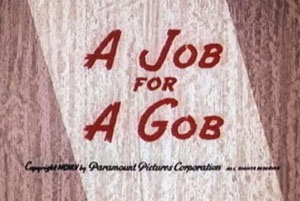 A Job for a Gob (1955)
Directed by Seymour Knietel, this short finds Popeye and Bluto on leave when they happen on Olive Oyl’s dude ranch, where she’s advertising for a new ranch hand. Both then compete for the job.
The two have to ride a bronco and brand cattle, but Bluto (Jackson Beck) loses and retaliates by setting off both a cattle stampede and a fire at the same time. Popeye (Jack Mercer), thanks to spinach, puts out the fire, saves Olive (Mae Questel) from the stampede, and gets Bluto out of the way, winning both the job and Olive.
With gags like spinach-infused Popeye using a well to put out a fire and then using the same well to trap the stampede of bulls by the horns, A Job for a Gob is a nice change of pace for the characters, particularly with the western backdrop.
There are just three of the many cartoon shorts that feature characters hard at work. Feel free to mention some of your favorites in the comments below.
And here’s hoping for some time off for us all to celebrate and relax this Labor Day Weekend.
 Michael Lyons is a freelance writer, specializing in film, television, and pop culture. He is the author of the book, Drawn to Greatness: Disney’s Animation Renaissance, which chronicles the amazing growth at the Disney animation studio in the 1990s. In addition to Animation Scoop and Cartoon Research, he has contributed to Remind Magazine, Cinefantastique, Animation World Network and Disney Magazine. He also writes a blog, Screen Saver: A Retro Review of TV Shows and Movies of Yesteryear and his interviews with a number of animation legends have been featured in several volumes of the books, Walt’s People. You can visit Michael’s web site Words From Lyons at:


“A Job for a Gob” is one of several cartoons in which Popeye and Bluto compete for a job. The first, and best, of these is “Shoein’ Hosses” (1934). Olive is the proprietress of a blacksmith’s shop, and Popeye and Bluto try to impress her with their strength and metal-working skills.
I’m partial to cartoons that depict intricately choreographed, large-scale industrial operations, such as: the mass production of Easter baskets in Disney’s “Funny Little Bunnies” (1934); the assembly-line candy factory in Lantz’s “Candyland” (1935); and the subterranean power plant that causes the seasons to change in MGM’s “To Spring” (1936). Happy Labor Day, everybody!
From the Disneyland anthology TV series:
“Duck for Hire: a compilation of cartoon shorts with Donald taking on various jobs
“Duck Flies Coop” Donald calls it quits with the Disney Studio to try his luck elsewhere
“A Day in the Life of Donald Duck” explores a typical studio day for the Duck
“The Goofy Success Story” chronicles Goofy’s film career from bit player to star
Looney Tunes:
“You Oughta be in Pictures” Porky Pig tears up his cartoon contract in order to work in live action films
“What’s Up, Doc?” Bugs Bunny retells the story of his career in pictures (see the Dell comic book “Bugs Bunny’s Life Story” for a parallel account)
“Fool Coverage” Daffy Duck as an insurance salesman
Hanna-Barbera:
The Flintstones: “No Help Wanted” Barney gets a job as a repo man and has to take Fred’s TV set
The Flintstones: “The Hit Song Writers” Fred and Barney try their luck as songwriters
The Flintstones: “The Missing Bus” Fred takes on a job of school bus driver
The Flintstones: “The Happy Household” Wilma takes a job as a TV hostess
The Flintstones: “Fred’s New Job” during Wilma’s pregnancy Fred finds himself out of work and scrambles for new employment
Top Cat: “A Visit from Mother” The cats try to fool Benny’s mother into thinking that Benny is the mayor of New York City
The Jetsons: “The Flying Suit,” “The Test Pilot,” “Private Property” corporate espionage between Spacely Sprockets and Cogswell Cogs.
Huckleberry Hound: “The Scrubby Brush Man” “Two for Teevee” various jobs taken on by the industrious Hound, almost any one of whose adventures could fit into this category
Plus, of course many more that could be added to this list.
“Mickey’s Service Station” (1935)- The first trio short.
The wolf and sheep dog is probably the best pick for a Labor Day cartoon. I used to get confused and think the wolf was Wile E. Coyote.
There aren’t a lot of films of any kind actually set around Labor Day. The only one I can think of is Weekend at Bernie’s. I was just wondering if they had done a Peanuts special for Labor Day but I guess not. Probably because they’re kids and don’t have jobs and there aren’t any adults onscreen.
In one of his two autobiographical books – either “Chuck Amuck” or “Chuck Reducks,” I forget which – Charles M. Jones drew Wile E. Coyote and Ralph Wolf right next to each other. There is a HUGE difference between the two, I say, HUGE difference. The difference? Ralph Wolf has a red nose. HUGE difference, I say.
Or as Foggie would say, AH say.
Jim, the drawing you describe is not in CHUCK AMUCK (I don’t have CHUCK REDUCKS). There is, however, a drawing of Ralph and Sam on page 144, which the caption describes as a “Re-creation of Ralph Wolf (né Wile E. Coyote) and Sam Sheepdog.” In it, Ralph’s nose is small and black, not bulbous and red. On the following page, Jones describes Ralph as “Wile E. Coyote in another role.” Why he chose to downplay the HUGE difference between them in this volume, I cannot say.
Once again I find myself frustrated that Jones did not furnish his book with an index.