




As theatrical shorts faded out from the late 1950’s through the 1960’s and ‘70’s, fewer and fewer “moves” were observed in animation. Perhaps part of the problem was that with the dwindling number of continuing series and even-more-dwindling number of people able to access them as part of the standard theatrical program in their areas, it was difficult enough to establish an audience to follow the adventures of a character always situated in the same place, without upsetting the apple cart by relocating him to unfamiliar turf in what might be your viewers’ first and only glimpse of the character. Location shock, or introduction of additional characters as new movers-in, was an easier theme to execute with financial success as part of a weekly or daily TV series, where the audience, through what would be hoped to be repeated viewings, would already know the central characters’ traits well, such that seeing them surprised by new surroundings or new faces would be more prone to generating expected laughs – especially if the status quo was restored by the next episode, so the viewer did not feel himself jolted out of his or her comfort zone. So this week, we see sporadic moves or reactions thereto by the Goofy Gophers, the Honey-Mousers, Popeye (in a trifecta of furniture-hauling, crossing over into his TV career), Astronut, and a late Goofy comeback – plus a classic moment from one of the most well-remembered Disney features of all time.
 Lumber Jerks (Warner, Goofy Gophers, 6/25/55 – I. (Friz) Freleng, dir.) – A personality script, loaded more with dialogue than with action – but then, that’s what has almost come to be expected from the Goofy Gophers, for whom no outing would be complete without a healthy dose of formality and gentlemanly manners in their lengthy exchanges of complimentary remarks and relinquishment of rights to take action to each other. I am reminded of the puzzled looks of the dog in “A Bone For A Bone” upon witnessing a sample of their verbal interplay – an expression that could only be translated as “What in hell…” Still, from within such wordplay is rooted the gophers’ charm – the characteristic that distinguishes them from all other comedy pairs.
For this story, and in an earlier similar short produced by Freleng (“I Gopher You”), the gophers face no live adversary (neither dog, nor Elmer Fudd). Instead, it is gophers versus mechanization. For the second time also, Freleng confuses the gophers with Chip and Dale, having them living in trees and storing nuts, rather than burrowing underground (also the situation in “Pests for Guests”). In this description, I’ll try to get by without distinguishing the gophers by name (names were not even assigned until television’s “The Bugs Bunny Show”, where they became known as Mac and Tosh.) Don’t ask me which is which, as (if possible) they are more identical than Heckle and Jeckle. If I had to bet, I’d say Mac was the one voiced by Mel Blanc, with Tosh going to Stan Freberg. But even their voice reads are close to identical, leaving little left short of a printed dialogue script from which to tell who is who.
 The film opens with one gopher complimenting the other upon his selection of a new tree as their home for the winter – and, of course, getting complimented right back by his partner. They concur that this would be a good time to gather and store their nuts. After climbing partway up a hollow pathway in the tree’s interior (and stumbling on the interior stairs, courtesy of a Treg Brown demonstration of sound effects during a panning shot), the gophers emerge into unexpected light, finding a good 20 feet of the top of the tree absent, having apparently been sawed off and hauled away by someone during their absence. Searching the woods for where it was taken, a gopher yells that he’s spotted it. The other arrives to meet him at the crest of a hill, and is informed by his partner, “It’s down there”. He points to an entire river, its waters nearly covered over by a layer of cut, floating logs. The other gopher remarks, “Don’t you anticipate some difficulty in locating our particular tree?” “Oh, yes indeed”, replies the first gopher.
After scurrying over the bay of logs, the first gopher again declares that he’s located it – this time the singular tree which is their property. The gophers set out to return the log to its original place, by rowing it back to shore with improvised miniature paddles. They set out on their voyage, and make good progress – but in the wrong direction. “That’s funny”, remarks gopher 2 – “I am certain we are rowing in the right direction.” An explanation offers itself immediately – the current is heading them for a waterfall. Gopher 1 politely taps gopher 2 on the shoulder, and informs him, “I think there is something you should know.” Finally, the gophers are spurred into action, paddling like mad as their log still proceeds backwards and over the falls – but miraculously reappears again, rising back over the edge from the gophers’ fevered propulsion.
 Our duo and the log wind up back at their original location in the river with the other logs. Gopher 1 requests permission to rest, using the vernacular with advance apologies, “I’m bushed.” Gopher 2 joins him, being “bushed myself”. But the log begins moving again, being dragged backwards and up a conveyor belt into a sawmill. The log proceeds into the path of a rotating saw, which cuts a line directly between the sleeping gophers. Gopher 1 shakes the shoulder of Gopher 2 to awaken him, then observes, “My, but you snore loudly”, leaving Gopher 2 with a puzzled stare. Another saw passes across the width of the trunk. One gopher is glad that the saw missed them completely, but the other gopher is not ready to say “completely”, having had the fur trimmed off his backside. A third pass by the saw sends the gophers scurrying off the belt. They decide to look around at what kind of a place they have stumbled into. They observe one machine taking large logs, grinding them into sawdust, then mixing the sawdust with water and glue, poring the mix into a mold, and producing from it a miniature artificial fireplace log. Another machine performs the traditional stunt of grinding a whole tree into a single toothpick (thank you, Max Fleischer, for the original machine producing a single clothespin in “All’s Fair At the Fair”). The gophers are convinced this place is bent upon the destruction of our forests. They then spot their tree again (curiously not falling apart from all the cross-cutting), heading for a machine that resembles a giant cheese grater. One gopher heroically leaps upon the log to save it, but instead rides the wood through the machine – coming out the other end with wood shavings bedecked upon his head like golden curls. He returns to the other gopher, possessed by a whim of frivolity, and begins to recite in juvenile voice, “There was a little girl, who had a little curl, right in the middle of her forehead.” “Stop it, stop it! There’s a time and place for everything!” shouts the other gopher, resorting to slapping the first gopher’s face to snap him back to the task at hand. An ashamed apology is delivered by the gopher in curls – then on with the search.
 The gophers are sure their tree has been transformed into something by this time – and discover a room full of freshly made – furniture! Spotting a chest of drawers being loaded upon a moving van along with other items of furnishings, the gopher somehow recognize it as “unmistakably our property”. After a time out to think, one gopher hatches an idea to engage in a repossession. They find a section of rubber hose, then insert one end into the truck’s gas tank. A gopher sucks upon the hose’s other end, using it as a syphon (and turning green as he swallows some of the gasoline). The two hurry out of the way as the truck starts. It leaves behind a trail of leaking gasoline upon the road. The gophers know they need not hurry, as they are bound to catch up with the truck sooner or later. At a spot 10 miles from the nearest gas station, they spot the truck drivers hiking back to civilization with a gasoline can, while one driver asks the other ‘Are you sure you filled up before we left?” Conveniently, the truck has stalled not too far from the site where the gophers’ tree began, and a new structure is raised by the gophers atop the old tree stump, consisting of the chest of drawers and other items of furniture from the truck stacked one atop another, with a few stray twigs of foliage inserted sticking out of them to give the place the remotest resemblance to a tree. At the top the gophers sit contentedly in front of a television set, remarking at how much better their home is now. “Isn’t television just wonderful?”, asks gopher 1. Gopher 2 responds, “Oh, yes…and think how much better it will be, when we get electricity.”
 The Honey-Mousers (Warner, 12/8/56 – Robert McKimson, dir.) – The first of a Bob McKimson trilogy, un-subtlely lampooning Jackie Gleason’s immortal sitcom, “The Honeymooners” – the same show which would provide the inspiration for the characters of “The Flintstones” – only here, the cast is re-molded into a trio (later a quartet) of animated mice, rather than cave men and cave women. No, there is no Mel Blanc interpretation of Ed Norton as Barney Rubble. In fact, Mel doesn’t appear to even show up on the recording date. Yet, there is a connection to future Hanna-Barbera work, as the sound-alike voices paralleling Jackie Gleason and Art Carney are provided by Daws Butler – voices he would use frequently in later years for H-B, especially the Carney, which would become increasingly reshaped in tone over the years, and evolve into the well-known dialect of perhaps H-B’s most renown character – Yogi Bear.
New people moving in to the tenement apartment which the Honey-Mousers (Ralph, Alice, and “Morton”) also call home (from within the walls). Good thing, too, as food supplies have been running low since the last tenants left – Ralph having to resort to raiding the mouse-traps for the last fragments of cheese (leaving Alice to remove the traps from his tail). Morton bursts in with the announcement that new people are moving in. A state of the art Freezo ice box is wheeled past the hole entrance, followed by crates of foodstuffs on a dolly. Ralph remarks it’s like having Greenblatt’s Delicatessen right next door. Morton turns from the mousehole door a little too soon, however, missing the carrying-in of an animal cage, and the release of a vicious-looking house cat. Ralph tells Alice to break out the monogrammed Krumden silverware – there’ll be feasting tonight.
 When night arrives, Morton wants to go out to get the groceries. Ralph insists he’ll get the groceries, not trusting in Morton’s tastes. “I am not in the mood for mustard ice cream and kreplachs!” Ralph exits, closing the mousehole door on Morton inside. A few moments later, Ralph is back – and has met the cat, in the worst way. His shirt is in tatters, his face bruised and bandaged, and his nerves frazzled as he stammers “C-c-c-CAT!” “Can’t be no cat, Ralph” says Morton, advancing to the door for a quick peek. He turns back to Ralph, stating. “I don’t see no cat…”, while a swipe of a giant paw filled with sharp claws slashes at him from behind. “…But I feel his presence”, continues Morton, as he falls apart from the sides into four equal segments. Ralph criticizes him for picking a fine time to go to pieces, and to pull himself together. “We gotta put out heads together and outsmart that cat.” Alice quips, “I’ve seen better heads on a glass of beer.” “Hardy har har”, says Ralph, in a classic Gleason sarcasm.
Morton gets the first idea – having Ralph venture outside hidden under a tin can, serving as a mouse-ready suit of armor. Alice observes she never knew there was a market for canned slob. Ralph doesn’t get more than one foot out the door, before learning quickly that his armor is not cat-proof – as the cat merely pounds down on him with his fist, crunching his suit like a beer can. The accordion-pleated Ralph stumbles back into the hole, using another Gleason catch-phrase: “One of these days, Morton…one of these days!”
 Ralph hatches the next scheme – an elaborate one. The Trojan Dog – a modified barrel on four pivoting stilt legs, with a fake dog’s head and tail attached. “Beware of French Poodles bearing gifts”, quips Morton. The two-mouse device allows Ralph and Morton to manipulate the legs from inside, with a hatch where a tap would fit in the barrel side so the mice can climb easily into the refrigerator. Alice thinks the boys are going to too much trouble, and keeps trying to suggest a better way: “Why don’t you just…” “Why don’t you just shut up!”, barks Ralph. The boys shuffle the device through the living room and into the kitchen unopposed. Then, Ralph opens the refrigerator door, climbing up the shelves inside to pass Morton groceries to fit inside the barrel, via a slide made of a celery stick. Morton makes various quips and rhymes all the while, “A pimento for a momento” included. But the cat is well aware of their moves, and takes the opportunity when the boys are preoccupied with their foodstuffs to pry open the lid of the barrel at tail end and sneak inside. The boys are satisfied they’ve got grub for a week, and climb back inside the barrel. A yowl is heard from within. “Hey Ralph…We got company”, says Morton’s voice. Then chaos breaks out from within, food flying everywhere, the cat’s paw grabbing Morton as he tries to escape through the hatch, and the contraption busting apart at the seams. A continuity error shows Morton following Ralph into the mousehole, his body suited with a wedge of cheese. But once inside the mousehole, the cheese is gone.
 Could this suggest that an alternate ending was planned, with Morton showing up Ralph, or perhaps similar to the ending of “A Tale of Two Mice”, with Ralph not liking the variety of cheese Morton salvaged? (Such an ending might not make sense taken with the scenes we have already seen, since it was Ralph, not Morton, who was selecting the items taken in the raid.) Alice once again suggests a better idea – why not just get rid of the cat? Ralph challenges Alice: “If it’s so simple, why don’t you do it?” “All right, I will”, responds Alice, and marches with determination out the mousehole door, while Ralph cringes in the anticipation that Alice is nuts, and heading for suicidal disaster. The cat sees her emerge from the hole, and slowly creeps forward as if ready to pounce. Alice keeps right on marching, removing the need for the feline to pounce, instead coming up right before his toes. The cat yowls in her face for a final warning before striking. Alice reaches upwards, and shouts “Aww, SHUT UP!!”, slapping the cat soundly on the jaw. “Now, beat it! Scram!”, she continues. The stunned and entirely demoralized cat slithers away like a coward. “Okay boys, gather your groceries”, states Alice to Ralph and Morton. Morton leaves the scene to do so, but Ralph can’t resist another “One of these days…” wise-crack to Alice. However, he returns a moment later, with a change of heart, and utters Gleason’s famous curtain line: “Alice…you’re the greatest”, then smooches her in an embrace, for the iris out.
• “The Honey-Mousers” is on Toontales.
 A Haul in One (Famous/Paramount, Popeye, 12/14/56 – I. Sparber, dir.) – If you had never seen “Let’s Get Movin’” (with many audiences of 1956 potentially likely to fall into such category), you might consider this cartoon to present a reasonable amount of formula fun, and to be on the usual par in art quality with most productions of the day. However, we, of course, HAVE seen the former film (just two weeks ago), so we know exactly what the studio was up to. Another Technicolor remake of a black and white episode they knew they’d never theatrically reissue. This time, however, unlike some of the remakes produced in the early 40’s, there is no compelling need for color, nor any improvement of any gag sequence. In fact, the whole thing seems to progress at about one-third to one-half slower than the original – resulting in a dramatic savings in animation labor, by losing over half the climactic brawl and ending the story too early, with only the first sock to Bluto’s jaw. Knowing budgetary cutting of the day, this editing of the material was no doubt purely intentional – leaving one to only dream how much closer a 40’s remake on a full color-subject budget might have come to recapturing any of the energy of the Fleischer gem.
 Another flaw of this production as compared to remakes of the 1940’s is that the early remakes generally left plenty of room for new gags and new twists, usually consisting of at least 50% new material on top of the best of the old. This one sometimes feels like it’s lucky to get in a new gag anywhere. It begins with one, as Olive, preparing for the movers’ arrival, braces herself between the ceiling and the lid of an old trunk to pack her linens in tight. She manages to latch the lid of the trunk with her toes, then sits atop the lid to rest. Of course, the overloaded trunk springs open. All the linens fly up to the ceiling, then fall back down in a messy heap. Olive is revealed as the last item falls away – herself flattened and neatly folded against the ceiling. Her feet, legs and torso eventually unfold from force of gravity, finally revealing her head – or rather, her neck, with her face stuck in a crack she has made in the ceiling. Finally, the ceiling plaster gives way, and Olive’s face is finally seen – popped out of the drain of the bathroom sink from the second floor, the fixture stuck around her neck. Another new gag occurs as a moving van pulls up outside, this time with Popeye and Bluto both employed as moving men, seemingly working on the same side for a change. Bluto, driving the van, can’t find a place to pull the vehicle up to the curb, as a solid row of parked cars lines the curb in front of the apartment house. Popeye steps out to remedy this problem – merely lifting one of the parked cars with one arm, and partially stacking the vehicle atop another parked car. The boys proceed upstairs, but one look at Olive, and their teamwork turns into every man for himself. Olive apologizes that she hasn’t finished packing yet (her last effort to hurriedly refold the linens resulting in her arms being twisted into a pretzel knot). Popeye offers to assist with the packing of dishes in a barrel. Bluto pulls the rug out from under Popeye’s feet while he has a full load of the plates in his arms. As usual, with super speed, Popeye plucks all the dishes one-by-one out of the air, stacking them into one neat pile in a barrel.
 So practically ends the new material. Bluto starts to compete by folding the linens, but Popeye does Olive’s bit from the original film by vacuuming up all the clothes, then removing them from the vacuum bag, all in neat folded stacks. Bluto tries to carry out a heavy sofa, but Popeye passes him, doing Bluto’s old stunt of carrying a crate in each arm and a barrel on each foot simultaneously. One brief tweak, though derivative of similar gags from many other Popeye shorts, has Bluto stack several more items of crates and furniture atop the sofa, then start carrying again. However, Popeye picks Bluto and his whole load up with an easy chair under them, then carries the whole load and Bluto out the door. Bluto climbs down once they reach the van, and locks Popeye in the vehicle. However, by the time Bluto gets back upstairs, Popeye has slipped out the van’s exhaust pipe, climbed like a human fly up the side of the building, and returns to stealing old routines from himself, doing the drop-the-piano-out-the-window bit, then outrace it to the street before gravity can pull it down. Bluto repeats his bit of tossing everything else out the window, only to have Popeye redecorate the front walk with them as if setting up the living room on the ground floor. In exact match to the Fleischer film, Bluto socks Popeye into the piano, its lid falls upon Popeye’s head, then Popeye gets trapped with his emerging head falling between the halves of an expanding dining room table. Here, things become simplified. Popeye does not sock Bluto with his feet, nor get the kitchen cupboard thrown at him with a can of spinach inside. Instead, his arms merely pull out his own can of spinach from his shirt, then pass it under the table to Popeye’s waiting jaws. Popeye skips the gag with the sofa springs, and jumps to socking Bluto into the wardrobe closet, with Bluto coming out dressed in women’s clothes. That’s the end of the cartoon, as Popeye drives off the van with Olive in the cab, and with Bluto tied to the furniture at the van’s rear – still dressed in women’s clothing.
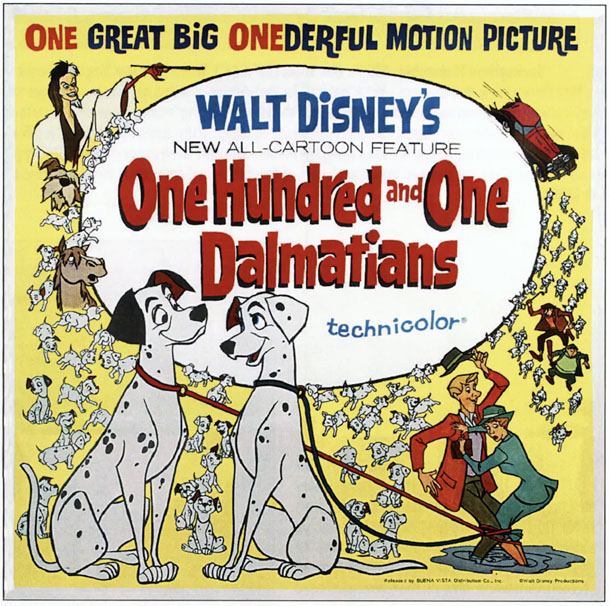 Disney’s classic feature One Hundred and One Dalmatians (1/25/61) climaxes in a memorable “moving” experience. The Dalmatians, attempting to make their escape back to London in a cross-country race in the dead of winter, with Cruella De Ville, Horace and Jasper in hot pursuit combing the countryside, reach the small town of Dinsford. There, they meet a Labrador retriever who has been awaiting their arrival, thanks to advance word of their trek relayed through the Twilight Bark (a signal system of dog howls and yips to send messages at long distance by relay from pooch to pooch). The Labrador has good news – a possible ride home, saving them days of fatiguing walking. A moving van has stopped in town, headed for London, to receive engine repair from a local mechanic. (I learned something in the course of this writing I had wondered about as a kid – why did Disney choose to refer to this vehicle as a van, instead of the British term “lorry”? AI indicates the distinction between the two terms is according to vehicle weight – and the average moving van would not be large enough to classify as a lorry.) He carries a load of various furniture, but there’s still plenty of room, including within a large chest of drawers, to include Pongo, Perdita, and the 99 puppies among the cargo, if they can sneak aboard. (Heaven only knows what the extra weight will do to the driver’s gas mileage.) But before they can even formulate their plans, the screech of brakes is heard, as Cruella careens into town in her souped-up luxury limo, followed by Jasper and Horace in their beat-up truck. The dogs cower inside an old shop, possibly a blacksmith’s, as it includes a large, long-abandoned fireplace, and try to chance peeks out the window while keeping down to avert the passing, piercing eyes of Cruella staring into every building from her car. Cruella is sure, from discovering the dogs’ tracks, that they are somewhere in this village, and vows to find them. Horace and Jasper are also out of their truck, snooping everywhere. How to get to the van?
 The answer comes from the darkest corner of the shop. “Patch pushed me in the fireplace.” “Lucky pushed me first”, bicker two of the pups before their mother. Instead of their usual sparkling white with black spots, the pups are all over a sooty black. Father Pongo brightens, stating he’s got an idea. He jumps into the old, soot fill hearth, and rolls. Instantly, he is as black as the pups. “We’ll roll in the soot. We’ll all be Labradors!” The pups are almost shocked when Pongo instructs them to all – get dirty? They even double check with Mom first, as a precaution against receiving a punishment. “This’ll be fun!”, declares another pup, and soon, the hearth is filled with coughing and sneezing puppies, following Pongo’s lead and striving for “The blacker the better.” Once the pups are in their “make-up”, the blackened Pongo and Perdita, along with the real Labrador, take turns leading small squads of the puppies through the street, right under the noses of their pursuers, and hoisting the pups by the scruff of the neck into the van bed. Horace is the only one suspicious about all the black puppies, and questions Jasper as to whether they might have disguised themselves. Jasper sarcastically replies, “Now, that’s exactly what they did, Horace. Dogs is always painting theirselves black! You IDIOT!” Still, Cruella pauses to give the last group the fish-eye when she is forced to slam on the brakes to avoid a near-collision with them. “Keep going”, whispers Pongo to the pups to prod them along under Cruella’s scrutiny. Nature chooses this moment to take a turn for the worst, the morning sun causing droplets of water to begin falling from a line of icicles on the roof eaves above. The droplets land on the pups’ backs, and begin to wash away the soot, dot by dot. “It can’t be. It’s impossible!”, snarls Cruella. All doubt is erased by a larger clump of snow falling upon one of the pups, washing him clean. Nothing for the dogs to do but run for it. The repairs have just been completed to the van, and the engine is revving up. Carrying the whitened pup by the scruff with his teeth, Pongo takes a massive leap, and they are aboard the van. The Labrador runs interference, snarling at Horace and Jasper to prevent them from also boarding the truck.
 What follows is a nightmare of driving insanity – a sequence which would have been a pure highlight of special effects, had Disney chosen to remake it in the live-action version of the film. But regrettably, the studio knew its budgetary limitations when filming the remake, and deliberately avoided need for the whole affair, by ending the live version when it was only three-quarters of the way through the animated story. Cruella, in a fury of what now might be called “road rage”, roars down the winding country roads in pursuit of the van. When narrow points in the road are reached, she attempts to squeeze her limo alongside the van, and steer into its side in attempt to force it off the road. After shouting at Cruella, the van’s owner pegs her as a “Crazy woman driver”, and begins to take defensive tactics. As Cruella steers into him, he steers back, using the heavier weight of his truck to keep her at bay. The tactic works when the road narrows to a single lane for a passage over a river bridge. Cruella literally runs out of road, and can’t force her way through the truck onto the bridge’s entrance – so goes sliding down the embankment, landing in a snowdrift which has piled up atop the frozen surface of the icy river. Cruella putes pedal to the metal in reverse gear, squealing her tires against the snow and ice until she is able to back up a bit, then shifts into forward, roaring through more snow and up the steep embankment on the opposite side. She comes out in a leap that hurls her car momentarily into mid-air, then comes down hard, slamming her car into the crotch of a sizeable tree. The impact peels away like a can opener the roof, hood, and several fenders off the chassis of her vehicle, leaving her looking even more demonic, as she barrels down the road with four exposed engine exhaust pipes, seemingly belching flame as if from the fires of Hell.
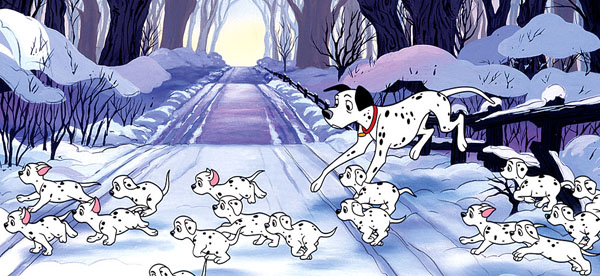 Joining up again with the road just as it heads into a mountain curve, she approaches the van’s rear at full speed, crashing into it and locking her front bumper under the rear frame, lifting the truck’s rear wheels off the ground. Now, Cruella controls the van’s traction, and she deliberately zigs and zags in attempt to topple the van over or send it over a cliff edge. The dogs inside the van are jostled severely, and one pup nearly flies out, Perdita catching him with her teeth, just short of soaring out over the cliff. The van driver desperately struggles with his steering wheel, doing everything he can to maintain a front-footing on the road. Meanwhile Horace and Jasper have caught up, taking a direct route as a shortcut over the hill. They proceed down a steep slope toward a junction between their side road and the main road, on which the van and Cruella approach. Jasper plans to give the van “a bit of a nudge”, and shove it in a ditch. Cruella, shock-hairdo and fur coattails flying in the wind, bears the crazed look of a mad skeletal specter, as she concentrates all her energies and hatred upon reaching the pups and bringing about the destruction of the van driver – so she never sees what’s coming. The steering wheel comes loose in Horace and Jasper’s truck, and the truck wobbles down the steep hillside uncontrolled, missing the junction, and veering off the path and right into the side of Cruella’s car. A tremendous crash, and the sequence ends with the van, finally in control of its own steering, wasting no time in exiting the area and heading off to its London destination, while both of the villains’ conveyances rest in shambles along the walls of the ditch to the side of the road. Cruella screams at her henchmen: “You idiots! You fools! Oh, you IMBECILES!” Jasper simply responds, “Aw, shut up!”
 Oscar’s Moving Day (Terrytoons/Fox, Astronut, 1964 – Art Bartsch, dir. and anim.) – There is confusion as to this film’s release history. Surviving prints bear 20th Century For release credits. Yet, no filmography seems to list it on the theatrical release schedule. It perhaps premiered on TV, then received later reissue theatrically – as did many of the studio’s TV cartoons. But heaven only knows how many years the reissue was delayed, or why it is not noted among other Astronut theatrical reissues.
Despite the title, there really isn’t any long-distance moving or changing of address in this one. The furniture moving is all from within, as Oscar Mild’s boss, Mr. “Nicely”, decides he wants a little office redecorating with new furniture already in the storeroom – and volunteers Oscar to assist him, on Oscar’s afternoon off, whether he wants to or not, or face the infamous “F” word – FIRED! Astronut pops in with his space ship through the window, having picked up the frequencies of Oscar’s distress on his built-in antenna. Astro tells his old friend to go enjoy his planned day of golf and not worry about anything, reminding Oscar of Astro’s shape-shifting powers. In a blink, Astro transforms himself into a perfect double of Oscar, complete with perfect voice impersonation, and offers to stand-in in Oscar’s place. Oscar packs his golf bag, and borrows Astro’s mini-saucer, flying out the door to make his appointment for the first hole.
 Nicely’s first order is for “Oscar” to polish the floors before the new furniture is moved in. As soon as Nicely leaves the room, Astro changes back to himself, and surveys the floor polisher. “Is this an oldie”, he remarks, and decides to “automate” it, so he doesn’t have to push. A zap of energy from his antenna, and the machine springs to life, moving on its own with no assistance. Nicely makes a surprise re-entrance into the room to assign Oscar a follow-up task, and is knocked down by the machine, which spin-polishes the top of Nicely’s bald head, then propels his whole body into a top-spin. Astro quickly shape-shifts back to Oscar, and remarks that Mr. Nicely shouldn’t go around entering into rooms without knocking. “Don’t tell me what I shouldn’t do!”, shouts Nicely, handing Oscar a second assignment. Paint the walls before the furniture is moved in. A snap for Astro, once Nicely leaves the room again, and Astro can convert back to his natural alien form. He merely flies from degravitation sideways across the room, back and forth, extending his arm with the paint roller to cover entire sections of wall with one stroke. In comes Nicely through the door again, with bad timing – getting paint slapped right across his face as Astro passes. Before Nicely can get the paint out of his eyes, Astro reverts to Oscar form again, and again reminds Nicely that he entered without knocking. Astro gets pulled along by “Oscar’s” ear to a storeroom, where Nicely announces that “we” will get started moving the furniture in. “Ooh, you’re going to help me”, says Astro in Oscar’s voice. Nicely replies, “Oh, Mild, you didn’t think I’d let you do it alone. I’ll load you up!” Nicely piles on Oscar’s back a heavy wooden desk, a large swivel chair, and all the rest of the furnishings for an entire room. Astro as Oscar trudges toward the office door, but under the desk reconverts to himself, effortlessly levitating the furniture with energy waves from his antenna. “This is no hardship on me, but whoever named Mr. Nicely sure had some sense of humor.” Projecting the furnishings in a scatter from above him, Astro causes everything in the load to land in its perfect position within the office. “Now to rearrange Mr. Nicely’s personality.” Nicely waits back in the storeroom, with a loaded filing cabinet for Oscar’s next pile. Before he can turn around to view Astro, Astro hits him with an energy wave, causing Nicely’s eyes to glow momentarily, and a broad, dazed smile to sweep across his face.
Later that afternoon, the real Oscar returns through the window in the space ship, to observe a startling sight within the corridor. Nicely is lugging the heavy filing cabinet atop his own back, while Astro as Oscar carries only an empty waste-paper basket – which Nicely asks him about to make sure it’s not too heavy. Astro spots Oscar peering out of his own office door, and darts away to switch places with Oscar. Oscar remarks that he’s never seen Mr. Nicely this way – well, nice! Astro explains he neutralized the undesirable portions of Nicely’s personality, adding “I only wish it would last longer.” Oscar darts into the other office to help Nicely out. Nicely has let the file cabinet down off his back, but now can’t budge it, even with Oscar’s help. Nevertheless, he graciously remarks that Oscar has worked hard for the day, and he’ll handle it alone, suggesting that Oscar take the rest of the day off and play some golf. Foolish Oscar blurts out that he doesn’t feel like playing any more golf, then tries to cover for his slip of tongue. The effects of Astro’s brainwashing suddenly wear off, and Nicely blows his stack, shouting, “When I say, play golf, YOU PLAY GOLF!!” Oscar is again dragged out by his ear, Astro slipping him his golf bag as he passes his own office door. “Poor Earth creature”, observes Astro, as the film fades out.
 Goofy’s modern-day theatrical comeback, How To Hook Up Your Home Theater (12/21/07- Kevin Deters/Stevie Wermers, dir.), has already been recently visited on this website in the pages of our previous Animation Trail, “Get With the Times”. However, it still deserves mention here, for a short but clever gag. Goofy has just purchased the largest-screen TV the local “Shiny Stuff” electronics mega-mart has to offer. He waits – and waits – and waits for the delivery truck to deliver the media marvel to his home. But we can easily see from the layout of Goofy’s home that the gadget’s sheer size will prevent its ever being carried through the front door. So, when the moving truck arrives, the workmen have their own strategy to complete the delivery. Goofy, in the living room, suddenly hears from outside the buzzing of multiple power saws. A moment later, we discover that they have cut through the walls surrounding the entire house, as the entire structure is lifted off the foundation by a giant crane now positioned directly over the roof. (No matter that moving the home as a unit would have required sawing through the base of the interior walls as well – and further with complete disregard for what happens to all the wiring and plumbing). With the house out of the way, the jumbo packing crate is simply slid into place in the living room, and the house dropped back upon the foundation by the crane. No one even bothers to secure the home’s re-attachment to the foundation with bolts, hammer and nails, or even so much as a little glue!
• “How To Hook Up Your Home Theater” is on Vimeo.
 Although a few more theatrical features will be discussed in later installments of this series, we’ll close this present installment with a look at the final two instances of Popeye involved in moving, from his television output. Popeye the Piano Mover (Jack Kinney/King Features, circa 1960) finds Popeye and Bluto (aka Brutus, as in all the early TV episodes) again in the moving business together, this time specializing in pianos. They arrive at an apartment building, where they are to pick up an upright piano for move to a new address. Taking the express elevator to the 99th floor gives both of them a queasy, gut-sinking feeling, and Bluto remarks as they reach the upper landing, “Two more floors, and we’d be on the moon.” As often occurs in Jack Kinney productions, something seems to be missing in plot exposition, as Bluto begins the cartoon being helpful, and even complimentary to Popeye, but abruptly returns to his old competitive self – although Olive isn’t even around to see it. Bluto first observes that the piano won’t fit out the door (though it appears from the drawing that it would easily do so), and Popeye suggests running it on a pulley out the window. (So, the window is supposed to be larger than the door? It’s not even a double-door model leading to a patio, but a conventional slide-up two section job!) Somehow or other, the piano is strung up and slipped partway outside by Bluto, while Popeye at street level attempts to hold the rope tight as the instrument is released. Bluto, after calling Popeye’s idea “genius”, unexplainedly mumbles to himself that this will show Popeye who’s the smarter, and deliberately drops the piano outside with no effort to restrain it for a slow descent. Popeye is spun around several times by the rope wrapped around his waist, then hauled up to the roof, while the piano plummets Earthward. The rope is measured just right, and as Popeye lodges in the upper pulley, the piano stops precisely at ground level, landing unscratched. Then, the knot in the rope tied around the piano gives way, allowing Popeye to go into free-fall. The loose rope end flies upwards, curls around as it reaches the pulley, and somehow re-forms into a knot around the pulley wheel, causing Popeye to also come to a stop, two inches above the pavement. “Looks like this is the end of the line”, says the safe and sound Popeye.
 With no hard feelings against Bluto, the boys drive to Olive’s new address – a house at the top of a long flight of inclined stairs, intended to rival those of Laurel and Hardy in “The Music Box”. Bluto volunteers to take the front end of the piano while Popeye pushes from the rear – the perfect opportunity for Bluto to take it easy by sitting on the piano keyboard, while Popeye does all the physical labor. Again, Bluto’s motives seem mixed and confused, as, instead of impressing Olive with a feat of strength, Bluto bows to her at the top of the stairs, only as an excuse to bump the piano with his rear end, sending it rolling backwards over Popeye. How this is supposed to impress Olive favorably, seeing as it’s her piano in jeopardy, defies logic – even cartoon logic. Popeye finds himself in a race across town to catch up with the piano – which mixes in traffic cop Wimpy. Wimpy first gets mowed down by the passing piano, and blows his traffic whistle at it, shouting, “Arrest that piano!” Next, the passing Popeye does the same thing to him. “Arrest that piano chaser!” “Come back here, ya musical monsker”, shouts Popeye, as the instrument begins to roll up another hill. Gravity takes effect (or perhaps merely a lack of ink and paint to further extend the background), and the piano pauses and reverses direction. Popeye expresses concern that maybe he hurt the piano’s feelings. The instrument catches up with Popeye, taking him along for the ride, then bowls down Wimpy again. Another budget-cutting move has the piano roll into the same background layout three consecutive times – one background painting performing the services of three. The story has Popeye and the piano rolling into three kinds of stores, then rolling out their back doors, with Popeye dressed in a different surprise costume. Instead of three buildings, a single background is left with positions in the windows and on awning signs left blank of detail, so that a cel overlay can merely change the shop name and the objects in the front windows on each pass. So, in scenes noticeable even to a child as insanely repetitious, Popeye supposedly passes through a shop selling baby clothes, and emerges dressed in them, stating he is in his second childhood. Next, a florist, with Popeye emerging dressed as if the Queen of the May, tossing rose petals. Finally a tea shoppe, with Popeye emerging dressed as a little old lady in a rocker, drinking tea. The piano finally reaches the base of Olive’s staircase, and rolls all the way back up the stairs, with Wimpy still in pursuit. Inside, Bluto politely asks where Madame would like the piano placed, having no idea the instrument is actually returning. Popeye ducks under the doorway as the piano enters the house, then dismounts it by grabbing onto the framework of a chandelier, and seating himself inside the fixture. The piano strikes Bluto, picking him up upon it, then rolling to a stop right in a corner where Olive waits, seated upon a stool. Olive immediately breaks into playing a tune, while panting Wimpy darts in behind Bluto, mistakes him for the one he’s been chasing all over town, and arrests Bluto for reckless piano driving. Bluto simply gives a look to the camera as if to say, “What happened?”, while Wimpy writes up the citation. All that Popeye can say, observing this twist from his chandelier perch, is “Well, blow me down!”
 Olive’s Moving Experience (Hanna-Barbera, The Popeye and Olive Show, 9/5/83) – This time, the boys run rival moving companies. Bluto’s company motto is, “Move it or lose it.” Olive wants all her furniture moved to her beach cottage because of a heat wave. She calls Popeye for the job, but Bluto, listening in at the window of Popeye’s office, shows up first. Though Olive insists she wanted Popeye, Bluto won’t take no for an answer, and begins removing an easy chair, with Olive still sitting in it. Popeye arrives to protest. “I’ll take it from here”, he tells Bluto. Bluto, lets him, by removing Olive, and kicking the chair into Popeye’s chest. Popeye is knocked backwards atop the chair, and into the back of his truck, where the chair breaks, its foot extension slapping Popeye in the face. Popeye states “I ain’t gonna take this sittin’ down.” Next, Bluto plays tug of ware with Olive to remove her bed to his truck. Bluto makes the battle easier for himself by letting go, allowing the bed and Olive to roll downstairs and out of the house. Popeye once again tries to intervene, but Bluto bends the upright rods of the brass headboard like a bow for an arrow, and shoots Popeye skyward. Descending from the clouds, Popeye makes a U-turn (first giving the correct hand signal), by extending one arm, and spinning himself around by performing a loop around a traffic post. Bluto has just completed loading the bed into his own truck, but Popeye passes him, lands inside the van atop the bed, and rolls with the bed out of Bluto’s van and up the ramp into Popeye’s own truck. Score one for the sailor.
Olive next needs to move out her fine China. She piles a tall stack of plates into Popeye’s arms. Bluto reappears at the window, determined to “stack the deck” in his favor, and adds to the pile two more tall stacks of dishes he contributes himself through the window. Popeye teeters under the tall load, remarking to Olive, “Just don’t ask me to wash ‘em.” As Popeye emerges from the front door, Bluto makes things worse by rolling a dolly into Popeye. The sailor is swept off his feet, the dishes flying into the air. Popeye manages to steer the dolly with his feet so as to catch all the dishes again, then rolls straight into Bluto. The two ride together, right into a tree, with all the dishes smashed. Popeye quips to Bluto, “Ya can dishes it out, but ya can’t takes it.” Olive is furious, and threatens to call in a third moving company, prompting both boys to hustle back into the house to prove they can do better.
 Popeye rounds up framed pictures off the walls with the old vacuum cleaner trick. But Bluto starts pulling a long rug out from under Popeye. In the process, he nearly causes the sailor to topple a valuable vase off an end table. Popeye catches it, until Bluto playfully remarks at his own carelessness, “I could just kick myself”, punctuating the remark by kicking the rolled-up rug at Popeye. Popeye is knocked headfirst into the lower shelf of a chest of drawers, which closes upon him. The vase flies into the air, and begins to fall. In rapid succession, Olive screams “Get it!” “Got it!” responds Popeye, his head, arms, and upper torso appearing out the top drawer of the chest to catch it. “Good”, responds Olive, completing the advertising phrase. Olive holds onto the vase for safekeeping, while Popeye uses a rope to lasso another chair cowboy style, then turns to drag the item out. “I’ll give him a bum steer”, says Bluto, reaching in the window again to shift the loop of rope from the chair to a much larger sofa. Without turning to identify his load, Popeye steps out the door, and continues tugging on the rope. The sofa is too wide to fit the doorway, and Olive is swept up upon it, as Popeye gives one last mighty tug, pulling off half the front of the house and the doorway, along with Olive, the vase and the sofa, to his truck. By a sheer miracle, the vase is still in one piece. Olive tells him to quit playing around and get moving. The truck suddenly lurches forward, and Popeye remarks that indeed they are movin’ – but who’s drivin’? Bluto is, so to speak. Not in the driver’s seat of Popeye’s truck, but in the rear of his own van, with a tow-hitch rope and hook fastened to Popeye’s bumper. “Thanks for loadin’ it up”, he chortles, dragging Popeye’s whole truck into his own, then slamming the cargo bay doors to lock them in. Bluto steps on his own gas, and drives away to the beach house.
 Someone writing this script seems to have remembered “Porky’s Moving Day”, placing Olive’s beach bungalow near the edge of an ocean-facing cliff. Bluto backs his van up toward the door, but clumsily overshoots the mark, colliding the truck with the house’s front porch, and tipping the cottage off its foundation, into a lean over the cliff edge with rear door leading to a sheer drop. Olive and Popeye could feel the impact, and Popeye breaks out of the van to investigate – immediately hitting the inclined slope of the house’s interior, and sliding out the back door, saved from a fall only by hanging from the rear doorway with the barrel of his pipe. (It was at least nice during this period that, although we never actually see Popeye using tobacco (as we also never did during the theatrical days), they remained faithful to the character by leaving his pipe uncensored. It would probably have been too much of a handicap to the writers to remove it – after all, how many times has Popeye been saved by his pipe tricks?) Olive also steps into the house – and right out the back door, winding up hanging upon Popeye’s ankles, and catching the vase with her foot. “That Bluto will pay for this”, vows Olive. But all Bluto has to hear is that he isn’t going to get paid himself, to prompt him to resort to self-help for his pay. “Since ya feel that way, I’m takin’ yer furniture”, he growls. As he prepares to shift into forward gear and drive away, Popeye pulls a nice twist on one of his famous catch phrases. “That’s all I kin stand – and I ain’t even standin’!” He takes a mighty inhale through his pipe, sucking from within his own truck and through the house his trusty can of spinach. (See, I told you that pipe comes in handy.) The dose of energy is represented on his bulging muscle, as the image of a power winch. He performs a somersault flip, flinging Olive and the vase back into the safety of the house, then scrambles as if walking on air, pushing by his own propulsion the house back into place atop the cliff. Bluto pulls out, but Popeye catches the van’s rear bumper, preventing it from advancing. Bluto gives it full gas, but Popeye rears back, yanking the cargo container right off the vehicle. Bluto’s cab shoots forward like a rocket, hits an incline, and flies through the air, right into the trash heaps of the city dump. Olive leans forward to kiss Popeye as a reward – forgetting she is still carrying the vase – and it crushes between them. Olive is so upset by the day’s events – and so fickle as to observe that the beach weather is really too cold – that she demands Popeye move her back to her old address. Though the whole thing was thus for nothing, Popeye complies with her wishes – but the film lacks a wry comeback remark for Popeye in the closing bars of his song, just ending with the usual, “toot toot”.
NEXT WEEK: More television transit.
 Charles Gardner is an animation enthusiast who toils by day as a member of LA Law – but by nights and weekends indulges in classic jazz and ragtime as a performer; and studies classic Hollywood cartoons… maybe a little too much.








I’ve always loved the Goofy Gophers, and “Lumber Jerks” and “I Gopher You” are probably my two favourites. The scene where Mac (or is it Tosh?) gets silly in a curly wig made of wood shavings never fails to make me laugh, suggesting, as it does, that female impersonation is something the gophers do get up to occasionally — at the proper time and place, of course.
There was, however, an earlier comedy pair also noted for its exaggerated politeness, formality, and insistence that the other always go first, namely the early 20th-century comic strip characters Alphonse and Gaston (“After you, my dear Alphonse!” “You first, my dear Gaston!”). Unlike the Goofy Gophers, they didn’t look alike. Back in those days, strange as it may seem today, the stereotypical Frenchman was seen as courteous to a fault. Whether Alphonse and Gaston had any influence on the creation of the Goofy Gophers, I have no idea.
I remember a Don Martin cartoon in MAD magazine in which a lumberjack felled a tree and then chopped, sawed, planed, and whittled it down into a toothpick. I always gave Martin credit for more originality than that.
Come to think of it, it’s odd that the Laurel and Hardy cartoon series of the 1960s apparently never paid tribute to the famous piano-moving sequence in “The Music Box”. Could Larry Harmon and Hanna-Barbera have done a better job with the material than Jack Kinney? Almost certainly.
Actually, Larry Harmon didn’t forget Laurel and Hardy’s moving career. Hanna-Barbera did. Production of the Laurel and Hardy cartoon series was held up at least a year past when Harmon had announced the project, and Harmon had already gone ahead with producing two records (a single for Little Golden and an album for Peter Pan) in anticipation that the films would crystilize. The records got released, but with no corresponding cartoon show – and by the time H-B did pick up the project, they had lost the services of Henry Calvin, who proved on the recordings that he would have made a much better Oliver Hardy. Also, I believe a short time before the records’ release, Harmon introduced the pair in comic book form, where several if not all of the stories used on the Peter Pan album first appeared. (I remember owning a comic featuring “Lucky Ducky Buckaroos”, and another story from the album of them guarding a military magnetic ray machine against a spy (who talks like Slippery Bly) who acquires the ray’s magnetic powers.) The second cut on the Peter Pan album was “On the Move Movers”, which, of course, has them moving a piano. I have a vague recollection of seeing illustrations from it, so suspect it was a comic book story too. So Harmon was indeed willing to pay tribute to the duo’s roots, and produced a rather fun audio track from it all. (He blows one line in his performance, mixing up the oft-repeated address of 998 with “988” toward the end of the recording. But he gets in a few clever lines. Hardy: “Don’t your ever use your head for anything but a place to put your derby?” Stan: “Well, sometimes I crack walnuts with it.”) It was H-B who ultimately dropped the ball by not producing a film, or a storyline on similar grounds.
The audio recording can be heard at https://www.youtube.com/watch?v=o01CEejZkFg
Ironically, the live action Honeymooners often used mousetrap gags, as in the Christmas episode when Alice tries to hide Ralph’s present. Also worth noting is Daws Butler’s Ralph voice which is essentially the same voice he used on the rare occasions when he voiced Fred Flintstone, such as on the original “Flagstones” pilot and also on the Safety record which was produced in the early 70’s. The fact that Daws Butler’s voice was used with increasing frequency in the later years of the theatrical cartoon shorts is almost a presaging of the coming of television.
The three Popeye cartoons referenced here are good examples of the changing times regarding animation, with a gradual shift from emphasizing visual gags to increased dialogue and more verbal work. The piano mover short does have some fairly effective visual gags, however, proving that the use of limited animation could still allow cartoons to be “cartoony.” At the same time, I notice a heavier reliance on the voice actors in the later cartoons. With fewer options for variation of facial expression, the vocal artists had to convey more of the nuance through their inflections and line readings. Probably not too much of a stretch since so many of them had experience in radio.
Thanks for the plot rehashes.
One moving cartoon from TTV that comes to mind is from King Leonardo’s “Leonardo the Neat”, where the two traitors want to get the King and Odie out of the palace so they can hunt for a secret treasure buried in the basement.
Of course the Warner Cartoon ancestors of Mac and Tosh are in “Gopher Goofy”, June 1942, directed by Norm McCabe. They are Virgil, a fat gopher and his unnamed friend, who talks a lot like Bugs Bunny. These two owe a lot to Duffy’s Tavern, a radio show of the 1940s, featuring “Archie” and his dumb friend, Clifton Finnegan. Virgil’s oft-repeated remark, “I like Central Park better”, sounds a lot like a Clifton Finnegan argument.