




There’s quite a bit of house moving in today’s line-up of cartoons, as well as piano moving, and conventional furniture moving, as 1950’s characters adapt to new (and sometimes even old) surroundings. Featured among our cast members are Mister Magoo, Heckle and Jeckle, Claude Cat, Donald Duck and Pete, Maw and Paw, Tweety and Sylvester, and Woody Woodpecker, as well as a memorable Disney one-shot.
 Bungled Bungalow (UPA/Columbia, Mister Magoo, 1/15/51 – Pete Burness/John Hubley, dir.) – For once using the spectacles he normally makes of the two “O”’s in his name in the main titles, Magoo is actually able to read parts of the lead headline of the morning paper – though he thinks he is reading the funnies section. Hot House Harry, the house thief, is still at large. Magoo thinks this a “droll” new character added to his favorite comic strip, “The Adventures of Sam Slophead”. But lurking just outside in the shrubbery is Harry himself, in the flesh, with his sights set on Magoo’s house as his next target. Paying no mind to Magoo’s presence within the residence, Harry signals for a team of five henchmen to move in – professional house movers. They begin to jack up the house on wheels. Meanwhile, Magoo has moved into the living room, to practice on his game of “billiards” (really pool, complete with the usual six pockets). He lines up his shot, mistakenly using the metal lance from a suit of armor as a pool cue. But before he can let the shot go, vibrations and rumbles shake the house from the activity outside. “Termites…California termites!”, mutters Magoo. Finally taking aim, Magoo shoots. The cue ball misses everything, zig-zagging a path between all the rest of the balls on the table. Suddenly, the whole house tips into a leaning position in one direction, causing all the balls to line up along one railing, and disappear in single file into a corner pocket. “I’m making it”, shouts Magoo, impressed at his own perceived mastery of the game. But another massive vibration of the structure shakes all the balls right back out of the pocket, onto the table again. Magoo won’t tolerate a house where termites ruin a man’s game, so grabs his hat and coat and heads for the car, intending to look for new real estate. On the way, he passes right by Harry and the nervous house movers, who play it cool and act nonchalant, whistling and leaning with one arm on the side of the house. Magoo pauses, then launches a reprimanding remark at the group before driving off: “Why aren’t you boys in school?”
 As Magoo proceeds down the road, he hears a horn honk behind him, and gives the signal for the driver to pass. He is passed by a truck, towing his own home. Magoo mutters that you’d never get him behind the wheel of one of those foreign cars. Ahead, the speeding truck drives into a huge warehouse with the home in tow – then emerges out a door on the other side, with the house resplendent in shining paint of a brand-new color scheme. The truck drives on, to a vacant lot on a hillside overlooking a cliff face, and deposits the house at cliff’s edge, its back door and exposed cellar stairs facing a sheer drop-off. Harry quickly hangs strings of pennants around the lot, and advertising signs reading “Open House”, “This Won’t Last”, “Cash Only”, “Forced To Vacate”, and “It’s a Steal”. He finally flips upside down the sign displaying the street number of the house’s address, changing the number from “199″ to “661″. Of course, who shows up as a prospective buyer, but Magoo. Our nearsighted hero makes his entrance by rolling his jalopy right over Harry’s back, then walking on Harry’s head to the front steps, never seeing the criminal. Harry nevertheless is worried, recognizing Magoo as the real owner, and afraid Magoo will get wise to the quick paint job. Harry thus skulks behind Magoo, hoping to do him in.
 Magoo begins to give the place the once-over inside. He eyes a painting of ancient ruins, and, thinking it’s a window, remarks, “Run-down neighborhood.” He ducks past Harry’s swing of a black-jack at his head, then pulls a rug out from under Harry’s feet to examine it. “Nice throw rug. Make a lovely shawl. Very fetching.” Magoo opens the back door, leading to nowhere but thin air. “Nice roomy closet.” Harry tries to kick Magoo off the rear landing, but misses, sliding out the door himself. Clinging by his hands to the porch step, Harry knocks on the back door with one hand to get back inside. Magoo doesn’t even notice him, and walks outside on top of Harry’s hat, kicking off mud from his shoes before reentering the house, as if Harry’s head were a welcome mat. Magoo spots the refrigerator, and thinks it is a handy safe. Upon opening its door, he spots three shelves stocked with heads of lettuce, and remarks, “Greenbacks! A fortune in legal tender.” However, he is not sure about their smell, and inhales from one head deeply. “Legal tender indeed!”, he sarcastically declares, and immediately rushes to an old candlestick phone. There (although listening into a vase instead of the earpiece), he gets off a call to police that he’s uncovered a cache of counterfeit money, and for them to come right over. Finally, he discovers who he thinks is the owner of the premises – the same suit of armor previously seen next to his pool table. Shaking the armored suit’s hand, while Magoo still holds the head of lettuce in his other hand, Magoo suggests a wager – his “wad of cash” (the lettuce) against ownership of the house that he can make a four-carom cushion shot on the pool table the first try. The armor suit is vibrated, so that its helmet seems to nod assent to the bet. Meanwhile, Harry has somehow managed to crawl back into the house through the exposed cellar stairs underneath, and prepares to use the telephone as a blunt weapon to smash Magoo’s head. A wail of sirens, however, announces the arrival of the police, and Harry runs for the nearest hiding place available. The cops enter, and Magoo directs them to the kitchen to find the greenbacks. They open the refrigerator door, only to find not the lettuce, but Harry inside – quick frozen inside a giant ice cube. The cops carry Harry in ice back through the living room in effort to make the arrest, just as Magoo lines up his pool shot with the metal lance. Magoo’s pull-back of his arm in making the shot hits the ice cube, knocking it from the officers’ arms, and sliding Harry out the rear door and off the cliff, with the police quickly following him down the cellar steps. The weight of the three in the rear of the house tips the home at a slant, again placing the pool table off-level, and causing all the balls to roll along the rail into the corner pocket. Victorious Magoo shakes the hand of the suit of armor, while himself pocketing the lettuce, with a triumphant shout of “The house is mine!” Thus, status quo is maintained – even if Magoo has a new address.
 House Busters (Terrytoons/Fox, Heckle and Jeckle, 8/1/52 – Connie Rasinski, dir.) – This well-chosen title (illustrated on the rarely-seen original title card as spelled out in plywood planks) has a double-meaning. It begins with a Jim Tyer sequence of a convict (a dog named Spike) busting out of the “big house” – that is, the State Penitentiary – by merely crashing right through one of its outer walls. (The guy must be stronger than he looks, giving meaning to the old challenge, “No walls can hold me.”) He exits the area in a hurry, with searchlights flashing upon him, and a hail of bullets making a right-angle turn to follow him down a country road. Eventually escaping the authorities, he shows up in front of an old, boarded-up house in the country, popping out from behind a tree much too small to conceal his wide girth. As he sneaks into the home, we discover that this is his chosen hideout. “They’ll never find me”, he sighs in relief, “as long as this ol’ house holds together”.
 Enter the second part of our double-meaning title. Heckle and Jeckle, driving a beat-up jalopy of a truck, advertising on its side their new line of work – at last, a profession befitting their natural destructive talents – house wreckers! They duet in singing a memorable and jaunty tune – “Give us a house to wreck (We’ll tear it down, by heck!)”, one of Phillip Scheib’s more creative and spunky compositions, worthy of a Terrytoons “top ten” list. Animation of the sequence is definitely NOT by Jim Tyer, as it is meticulously on-model, full of nice detail, and moves with a great dimensionality that bounces the characters in relation to one another to-and-fro, even in close-up, with every shift of the truck’s chassis. It shares this feeling of free-wheeling, almost POV movement with such other memorable driving scenes as Daffy Duck in his overloaded convertible in Art Davis’s “Mexican Joyride”, or the ride-along on fire engine with Mickey Mouse and company in “Mickey’s Fire Brigade” (though falling slightly short of the Disney detail), and (at least to me) provides one of the most iconic views ever created of the magpie stars. Also notable is that this film marks one of the earliest performances of Roy Halee (used to singing as Mighty Mouse) in assuming voice duties for the magpies in place of Dayton Allen, who seems to have departed performing for Terry at this point for a number of years before being recalled to supply the one-man voice cast of The Deputy Dawg Show. It is unknown if Dayton’s departure was one of choice, or forced upon him by the studio both as a personnel cut and to improve the quality of the magpie shorts – as Halee offered the ability to sing in each of the magpies’ voices, and to combine their voices in flawless multi-tracking – a talent which Allen did not share. Halee would get to show off this ability in each of his first four voicings for the birds, including among them “Off To the Opera”, “Moose on the Loose”, and “Hair Cut-Ups”.
 As the magpies arrive at – wouldn’t you know – the same house in which Spike is hiding out, Spike is busy in the bathroom, giving himself a shave. The birds begin tugging at the plumbing lines from the outside. Hard metal and ceramic sink and bathtub become like so much play-doh, behaving like rubber, and disappear into the walls along with all the pipes. One of the birds’ hands even reaches through the hole left in the wall, to grab away Spike’s straight-razor! Spike spots the birds outside, loading the tub onto their truck. Spike steps out the front door to protest, but hears a hollow clunking sound high above him. One of the birds is hammering at the chimney with a sledge hammer, and knocks it away. Spike assumes a defensive pose and stands stock still, as the bricks fall all around him one-by-one, rebuilding the chimney entirely on the ground with Spike in the center. Now the magpies are inside the front hall, tearing down part of the staircase railing. Spike confronts them with revolver drawn, demanding that they drop that railing, and not remove another piece of the house. But Heckle appears to have noticed something unusual about Spike’s gun. Peering into its barrel, and pressing repeatedly upon the protruding gunsight, Heckle begins to wolf-whistle, as the camera shows us what he sees within – girlie pin-up pictures, progressively changing images upon a rotating wheel (like a view-master disc). Jeckle requests a peek of his own, but Spike is more curious than Heckle’s partner. Spike turns the gun on himself, staring into it, but presses upon the trigger hammer instead of the gunsight. BLAM! Spike’s head fur is neatly parted down the middle with a singe effect by the flying bullet.
Considering Spike no longer a threat, the birds merrily skip out the front door with their prize railing. Spike slams the door behind, hoping he’s seen the last of them. Not likely with these persistent birds. An entire section of wall to the left of the door frame disappears, as it is ripped out and taken by the magpies. Then, the right side of the wall makes its exit, leave Spike braced against nothing but an unmounted door, which falls over with Spike onto the front walkway. Not ones to leave any valuable fixtures behind, one of the birds returns to tip the door, dump spike off, and also take the door to the truck. Spike is getting nowhere fast, and runs upstairs to the bedroom, locking an interior door behind him. A grappling hook arrives at the window, to yank the window frame out of the wall. Then, the hook is again tossed upwards, snagging the waist band of Spike’s pants. Spike’s underwear and socks are dragged down to ground level on a rope – and then Spike. One magpie tosses Spike to the other, who dumps him unceremoniously on the ground as unwanted baggage. The magpies flee into the house, head upstairs, and hide within another room which oddly has an office-style door with window in the upper half. The birds take a key and lock the door from the inside, then make faces at Spike through the window to humiliate him for not being as fast-witted as they. To their surprise, Spike displays to the birds a second door key, in his own possession. Well, they can’t give him the chance to use it, now can they? One of the birds thus begins sliding the keyhole to any place he wants it on the lower panel of the door, preventing Spike from taking aim and inserting the key within. Frustrated Spike gives up on the key, and merely smashes his fist through the window glass, lunging at the magpies but missing. The magpies make an escape by diving straight at the door, bursting a hole through it, just where Spike’s lower half should be. But it’s a borrowed Tex Avery gag, as the door is swung open by Spike, revealing his legs to be in wide bow-legged pose just matching the shape of the hole the magpies made in the door.
 Inside jokes are exceptionally rare in Terrytoons. Except for some volunteer fire department references in 1932’s “Hook and Ladder No. 1″ mirroring the staff’s own activities in New Rochelle, this film may be the only other instance where real-life was lampooned – and few but the most savvy viewers would catch it. Heckle and Jeckle proceed down a corridor, which includes a row of framed paintings. The birds don’t seem to have much appreciation for the owner’s art tastes, and pull down and toss each picture they encounter. The third painting is a caricature of studio boss Paul Terry! Obviously, THAT has to be given the heave-ho! (Just imagine if this behavior had been taken to its logical extreme, and the studio had ever produced a live-action/animation equivalent of Warner’s “You Ought To Be In Pictures”, with the magpies meeting their boss in his own office. What brand of devilish destructive mayhem would have left its permanent mark on Terry’s surroundings? Maybe Terry would have had to call upon Mighty Mouse to round the birds up and toss them in the slammer.) Anyway, one last large painting of a ballerina has a very familiar face – that of Spike, sticking out of a hole in the painting. Spike thus confronts the birds once again. Displaying his “Wanted” poster picture, Spike declares, “I’m a desperate criminal, and ‘dis is my hideout, an’ you’re not gonna tear it down, see.” Jeckle is impressed at how “desperate” Spike is, and Heckle equally impressed at his “celebrity” status. They request an autographed copy of the Wanted poster, Jeckle providing a “pen” to sign it with – made from a stick of TNT. BOOOMM!! Spike, with face charred, pursues the birds down the stairs. Continuity of color falls apart during this sequence, Spike changing in the course of three shots from completely blackened face, to white face with black top of head and black ears, to completely white face again. Before Spike can reach the bottom of the stairs, the magpies break off about the lower eight stairs from the row, and carry them away. (Lift of gag from Fleischer’s “Bimbo’s Express”, as mentioned in a previous article.) But the magpies do it one better. Spike stops short, just before plunging off the edge of the incomplete staircase, and sits to catch his breath upon the lowermost of the remaining stairs. The magpies re-enter the scene, and now slide out from under Spike the upper half of the staircase, leaving only a gaping hole to the cellar. Spike falls – right into the bottom-half metal framework of a dressmaker’s dummy. One of the birds snaps on above him the dummy’s upper torso, trapping Spike like a bird in a small cage. The film ends with the magpies reprising their song, driving away with truck loaded with the fixtures they saved, and towing behind on its caster wheels the dressmaker’s dummy encasing Spike. The boys’ truck rounds a turn, snapping the tow rope like a whip and causing it to break, releasing the dummy to roll Spike down a hill, and right through the waiting open gates of the State Penitentiary. Off to the next wrecking job go the magpies, where we can only imagine anyone within their range will receive more of the same.
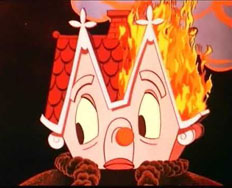
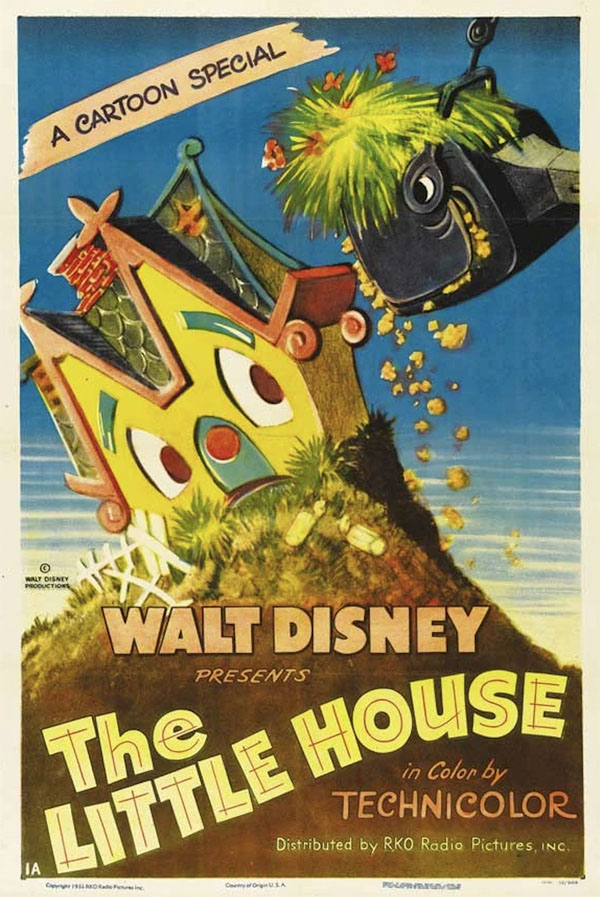 The Little House (Disney/RKO, 8/8/52 – Wilfred Jackson, dir.), follows the stages and progressions of the “life” of a newly-constructed cottage built on a hill way out on the country. The house itself has a face and personality, its windows serving as its eyes, and its front porch steps as lips (though she never speaks aloud, but projects her dialogue in thought-voice, provided in narration by Sterling Holloway). The house begins life as a honeymoon cottage, with newlyweds raising a family within. But her tranquil country life becomes jeopardized by the blight of urban sprawl, as the distant lights of the city draw closer and closer every day from new construction and expansion. The house suddenly finds herself overnight surrounded by a pair of new neighbors – two mansions which have sprouted up around her, each with an architectural design suggesting the face of a member of the snooty rich. From within their walls, the strains of formal waltzes are heard, as their owners throw lavish parties. The little house tries to chime in with her own brand of music – but country fiddling fails to impress her uppity neighbors. Suddenly, clouds of smoke rise out the windows of one of the mansions, and a call of “Fire” is heard. Alarm bells sound, and the wail of sirens rises, as fire crews arrive on the scene. The flames begin to leap from building to building, lifted by the winds from the tower of one mansion to the other. Even the little house’s roof is set ablaze on one side. Living hydrants pump water to the fire crew, who concentrates all their hose power upon the mansions, ignoring the little house entirely. However, the runoff of the water poured upon the mansions converges on the house in-between, successfully extinguishing her fire despite being ignored. As dawn breaks the following morning, the little house, bearing char-makings on one side that resemble a black-eye, is still standing, but the mansions are burned to the ground. “My my,” thinks the little house. “What a pity. Still, they weren’t very nice.”
 The neighborhood depreciates during the McKinley administration, into a surrounding of urban slums and raucous neighbors. It is too much for the family, and a moving van arrives to cart away the family’s belongings, and leave a “For Rent” sign outside the house’s door. But there are no tenants interested – especially as the city further modernizes, renovating the slums by means of the wrecking ball, and building mile-high skyscrapers in their place. The sign changes from “For Rent” to “For Sale”, but the lot is nowhere to call a home any more, lost in the shadows of the concrete canyons, and kept restless at night by the flashing lights of neon signs in the house’s eyes. A storm breaks above, so high up it can barely be seen past the massive tower spires – but enough to seemingly provide tears in the house’s window eyes. Finally, what appears to be a wrecking crew arrives, and uproots the house from its foundation. “Get it over with”, thinks the little house, “I’m only in the way.” The house believes it is the end of the trail, and resigns herself to her fate. However, the crew is actually in the business not only of house wrecking, but house-moving – and the house is carted away, to awaken and find herself transported to a new stretch of open countryside, on a hill matching her original location, where she is repaired, repainted, and refurbished to serve as the new honeymoon cottage for another married couple – happily beginning the life-cycle all over again. Holloway closes with the observation, “The best place to find peace and happiness is in a little house, on a litte hill, way out in the country.” (Cue Elton John to sing “Circle of Life”.)
 Mouse Warming (Warner, 12/6/52 – Charles M. (Chuck) Jones, dir.) – Yes, even mice relocate from time to time, with their own wind-up toy moving vans to carry the furniture. In an episode presented almost completely in pantomime (except for a few screams), a wind-up toy car follows the van, with a father figure mouse emerging, to open a small panel of a residential house wall as if a garage door, to allow the car to enter. Carrying baggage into the wall, the papa, a mama, and a teenage daughter emerge from the car, setting up housekeeping, and hanging a sign on the mousehole door inside the house, reading, “No peddlers or cats.” The daughter wistfully looks out of the windows of her room, one which has a view of the house interior. Suddenly, zooming through the living room comes a young boy mouse, driving a souped-up toy car at full speed. (A box shaped like a garage explains that the vehicle is “Hot Rod”, the toy car with a real gasoline motor.) The girl mouse, peering out over a flower box made from an empty box of paper clips, is smitten with admiration. The boy becomes likewise at first sight of the girl, gazing from the doorway of his own hole across the room. The boy finds a quick excuse to bring himself to the girl’s front door, emptying a miniature sugar bowl from his pantry (big enough for only one lump of sugar), and crossing to the girl’s mousehole to borrow a lump in neighborly fashion. Enter Jones’s old-reliable villain, Claude Cat. Claude sets himself down right in the path of the advancing mouse, who is so caught up in his romantic daydreams, he fails to notice Claude, knocks on Claude’s teeth instead of the opposite door, and is admitted inside by means of a “pivot tooth” which Claude pushes open with his tongue. The mouse closes the “door” behind him as he enters, then reappears again with a look of “What am I doing?” He quickly zooms back to the safety of his own hole, and surprises Claude, who reaches in with his paw, by way of a snapping mousetrap.
 The boy moons and sighs while Claude maintains a watch, sleeping directly between the two mouse apartments in the middle of the living room. The boy hatches an idea to get across, detaching a long pipe from the wall plumbing, and pushing it out the hole (these must be very deep walls!), straight across the room and under Claude’s belly. Before the pipe reaches the opposite wall, Claude grabs a small door off a kiddie doll house, places it within his jaws, then ducks down before the far end of the approaching pipe, fooling the boy into thinking it is the girl’s front door. Another knock at the door, and another entrance by the mouse into Claude’s mouth. Then comes a scene Jones would remember and repeat many years later. A still shot tracks along Claude’s anatomy, following the path something would take in traveling from his mouth to his belly. Treg Brown provides numerous sound effects, including the footfalls of walking shoes, the hinges of opening doors, a stumble down stairs, a crash, and the tinkle of glass. Claude’s face registers surprise and shock takes at the surprising array of sounds. (Almost the same bit would be repeated in the 1960’s, by a magician uncle of Jerry the Mouse inside Tom, in “Haunted Mouse”.) Finally, the boy lights a match, seen in silhouette glow through Claude’s fur, and smoke rises from Claude’s ears. YEOWWW!! Claude screams, coughing up the boy, who again makes a hasty retreat back to his hole.
 Claude spies the lovesick boy still gazing across the living room, and catches sight of the girl at the opposite window, and gets the idea what the boy’s objective is. Thus begins a series of “poison pen” notes to try to fool the mice into hazardous situations. With a sheet of paper and a claw dipped into an inkwell, Claude scribes in a feminine handwriting a note allegedly from the girl, inviting the boy to a nighttime rendezvous under the garbage disposal. The note is tossed to the boy as a paper airplane, and he arrives in the kitchen promptly at the appointed hour in his hot rod. There, the girl seems to wait – except that it is a hand puppet worn by Claude. The girl seems a bit more forward than might be considered ladylike, seizing the boy in a fond embrace. But when Claude’s face menacingly approaches the “couple”, the boy grabs up the puppet, lands on the pedal of a kitchen trash can, and smacks Claude in the face with the lid. But, so much for heroism, as the boy ultimately learns that “she” was just a decoy, and returns to his room in frustrated despair. Claude tries it again, this time with a note to the other mousehole. Papa receives an angry message, that the mouse across the way has seen that apartment first, and is moving in, like it or not. Papa pulls out from hiding a human-sized revolver, ready to deal with any intruder. Meanwhile, Claude tacks a sign on the wall of the girl’s apartment outside, sure to attract the boy’s attention – reading “Boarder Wanted”. Out comes the boy, laden with a suitcase and his humble belongings, ready to move in next door. Claude waits for the fireworks, but receives them in an unexpected way. The boy darts out from the girl’s hole, and willingly zooms inside Claude’s mouth. The gunshot comes next – right in Claude’s face. The boy exits through the pivot tooth again, and once more reaches the safety of his hole.
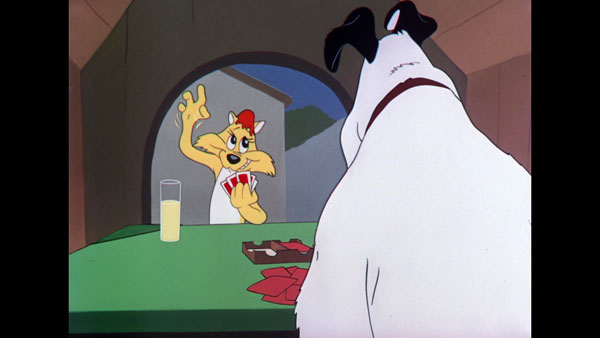 The boy has had enough of these strange notes and signs, and decides to fight fire with fire. He thus pens a note of his own, shooting it through the air to Claude. The note is allegedly signed by the bulldog in the yard, who informs Claude that he is through with his evil ways, and wants to be friends. How about coming over for a game of canasta? Surprised Claude is totally taken-in, and appears at the doghouse of Butcher the bulldog with card table, card deck, a chair for himself, drinks, and a box of dog biscuits. Butcher is rudely awakened, and still thinks he must be dreaming. As Claude deals, Butcher’s eyes turn red, and he kicks over the table. The doghouse vibrates with the impacts of a brawl within, and Claude finally emerges, staggering in a daze, the card table busted over his head, and throwing cards in a scatter everywhere as if he were spreading flower petals at a wedding. He disappears for parts unknown into the night. The evening’s festivities are not over, however, as a romantic date is just beginning inside the refrigerator, the girl and boy sharing a bottle of soda pop with two straws, with hearts rising from the popping soda bubbles, for the iris out.
 The New Neighbor (Disney/RKO, Donald Duck, 8/1/53 – Jack Hannah, dir.) – Narrator Art Gilmore begins, “It has been man’s constant labor to live in peace with his next-door neighbor. And on the newcomer falls the chore of getting along with the man next door.” Donald Duck is the newcomer, a moving crew just in the process of moving in his furniture to a classic single-family residential home in the suburbs. Donald hangs his “Home Sweet Home” sign, then looks out the window to meet his new neighbor. Enter one of the last Disney characters you’d want to reside next to – Pete!…followed by a large mutt of a shaggy dog named Muncey. The first thing Pete is observed doing is dumping his trash – right over the fence into Donald’s flower bed. Then, in delayed recognition of Donald, Pete cheerily introduces himself, and shows up at Donald’s door for a visit. But Pete has a purpose. “Wonder if I can borrow some ice cubes”, he asks. Donald politely invites him into the kitchen – but Pete enters, wheeling in a shopping cart. His request for ice cubes expands to a cube of butter, bullion cubes, cube steak, cucumbers…and he leaves having entirely emptied the refrigerator. As Donald begins a slow burn, Muncey returns to the door carrying a note, indicating Pete forgot to ask another favor. As Donald tries to read the note, Muncey enters the kitchen, then exits, carrying all of Donald’s dishes. Now Donald begins to squawk. Another knock. Donald opens the door, about to give Pete a piece of his mind, only to find to his surprise that Pete has prepared a bowl of food for him to sample, from an unknown recipe. “Try this”, Pete invites, handing Donald the bowl and a spoon. Donald does, smacking his lips, and declaring, “Delicious”. Pete turns to Muncey: “See? He eats it.” Donald does a spit take, realizing it’s dog food! “Trouble with you Muncey is, you’re too finicky”, says the departing Pete to his pooch.
The scene changes to springtime. Donald steps out into his yard with gardening tools to prune his bushes. What looks like a floral bush turns out to be Pete bent over, wearing poppy-flower patterned shorts. Pete quickly gets into a borrowing mood again, having Donald hand him tools like an intern assisting a surgeon, until there are no more in Donald’s box. A flash of lightning above keeps Donald from raising a complaint, as the duck ducks for cover on his porch from a rising rainstorm. As the rain falls heavily, Donald hears a call from Pete, who has also retreated to his own front door. “Hey, neighbor. Your tools”, says Pete, pointing into the yard, where Pete has carelessly left all of Donald’s implements to begin rusting in a rain puddle. Angry Donald is forced to get soaked by hurrying out into the rain to retrieve the tools.
 Fall weather sets in, and Pete trims his trees of decaying leaves, letting the wind scatter the cuttings all over Donald’s property. As Donald emerges to see his front yard immersed in brown leaves, Pete calls out in a belly-laugh, “Better rake ‘em up quick – They’ll ruin your lawn!” Peeved Donald spends the afternoon frantically raking everywhere. He finally takes the sack of leaves he has rounded up to his backyard incinerator – then notices Pete’s laundry hanging out to dry in the adjoining yard. Lighting the incinerator and blowing the smoke Pete’s way, Donald diverts the smoke right onto Pete’s apparel, then gives Pete the belly-laugh. Pete grabs a hose, and sticks it over the fence into the incinerator exhaust to douse the fire, and also blast Donald in the face with the water. Donald retaliates by re-routing the hose into Pete’s poppy-flower shorts, filling them with water, then punching holes in the shorts with a pitchfork, leaving Pete walking around the yard like a human sprinkler irrigation system.
 The commotion begins to draw the attention of other residents of the neighborhood, who flock to the backyard to watch the happenings. As Pete breaks a baseball bat across Donald’s brow, the action freezes, becoming a headline photo on the front page of the evening paper. “WAR BETWEEN NEIGHBORS!”, screams the headline. Further stories follow, reporting the brawl growing, and then finally the word, “Television Covers Battle”. A news van with remote transmitter appears, and a roving reporter to provide play-by-play coverage. At this point, the short becomes charmingly reminiscent of a Laurel and Hardy comedy, becoming the animated equivalent of classic shorts such as “Big Business” or “Tit For Tat”, with battle waged according to unwritten laws of alternating strikes and counter-strikes. As an audience of hundreds lines the roofs of adjoining homes for grandstand seating, and a concessionaire roams among them to sell peanuts and soda pop, Pete lines up at the fence to make the first move. Spotting one of Donald’s trees overhanging on his side of the property line, Pete grabs his clippers, and snaps off most of the tree right at the fence. Donald starts to climb over to protest, but Pete reminds him of the all-important rules: “Let’s watch that property line, punk.” “Oh yeah?” says Donald, matching Pete’s move by observing a pair of long-legged pajamas hanging from Pete’s wash lines, the legs extending over the fence in the breeze. Donald uses his clippers to cut them down to another pair of shorts. Pete grabs up a trash can, dumping the can and its contents over the fence without himself stepping over the line, all over Donald. “I’ll get ya for that” retorts Donald, taking up the trash can lid as a discus, and tossing it like a Frisbee in an arcing flight path, which smashes through all the glass of a greenhouse on Pete’s property, then conks Pete in the back of the head. Pete next throws his lawn mower onto Donald’s roof, where it mows a path through his shingles. Donald quickly climbs a ladder to stop it, but the mower rolls into his arms, toppling the ladder backwards, where it lands straddling the fence. Pete is caught at one end of the ladder between rungs, while Donald rides the lawn mower to the opposite end. The weight on each side evens out, and the two of them rise and fall, with the fence in the center acting as a fulcrum. “It’s a real see-saw battle, folks”, says the announcer. Pete gets loose from the rungs, and lifts the ladder high above his head, hoping to shake Donald down. He forgets that Donald is on wheels thanks to the lawn mower, and Donald rides the mower down the ladder like a track, scooting over Pete’s back and shearing off his clothes and fur in the rear.
 Another rule of battle is that the contestants get a one-minute breather between rounds, just as in a prize fight. One group of spectators escorts Pete to his yard corner, spurring him on with the encouraging words, “You’re going great, Fats. You’ve got him worried.” The rooter then whispers a suggestion in Pete’s ear: “Give him the ol’ spite fence.” But this guy isn’t really Pete’s supporter, and merely wants to increase the pace of the action. He quickly runs over to Donald’s corner, and whispers the news in his ear, “He’s gonna give ya’ the ol’ spite fence!” A bell sound signals the start of the next round. Both Pete and Donald charge in, loaded down with building materials. On either side of the fence line, they begin making additions. New upright posts. Wooden frameworks. Mesh wire. Tar paper. The structures rise about twenty stories into the air, while the crowd keeps chanting, “Higher, higher!” All the excitement over stimulates Muncey, who charges the fence in a circular path, knocking a couple of large holes in its foundation. Donald and Pete are on scaffolds at the top of the fence line, when the undermined structure begins to rumble. The crowd senses disaster, and deserts the scene in a panicked run. A complete structural collapse follows, and both back yards are buried in a cloud of dust and piles of rubble, as the scene fades out. The voice of the announcer continues to be heard. “Well, that just about winds things up.” The scene fades in on Pete, in bandages, seated on his front porch, but with his entire house being towed aboard a truck. “Old poppy-flower is moving…”, states the announcer. The scene cuts to Donald, who appears to be settling into his easy chair among his living-room furniture. “…The little fellow’s won out…”, the narrator continues. Then, the camera view quickly pulls back, to reveal that Donald is not seated in his living room, but among his furniture in the back of a moving van, which pulls away down the road. “No, no, it’s a draw!” concludes the announcer, for a surprise iris out.
 Plywood Panic (Lantz/Universal, Maw and Paw, 9/26/53 – Paul J. Smith, dir.), is about moving, much in the way of Fleischer’s “Little Lambkins”, to a house of the future – except the family doesn’t seem to need a moving van, taking along not much but themselves for their belongings. It may thus be here mostly by honorable mention. For saving one million box tops from Hominy Grit Pops cereal (a parody of Kellogg’s Rice Krispies), the family wins a new house (news that Milford the Pig, being the only one who can read the telegram, has to communicate to Paw in an extended game of charades). At the presentation ceremony, Maw notices something is wrong, when only a picture of the dwelling is displayed by the sponsor. “But where’s the house?”, she asks. The sponsor points to a vacant lot, over which is strewn a wide variety of huge packing crates. The house is pre-fabricated, assembly required. Essentially, the film becomes something of a poor-man’s remake of Mickey Mouse’s “Boat Builders”, with a dash of Fleischer’s “The House Builder-Upper” and Famous’s “House Tricks?” thrown in. Everything in the crates unfolds, including interior plumbing, staircases, easy chair, and picket fence – with the family kids quick to activate the unfolding buttons with shots from slingshots and peashooters. Maw is at one point flung into the air, and falls through a blueprint held by Paw, punching a hole through it and landing on the ground. Paw peers through the hole, and asks “What are ya doin’ down there in the basement, Maw?” Paw takes to an automatic easy chair, complete with pop-out reading lamp, foot stool, and potted flowers next to the arm rest, while Maw gets carried away by a long flexible board that begins to bend and flap like a set of wings. Paw asks the airborne Maw if she’s flying South for the winter. Maw abandons the board, and falls into a washing machine, with Paw watching her through the glass door. “You sure look good on television, Maw. The picture’s okay but I can’t get the sound.” Paw turns a knob on the washer, and inadvertently pits Maw through the spin cycle – then receives a sock on the nose from Maw for his effort. Maw later gets caught up by a self-expanding picket fence, which encircles the yard, leaving Maw stuck sideways with her feet in the slots where a gate should fit. Paw steps up the front walk, swinging Maw as if she were the missing gate, and hears a rusty-sounding squeak from her feet. “Gotta oil that gate one of these days”, observes Paw. A running gag also finds that Paw still hasn’t repaired the loose porch board on the original house, and carries the curse to his new abode, where a bird house on the roof suffers from the same loose board for its residents, and Paw’s final entrance into the new home uproots a similar loose board in the new porch, bringing the whole house down in the same manner as Mickey’s boat and Popeye’s two houses. Maw emerges from the rubble, and is asked by Paw what she is doing on the roof. Paw receives another well-deserved sock in the nose for his remark, and a fade out.
• “Plywood Panic” can be viewed at VK.com
 Muzzle Tough (Warner, Tweety and Sylvester, 6/26/54 – I. Freleng, dir.) – We open on a moving van in motion, driving down a city street. Sign on the van identifies its owners: Checker Movers (“It’s your move”). Sitting in the cab of the truck with the two moving men is Granny, trying to give directions to her new home. “The house has got to be around here someplace. It’s the only street left.” By process of elimination, the house is finally found, and the movers start carrying objects inside – past Sylvester, an alley cat lazily sleeping atop a wall paralleling the walkway, who couldn’t care less about the human goings-on. That is, until a bird cage passes by on a pole, housing Tweety. After the usual sighting of the “putty tat”, Sylvester runs atop the wall, trying to keep up with the cage, but smashes into a light pole installed along the wall top, and falls backwards. He climbs back up on the wall, and attempts to hop over into Tweety’s yard. Unfortunately, the movers have just brought in another animal home – the doghouse of Hector the bulldog, in front of which Sylvester lands. Watch for a background continuity error: long shots show the doghouse with a wooden bottom, so that Hector could be carried inside by the movers; however, an interior shot from doghouse point of view shows only bare pavement under Hector’s feet. Hector “tawt he taw” Sylvester, and chases him from the yard. How to get back in? Simple. Grab a lampshade from the furnishings piled to one side of the van, and stand stock still. One of the movers mistakes him for a lamp, carrying him in. Granny too is fooled, having no recognition of her own furnishings (well, after all, she couldn’t even remember the whole house), and has the new lamp put upon an end table. Tweety has never seen this fixture before, remarking “What a cwazy wamp”, and decides to see what it looks like plugged in, inserting Sylvester’s tail into a wall socket. An electrifying sight! The lit up Sylvester dashes away, back into the yard, returning to his normal colors of fur. But Hector appears, and chomps on Sylvester’s tail – receiving the same charge of voltage as the cat received from the wall. He chases Sylvester out again, and Tweety, observing from a window, decides Hector “doesn’t wike that wamp either.”
 Another plot to get inside. Sylvester borrows a spare set of workmen’s coveralls from inside the cab of the moving truck, and poses as a surprise third mover. He walks around the back of the truck to get anything tossed to him to carry, so as to make a convincing impression. He receives an unexpected item to tote – a grand piano. Single-handedly, Sylvester struggles under the weight to the front door. “Helpful” Tweety, who in “weality” seems to be wise to the disguise all along, thinks nothing of jeopardizing Granny’s prize possessions, just to thwart the putty tat. He offers to guide the piano mover to where the instrument should be placed – and leads him up three flights of winding stairs, all the way to the attic. The exhausted cat is finally coaxed to bring the piano forward “just a wittle more” – right out an attic window. “Watch dat first step”, says Tweety, as Sylvester plunges to the ground, to be crushed under the instrument, and come up with piano keys in his mouth instead of teeth. Savvy Tweety remarks, “Dat wast step was a wu-wu.”
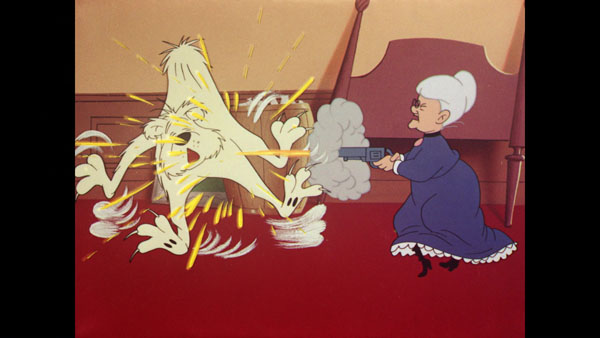
 Next, a polar bear rug begins to move of its own power – with Sylvester disguised inside. The bear climbs the pole of Tweety’s cage, and Tweety assumes “a cute wittle teddy bear” has come to play with him. Granny enters the room, and has been taking lessons from Yosemite Sam today, borrowing a gag from 1951’s “The Fair-Haired Hare”. Seeing the moving bear, she retrieves a revolver, chases the bear around the room, and blasts it in the rear end, ejecting Sylvester, seemingly unnoticed by Granny. Granny continues to blast the now unmoving bear until the rug is riddled with holes, then accuses the bear of spending “20 years playing possum.”
Sylvester is again “escorted” out of the yard by Hector’s chomping jaws. Something must be done about that dog, and a costume shop window (I thought this was a residential district) provides the answer. Sylvester acquires a female dog costume, and parades flirtatiously outside the front gate. Hector is smitten, and approaches the gate, timed to the steps of a French apache dance. Sylvester, in costume, waits just around the corner of the gateway, with mallet raised, ready to bop Hector. But just before he can swing, someone else swings, and down comes upon Sylvester the net of a dog catcher. Sylvester is placed into the rear of the dog catcher’s wagon, and it begins to drive away. Sylvester shouts at the driver to let him out, insisting that he’s not a dog, but a cat, and removing his costume head to prove it. He forgets that he is not alone in the truck, and hears the snarls of half a dozen dogs behind him. Sylvester turns white, faints, and withers to the floor of the truck, as the vehicle disappears down the road, the sounds of a mauling heard from within. Back at the house, observing Tweety remarks, “Dere won’t be no more putty tats awound to chase me now.” Then a movement catches his eye. From under two nearby lampshades appear two more cats, using Sylvester’s old trick. “Of course, I could be wong!”, states Tweety to the audience for the curtain line.
Convict Concerto (Lantz/Universal, Woody Woodpecker, 11/22/54 – Don Patterson, dir. (uncredited) – Apparently, Lantz followed in the pattern that deprived so many Warner cartoons of a director’s credit – giving none to this episode when Don Patterson left the director’s chair. I had previously thought this episode to be a production of Paul J. Smith, and it still seems like the dimwitted cop is the type of character Smith might have created, rather than resembling anything from a previous Patterson project – so perhaps, this might have been something started by Patterson but uncompleted at his departure, and possibly finished up by Smith. But that’s just my speculation – anyone know of more firm evidence of whether Don got an assist here or if the film was already finished by him? The other surprise in the credits is a story credit to – Hugh Harman! What’s he doing submitting material to Universal? This is the only such story credit I am aware of him receiving at this late a date anywhere – so how did this happen? Did Harman do anything more, immediately before, or at any time afterwards, in screenwriting? I learned of a Coronet film almost a decade later called “Tom Thumb in King Arthur’s Court” which he started but had to be completed by someone else, and some other commercial shorts here and there, but know of no other scripts contributed to mainstream animation by him. There must be a story as to how he and Lantz crossed paths – and if anyone knows it, please contribute.

Woody begins the film looking like he is playing a concert on piano. A re-do of “Musical Moments From Chopin”? No, as the camera pills back to reveal him sitting inside the window of the Melody Music Mart, with a box of tools identifying him on the lid as “W.W., Piano Tuner”. He pauses in playing to adjust a crooked key by reaching inside the piano framework and tugging at a string until the key is retracted into proper position, but it surprised when, upon letting go of the string, it seems to snap back into the piano framework with force producing a sound just like a gunshot. Actually, it is a gunshot, from the high-caliber pistol of a robber in the doorway of a bank next door. The robber carries a sack of money, and a cop comes a-runnin’ at the sound of the shot, causing the robber to duck into the next doorway – right behind Woody in the music store. The surprised Woody finds himself at gunpoint, as the robber instructs him “Make with them keys, maestro.” The robber climbs inside the piano, closing the lid enough to leave just his eyes and the muzzle of the pistol visible from within. “And don’t stop”, he commands, “…or…” His finger reaches out, to play on the keyboard the opening strains of the “Funeral March”. (Of course, the premise of this setup makes little practical sense, as anyone resting inside a piano would prevent proper vibration of the strings, making the effective playing of any number impossible. But in a cartoon world, Woody is able to launch into the ever-popular “Second Hungarian Rhapsody” without a hitch.)
 The robber pulls into the piano with him a conveniently-available telephone from inside the shop, and dials up two of his henchmen in an underworld lair. He informs them that he is on the lam, and inside the grand piano – and to bring a moving van and spring him, “before this woodpecker’s music drives me nuts!” Meanwhile, the cop, sniffing the ground like a bloodhound, and dimwittedly calling for police backup by yelling into a mailbox and a manhole rather than the police phone box, finally finds his way into the music store. Seeing no one there but Woody, he presumes Woody to be a suspect. “Put ‘em up”, he shouts, while all his bullets fall out of the chamber of his police revolver. Woody follows both gun-wielders’ orders simultaneously, continuing to play the piano with his hands, but putting up his feet for the cop. “I’m not a robber. He’s in…”, says Woody, trying to point to the piano interior with one finger. He suddenly finds his finger inserted into the extended muzzle of the robber’s pistol, so never completes the sentence, instead reacting with “Dyuuuhh….” and a facial expression as if he knows he’s going to be sick. The cop doesn’t know what to make of things, and sits down to think – right upon the money sack the robber has carelessly left outside the piano. The officer fails to even notice stray dollar bills and loose change which squirt out from the sack as he sits. Woody, however, spots this immediately, and again tries to tip off the cop. “There’s the dough…the dough…” Again, he catches sight of the bandit’s gun pointing at his head. Thus, he nervously whirls around, getting back to his business, singing, “Do de do do dooo….” (It should be noted that this film uses one of the simplest shortcuts ever to animating most of the sequences of piano playing – by viewing the keyboard at high angle, with the keys seen end-on, but with no lines drawn between keys to simulate shadows – i.e., a solid white edge for the length of the keyboard, over which cels are laid showing only the depression shadow of one or two keys at a time, wherever the animator chooses to draw them, with no reference points on the background itself.)
Looking back over his shoulder, Woody spots the police call box the cop previously overlooked, just outside the store’s door. Woody imagines his options in a thought cloud, first seeing himself phoning in the call for some law enforcement agent who knows what he’s doing, then imagining the consequences. One possible future shows him in the morgue (causing him to shudder). But another future shows him in the headlines of the newspaper as a hero. Woody broadly smiles and nods at this vision, as if to say, “Yeah, yeah, yeah.” He thus tries to make his way to the door without the bandit noticing any pause in his paying – by switching from one instrument to another as he moves steadily toward the front door. He progresses from grand piano to upright, to harp, and then to xylophone. His last xylophone notes, however, are not played upon the instrument – but upon the barrels of four pistols, all pointed at him, by the bandit’s two henchmen just entering the shop. Woody retreats with them back to the piano stool, and resumes his original performance. The henchmen cordially introduce themselves to the cop as piano movers, with orders to move the grand piano. The cop permits them to attend to their task unhindered. As they ready the piano for loading on the van, the cop’s bloodhound-like nose suddenly catches wind of something it should have noticed as right under his nose for most of the cartoon. A deep inhale brings to the cop’s face just what he’s been smelling – three of the stray dollar bills from the money sack. Even with the loot now in plain sight, the cop’s delayed- reaction sniffer still wants to look for a trail – and leads him headfirst into the bell of a tuba, where he gets stuck. The henchmen pass him, carrying both the piano and its stool, with Woody along for the ride atop the seat. The bandit is now seen sitting-up inside the piano, and, confident of a getaway, grabs up the money sack, and remarks, “If me mother could only see me now.” Just before his exit, he reaches downwards with his pistol, and fires a blast from the gun into the mouthpiece of the tuba – launching the cop clear across the shop, and right through half a dozen other musical instruments. When the dazed cop comes out from under drums and cymbals, the piano is already on board a moving truck. The cop darts outside, only to have the tailgate of the truck shut in hiss face, then dropped again to conk him on the head. The truck pulls out, and the cop gives chase in a squad car.
 Woody keeps on playing as usual, while the robber fires shots back at the cop. Each shot progressively destroys parts of the police car, removing its body and fenders, then ultimately leaving the officer riding a unicycle. The van speeds over a wooden bridge, lifting its boards high into the air like a raised drawbridge, but the single wheel of the cop manages to roll the slats out flat again. The van approaches a mountain road with too much speed, and the piano flies out, failing to make a turn, and sailing off a cliff. Woody and his stool are thrown along with it, so he still continues playing, while the bandit inside the piano chances a look down – with his eyes doing a Tex Avery-style take of extending like telescopes. The piano plummets, landing atop a moving train after several bounces. Woody’s stool is seated on one railway car roof, while the piano is seated atop another – then, the two railway cars become unhitched. Woody’s playing hands somehow manage to pull the piano onto his car, as the car rolls free down the track. Colliding with the roof of a tunnel, the piano and Woody bounce over the top of a mountain, reaching the tunnel exit on the other side just in time to land on the runaway rail car again. Now, the unicycling cop catches up, approaching the tracks from the opposite side of a long trestle toward which the railway car is headed. The cop wheels out upon the ties of the trestle bridge – and his unicycle falls apart. He races on foot across the ties to meet up with the car, forgetting that it has no brakes – so finds himself reversing course and running for his life as the car bears down upon him. Unable to outrace it, the cop takes a mighty leap, landing atop the railway car roof with Woody and the piano. Now the railway car rounds a bend in the track as sharp as that of the mountain road seen earlier. The piano flies off the roof, but the cop grabs hold of the piano’s rear leg, while keeping one foot hooked upon a smokestack pipe jutting out of the train car’s roof. The piano keyboard begins to detach from the instrument, but the bandit reaches out to grab it before getting away. Woody still determinedly keeps playing, as his stool disappears from under him, and all the keys of the piano extend out from the keyboard by the length of their strings. Something’s gotta give from all these g-forces, and it’s the cop’s footwear that does, his sock pulling out from his shoe, and the fabric unraveling down to the last thread, finally snapping. Everyone and the piano fall from the sky – and land right in the yard of a state prison. The cop gets the cuffs on the robber triumphantly, while Woody, now crazed from his constant playing, finishes the last notes of the rhapsody upon the nearly-totaled piano wreckage, then lumbers at the camera with extended playing-hands and the eyes of a zombie, emitting his signature laugh in an emotionally-detached manner, that suggests he is ready to join the ranks of the classic Universal monsters.
• “Convict Concerto” is on Archive.org
NEXT: A few more theatricals to go – then we “move” into television..
 Charles Gardner is an animation enthusiast who toils by day as a member of LA Law – but by nights and weekends indulges in classic jazz and ragtime as a performer; and studies classic Hollywood cartoons… maybe a little too much.











Roy Halee took over the roles of Heckle and Jeckle when Dayton Allen joined the cast of the Howdy Doody program. Since the show was broadcast live five days a week and required daily rehearsals (during which Allen was notorious for improvising lewd double-entendres), he would have had little time for recording sessions at Terrytoons. Cast members Allen, Bob Keeshan and Bill LeCornec were all fired from Howdy Doody in 1953 when they asked for more money. Since Allen was later welcomed back at Terrytoons, I assume that he had departed from the studio under amicable circumstances.
That’s an amusing idea about a Heckle and Jeckle/Mighty Mouse crossover with a live-action Paul Terry, but it never could have happened. Unlike Warner Bros., which was a big movie studio with its own live-action shorts division, Terrytoons was simply not set up to make live-action films. Besides, in any conflict between Mighty Mouse and the magpies, my money would be on the latter.
The “on-the-spot roving reporter” with the spectacles and the protuberant half-dome of a forehead in “The New Neighbor” is a caricature of Bill Welsh, one of the earliest television announcers in Southern California (not to be confused with Disney writer and producer Bill Walsh).
The doe-eyed, dimpled smirks that became such a trademark of Chuck Jones cartoons were already very much in evidence in “Mouse Warming”. I believe that Jones’s frequent collaborator Abe Levitow was at least as responsible for this as Jones himself; one sees the same expressions in Levitow’s later work for UPA, which Jones had nothing to do with. By 1952 Levitow was already an animator in the Jones unit but had not yet received screen credit for his work.
Hoyt Curtin seems to have had a predilection for low bass instruments, writing prominent parts for either the tuba or the contrabassoon in most of his Mister Magoo cartoon scores. In “Bungled Bungalow”, he featured both instruments. This gives the music a very bottom-heavy texture, but I think it suits the cartoon well.
You may recall that Heckle and Jeckle eventually did interact with a live-action Dick Van Dyke (albeit from the confines of a TV screen) in the CBS Cartoon Theater. There was also that documentary short (of which I forget the title) where they showed some behind the scenes footage inside the studio – including a stop-motion ending at the camera mount where we see from the cameraman’s POV the ending of “Throwing the Bull” taking on life as if changing cels by its own power. So there was indeed the possibility of filming a live sequence, then possibly animating around it. (Recall also the one instance of overlaying animation over live reference footage in “The Last Indian”.) Terry just didn’t get creative enough or risk-taking enough to do it for real.
‘Mouse Warming’ is one of my favorites of Jones’ shorts, coming at the tail end of that period from about 1948 to 1952 where his unit could seemingly do no wrong. Yes, the ‘doe eyes’ make several appearances, but they used just sparingly enough to drive home the emotions of the scene. Plus, there’s still plenty of cartoon violence with Claude to break up the ‘cute’ moments. To me it all just works on the same level as the more well-known ‘Feed the Kitty’.
I also love Stalling’s use of Raymond Scott’s piece ‘Reckless Night on an Ocean Liner’ in the opening scenes, effortlessly shifting from the ‘A’ to ‘B’ melodies as the camera pulls out to reveal the moving van is actually a wind-up toy and then to the ‘C’ melody as the movers start unloading. Compared to ‘Powerhouse’ or ‘Toy Trumpet’ Stalling rarely used ‘Reckless Night’ but he deployed it masterfully here.
The title “Muzzle Tough” sounds like a play on “Mazel Tov,” Hebrew/Yiddish for “good luck” or “congratulations.”
That’s the joke…
A couple of live action inspirations for “Plywood Panic”:
— In the first of Universal’s Ma and Pa Kettle movies, Pa wins a contest and the family moves into an already-constructed House of the Future. Lantz was an independent releasing through Universal; wonder if he inquired about using those actual characters instead of Maw and Paw. In fact, wonder if lawyers got involved over the obvious inspiration anyway.
— One of Buster Keaton’s silent two-reelers, “One Week”, has newlywed Buster assembling a prefab house after a rival sabotaged the instructions. Prefab houses were already a real thing. You could buy them from Sears.
This sounds like Carlo Vinci’s work style, maybe it’s done by him? (I’m not an expert and it could be wrong)
Wikipedia said that Harman freelanced on Convict Concerto. But I wonder if he just wrote a script for his own work, but it didn’t work out so he sold it to Lantz, with whom had collaborated before on the Mintz Oswalds before, and Lantz re-adapted into a Woody cartoon? (Just a guess and hypothesis, again it could be wrong)