



 I told you I’d be back! Looney Tunes Collector’s Vault Vol. 3 is even more new-to-Blu classics from Warner Archive. You know the drill by now, so rather than give any preamble, let’s dive right in…
Disc One:
This disc boasts the highest number of cartoons newly restored for this series to date. It’s been a long time since I’ve felt “white guilt” watching a studio-sanctioned collection, but that’s not the programmers’ fault I jumped to those newly restored titles first to see how they fared. Most of what’s left to be released was not released before for obvious reasons, but now, at last, everything is fair game for the “adult collector” market. It would not be shocking to be able to own, across a multitude of releases of course, every single Warner-controlled short one day with this new direction.
The cartoons remastered specifically for this set are A Feather in His Hare, Horse Hare, Nothing But the Tooth, Slightly Daffy, and Sinkin’ in the Bathtub. Yes, the first four all have something in common, and the last is the first theatrical Warner cartoon ever with the problematic Bosko, who spoke in a black dialect in this one and the pilot, but otherwise was a Mickey Mouse clone. (Rudy Ising insisted Bosko was an “inkspot” and didn’t like what happened to him at MGM.)

Sinkin in the Bathtub
The programming on this disc tries its best to be enjoyable but can’t hide a “whatever’s left” feeling at this stage (again, not a fault of the programmers; the fans want to complete those checklists). The entire collection gives a good overview of Friz Freleng’s career (half of the cartoons are his) and why he might be taken for granted by most critics and historians: the earliest stuff isn’t good and broke no ground, and it was his ‘50s Tweety cartoons on autopilot that got the most attention and airplay. Yet, there is a very long period between that where Freleng doesn’t take a backseat to anyone, and that makes up a lot of the second disc.
Billboard Frolics (1935, Friz Freleng)
Appropriate starter cartoon, not because it’s any good (it’s generic “stuff comes to life” material, a lot lifted from earlier films), but because it introduces Merrily We Roll Along to the Warner cartoons (which still generates money for the Eddie Cantor estate to this day).

Country Mouse (1935, Freleng)
A hick mouse aspires to be the champeen fighter, but he’s still weaker than his grizzled maw who saves the day. Relatively enjoyable for how odd it is to see mice drawn Mickey-size in a non-Disney cartoon.

Dog Gone Modern (1939, Chuck Jones)
This cartoon with the two curious dogs versus a robot sweeper in a model home of tomorrow got remade almost a decade later with Hubie and Bertie as House Hunting Mice. It’s not really fair to judge too harshly since it is one of Jones’ first cartoons as director (remember, too, Jones was a lot younger and more inexperienced than the Disney directors/animators he’s imitating and these cartoons were made for a lot less money, so it’s really shocking they’re as well-produced as they are). But I was struck by how stiff and ugly the robot is here, compared to the later one which is sleeker and hysterical and able to convey real acting with no actual face.

Don’t Axe Me (1958, Robert McKimson)
Without Foghorn to play with, Barnyard Dawg convinces the Fudds to cook the farm’s duck – Daffy. The late legendary animator Clay Croker insisted to me that Mr. and Mrs. Fudd are also siblings, and I agree.

Don’t Look Now (1936, Tex Avery)
This battle between Cupid and the devil (swiped later by Harvey Comics as their ‘Hot Stuff’?) is drawn sickeningly cute deliberately to make the perversion of Avery’s satire all the sweeter (he does it again much later at MGM with Li’l Tinker).

Feather Buster (1958, McKimson)
This cheater feels rather unearned—almost too lazy—as it’s lifting footage from cartoons barely two years old, but the designs of old fogey Foggy and Dawg and their grandkids are fun.

 A Feather in His Hare (1948, Jones)
A nerdy, bespectacled native (voiced by Maltese) pursues Bugs. Being the most “liberal” of the directors, Jones is clearly uncomfortable when handed material with racial caricatures and does his best to humanize them by making us aware he knows how backwards the material is. “Me thank-em you heap much. Er… ugh!”
Production documentation uncovered by Keith Scott reveals two interesting bits: this was absolutely shoved down the release schedule to accommodate the expedited Rhapsody Rabbit, so maybe it being a “lesser” cartoon was recognized in-house (which is why no Jones Bugs cartoons were released in 1947); and Maltese had to be paid through SAG specifically for this voice job. Having to be more “by the books” may be why Maltese and Tedd Pierce stopped doing voices in the cartoons, which was especially tragic in the very gifted Pierce’s case. (Later voices can be counted on one hand—Maltese is the non-Blanc Italians in A Hound For Trouble and heard at the end of Fox-Terror on this collection; Pierce is Wentworth J. Whistlestop in The Prize Pest; and both can be heard as alleycats in Bell Hoppy.)

The Gay Anties (1947, Freleng)
Part of Freleng’s ant comedy trilogy, which takes place in the 1890s but its longest scene is an unintelligible rendition of As Time Goes By ‘Time Waits For No One’ (complete with a Dooley Wilson-like pianist).

Horse Hare (1960, Freleng)
Soldier Bugs holds the fort against Renegade Sam and his band of natives. Incredibly designed cartoon, but the material feels a bit tired and unpleasant, specifically the shooting “Ten Little Indians” routine, and the “richocheted”/”plunk” shotgun gag from His Bitter Half is reenacted here with all the life sucked out of it. The best gag is with Geronimo. “Oh boy. Me wouldn’t like to be me tonight.” This rehash got remade years later as the truly rancid Trick or Retreat, which for some reason still saw a lot of broadcast during Roland & Rattfink’s recent two-year stint as the cancer of MeTV’s animation lineup.

Joe Glow, The Firefly (1941, Jones)
Jones’ first cartoon in black-and-white (after Schlesinger decided all the units would make black-and-white cartoons, not just Clampett’s and Freleng’s), and while there’s no real point to it, it sure is an exercise in effective scale. It probably would look more stunning (as it does in a good film print projected) if these ‘40s black-and-white cartoons weren’t so over-processed looking. Has a unique arrangement of The Merry-Go-Round Broke Down heard on no other cartoon.

Lady, Play Your Mandolin! (1931, Hugh Harman/Rudy Ising)
The first Merrie Melodie, with characters so identical to Mickey and Minnie that Walt actually called Hugh and Rudy to ask them, politely, to knock it off. If you don’t find the animation of the drunk horse (by Ham Hamilton) one of the funniest things ever, something is seriously wrong with you. This is a truly astounding restoration, the first time I’ve heard it without the drain gargling distortion in the opening titles.

The Lyin’ Mouse (1937, Freleng)
Smartass mouse escapes a cat by telling the fable of The Lion and the Mouse and lives up to the cartoon’s title for the final joke. At this point, the Freleng cartoons are getting good enough that they could almost pass for Avery’s (since by the Blue Ribbon reissues hacked off the credits, I know a lot of fans thought some of Freleng’s were Avery’s before knowing better).

Mice Follies (1960, McKimson)
Last and least of the Honey-Mousers cartoons, which came out the same year Hanna-Barbera cemented their TV cartoon empire with their own (much more popular) plagiarism of Jackie Gleason.

My Green Fedora (1935, Freleng)
Yet another irritating rabbit cartoon, this was Bob Clampett’s (credited with Jones as an animator here) example of how he didn’t work well with Freleng, who rejected most of the gags he pitched for it (although somehow Clampett magically created Porky Pig working for the same director who didn’t like his ideas that same year).

Nothing But The Tooth (1948, Arthur Davis)
Porky goes to stake his claim in the California gold rush and is pursued by a diminutive, glasses-wearing Mohican (another one in 1948?) who wants to scalp him. Awkward to see Porky as the chased character in a role probably better suited for Daffy (the Bill Melendez-animated scene of horny Porky practically dry humping the mannequin emphasizes this), but the demented scene of Porky and the Indian as salmon is a keeper.

Of Thee I Sting (1946, Freleng)
Cartoon based around reusing footage from Target: Snafu, only the mosquitos are now after a nameless guy’s ass.

A Pizza Tweety Pie (1958, Freleng)
Tweety, vacationing in Venice with Granny, versus Italiano pussycat Sylvester.

Shake Your Powder Puff (1934, Freleng)
Freleng does a bit of a rip-off of Goofy’s debut in Mickey’s Revue, which is fair since Harman-Ising did Goopy Geer first (some singing ducks also look exactly like the one that debuted in a Disney cartoon earlier in 1934). This ersatz Goofy got immortalized as part of the Guild Films logo. The best laugh is the end title, which tragically got cut when broadcast for years.

Sinkin’ In The Bathtub (1930, Harman/Ising)
Bosko’s car ride with Honey has no purpose other than to promote the Warner music library and Hugh Harman’s love of difficult shots, but there’s still something magical about seeing the birth of the best cartoon series (and ending signoff) ever looking this good.

Sleepy Time Possum (1951, McKimson)
Kid possum won’t stay awake long enough to peel ‘taters, so his paw tries to scare some liveliness into him. There’s the distinct impression from cartoons like this that the writers didn’t have to work very hard for McKimson, as he’d just take whatever they gave him and put it into production.

Slightly Daffy (1944, Freleng)
Remake of Clampett’s Scalp Trouble (with footage from other Freleng and Avery cartoons) with the liveliness sapped out of it. I’d seen this a million times (it played on TV in the ‘90s constantly when the Native American cartoons were still OK to broadcast; this was always a cue to go do something else), but this great restoration really highlights how bad a job the reused animation really is—sometimes it’s Fred Ladd level. The pointless exercise of retracing old animation being so unsuccessful, seen here and in Tick Tock Tuckered, may be why they wisely opted to stop doing them.

A Star Is Hatched (1938, Freleng)
Emily the Chicken returns and tries to find stardom in Hollywood to no avail. A creepy-looking Dick Powell caricature in a sendup of Busby Berkeley musicals takes up a lot of screentime with no actual point.

Tree Cornered Tweety (1956, Freleng)
Tweety narrates his life with Sylvester ala Dragnet.

Trick or Tweet (1959, Freleng)
Sylvester versus the unbelievably stupid Sam over Tweety. Freleng’s mastery of economy is used to great effect throughout to emphasize Sam’s stupidity, and when Sylvester gets just as stupid by proxy in the cartoon’s final moments.

Tweet and Sour (1956, Freleng)
This doesn’t have much to note beyond being the one where Granny threatens Sylvester with the violin string factory.

Disc Two:
While the disc is mostly cartoons we’ve all seen a million times, yet they still had not been on Blu-ray until now. While some are certainly weaker than others, there isn’t a genuinely bad cartoon here and most are actual classics, another testament to the strength of the Looney Tunes oeuvre. It was great to see a few of the Golden Collection audio commentaries ported over, although I wish all of them were when the exist.
Ballot Box Bunny (1951, Freleng)
Immortal Bugs and Sam battle, this time over mayorship and Sam’s campaign promise of rabbit genocide. Pretty much every scene is a masterclass in cartoon timing.

Boobs In The Woods (1950, McKimson)
Things are winding down for McKimson as a new decade starts, but there’s still plenty of fun to be had with Warren Foster’s take on Daffy ruining Porky’s excursion into the woods just because. (Though, the alphabetical order of the playlist dilutes the effect of the earlier, historic My Favorite Duck.)

Booby Hatched (1944, Frank Tashlin)
It’s fairly easy to envision this wandering unhatched egg story as a much earlier cartoon (and it actually got slightly remade by McKimson as the much weirder Shell-Shocked Egg), but Tashlin’s sharp posing and timing couldn’t have existed at any other point in cartoon history. I like the part where the mom screams, “Robespierre!”

Case of the Missing Hare (1942, Jones)
Bugs gets revenge on magician Ala Bahma in a story that would be reworked years later with the nice fat opera singer in Long-Haired Hare, which is about one of the most perfect cartoons ever made. This early version has Jones giving more attention/leeway to the art direction by John McGrew than the comedy (as he would in later years), but it’s still very funny with some great gross Bugs animation by Bobe Cannon.

Conrad the Sailor (1942, Jones)
Jones is still getting the plodding poison out with more Conrad Cat and a Daffy Duck on valium. The glacial pacing is actually used to great effect in one instance: it helps fool you into thinking Conrad is appalled that Daffy really did take a shit on the poopdeck.

Daffy – The Commando (1943, Freleng)
Von Vultur tries to assassinate the latest opposition to the Nazis’ cause: Daffy Duck. Owes its running joke to the Jack Benny movie To Be or Not To Be. “Schultz!”

Duck Soup to Nuts (1944, Freleng)
Porky hunts Daffy, and its wall-to-wall gags—all great ones. Tedd Pierce reused his ending from one of the stupidest Fleischer Popeyes, Olive’s Boithday Presink, for this, and the Warner magic transforms it into something fantastic (the kid spitting on grinning assassin Porky always kills me).

Fox-Terror (1957, McKimson)
Poor Tedd Pierce gets dumped on in this column for getting lazy and cribbing too much from radio and TV in the ‘50s, so, in fairness, it seems Maltese (in one of his rare jobs for McKimson) thought basing a cartoon around Sheldon Leonard’s racetrack tipster character on The Jack Benny Show was a good idea. The result is probably the most bizarre Foghorn Leghorn cartoon ever. (Actually, given McKimson did cast Leonard as the wonderful Dodsworth years earlier, I wonder if they thought they could get him again for the fox in this one.)

Foxy By Proxy (1952, Freleng)
This one is a break in the several-year rut Freleng and Foster got into (when they made endless and highly interchangeable Bugs/Sam and Sylvester/Tweety cartoons) and pays tribute to their friend Tex Avery, right down to reusing footage from Of Fox and Hounds (which sure looks awkward in the ‘50s) and the historic log gag from All This and Rabbit Stew (in a rare instance of Freleng’s timing not working, Bugs turning the log a third time plays too evenly to get the laugh as it does in the earlier incarnation). Very underrated, with a Lenny dog (Stan Freberg) stupider than even Avery’s, and the Art Davis-animated pack of dogs can finally be still-framed in HD properly.

Fresh Airedale (1945, Jones)
Probably the most cynical cartoon the studio ever did: the story of Shep, the backstabbing, conniving dog who gets all the breaks. The “No. 1 dog” is supposed to be F.D.R.’s Scottish terrier Fala. Changes were made very late in the cartoon’s production after Roosevelt’s death to eliminate any specific references (although the White House is still clearly visible in the last scenes).

Goldimouse and the Three Cats (1960, Freleng)
Fairytale parody that could almost pass for better TV stuff at the time with the design and prominent roles for June Foray. Sole use of Sylvester Jr. by Freleng and Maltese and it’s easily the best cartoon with him.

Herr Meets Hare (1945, Freleng)
Bugs meets fatso Goering and Herr Hitler. Most noteworthy for a Maltese-written Wagner “Brunhilde” sequence that would evolve a decade later into the most famous and beloved Warner cartoon of all-time.

Holiday for Shoestrings (1946, Freleng)
One of the Freleng pantomime musicals he excelled at, this one centered on the Shoemaker and the Elves story always felt a trite underwhelming compared to Rhapsody in Rivets and Pigs in a Polka.

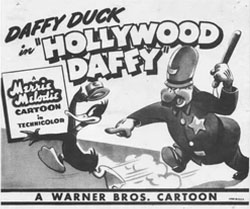 Hollywood Daffy (1946, Freleng)
Autograph hound and horndog Daffy evades a Joe Besser cop on the studio lot. Legend has it, as told by Mike Maltese, that he and Friz duked it out over this one: Friz wanted a completely new story, without Daffy. Maltese refused, and they took it to management. Management sided with Maltese, who said Friz took a timeout on this one and his layout man Hawley Pratt really directed it, and that’s why it didn’t have a director credit. It’s a cool story, but it always sounded a little apocryphal since Pratt had barely been a layout man for a year and simply didn’t have the experience to fully direct a picture. Pratt himself told historian Milt Gray in an interview that Friz instructed him to make a production board (breaking down the picture into scenes using his layouts) before Freleng worked on the timing, which was not their usual working arrangement. Maybe there’s no credit because Freleng just felt that strongly that it stunk. Either way, the drama did have an ostensible impact: the studio seemed afraid to assign or pitch a Daffy cartoon to Friz from hereon, as he directed very little of the duck for the rest of the studio’s run, compared to Jones and McKimson.

I Got Plenty of Mutton (1944, Tashlin)
One of Tashlin’s real classics, this one seems to have been an unspoken influence on Chuck Jones… not just the sheepdog and wolf concept, but the posing of the starving wolf highly anticipates Wile E. Coyote, and there’s of course the hopping horny French pursuer. The punchline is basically the same as Billy Wilder’s Some Like It Hot.

Mississippi Hare (1949, Jones)
Bugs is cotton-picked onto a riverboat where he meets Colonel Shuffle (you almost wonder if Jones let Maltese do a quasi-Yosemite Sam, right down to his introduction, because he wasn’t going to be working with Freleng’s self-avatar any more) in what’s Top 5 or 10 Jones material, easily. As Eric Goldberg tried to impress in his audio commentary to stop unrelenting misinformation, the dance animation is Ken Harris’, not Virgil Ross’. Please stop insisting otherwise.

Mutiny on the Bunny (1950, Freleng)
Shanghai Sam recruits Bugs, who keeps sinking the ship. It’s the first time the Bugs/Sam cartoons fall into the trap of having a really strong first half and descending into blackout gags for the second. In this case, they’re trying to recapture the “same punchline over and over again” magic of High Diving Hare to no avail.

My Favorite Duck (1942, Jones)
Jones and Maltese’s first collaboration on the continuing characters yields a gluttony of great poses and pratfalls.

Pizzicato Pussycat (1955, Freleng)
UPA-influenced “modern” cartoon with stylized human characters and storybook motif, with design that doesn’t reach the cluttered excess of a few surrounding cartoons (Yankee Doodle Bugs, By Word of Mouse). It almost seems to have been made specifically for Virgil Ross, who was a pianist and animated half the cartoon.

Puss N’ Booty (1943, Tashlin)
The last black-and-white Looney Tune and Warner cartoon, and sets the foundation of the Tweety and Sylvester series, albeit quite wilder than anything done with those characters together.

Rabbit’s Kin (1952, McKimson)
Pete Puma. Immortal masterpiece, enough said. Yes, this still has the fake “Photoshop” titles, but fortunately the slop artist’s vandalism that caused a typo in Robert McKimson’s credit was fixed.

Really Scent (1959, Abe Levitow)
One of the cartoons directed by Abe Levitow while Jones was out directing the Bell Science special. With Jones out of the room, it’s almost as if Mike Maltese jumped at the chance to get Pepe Le Pew out of his decade-long rut by making a cartoon where the cat’s stripe is real and she wants to be with Pepe – it’s just that he stinks (although as For Scent-imental Reasons and Little Beau Pepe prove, that was always the case).

Stage Door Cartoon (1944, Freleng)
Transitionary cartoon for Freleng, who always staged his cartoons like a vaudeville act, now actually placing Bugs and Elmer in one, with many standards used for the first time, including a primordial Yosemite Sam. The sight of Elmer actually strangling Bugs is up there in the “unpleasant imagery” category (which there wasn’t much of in prime Warner cartoons, hence why it stands out).

A Star Is Bored (1956, Freleng)
Daffy’s bid for stardom makes him the stunt double for Bugs’ pictures. The dead-eyed mid-air swap pretty much sums up most Hollywood production.

The Windblown Hare (1949, McKimson)
The naive Bugs Foster tended to write for McKimson actually works here, since he quickly takes control of being placed into the Three Little Pigs story. This is a good one to set alongside The Turn-Tale Wolf to illustrate McKimson’s deterioration just from design: the pigs are mostly stiff and bland there, but here there’s a broadness to the drawing, especially in the pigs’ jowls, that really lays into just how evil they are. Manny Gould’s scenes of the wolf kicking Granny out is the highlight. “Landsakes, wolfie, ain’tcha gonna eat me?”

Alright, folks, more later. Go be a good human being and see Coyote vs. Acme in theaters before this set arrives on your doorstep.
 THAD KOMOROWSKI is a writer, journalist, film restorationist and author of the acclaimed (and recently revised) Sick Little Monkeys: The Unauthorized Ren & Stimpy Story. He blogs at









For The Gay Anties, it’s not As Time Goes By that the female ant sings. The song is Time Waits For No One.
The “nameless guy” in “Of Thee I Sting” sure looks like Art Davis to me. A caricature of Davis was similarly besieged by insects in the Columbia Color Rhapsody “The Way of All Pests” (1941), even to the point of getting bitten on the ass by a mosquito.
Wonder if Art Davis had a thing about insects
Will this set have dvd copies. I don’t have blue ray and probably never will.
Your comment at the end there: In fact, my wife and I did exactly that just yesterday (31st) – that is, we went to the theater and saw “Coyote vs. Acme” – and…
WOW.
I couldn’t believe the number of cameos of Warners cartoon characters there are in that movie! You have to watch pretty closely, or you may miss some. Go see the movie, you’ll love it.
Couldn’t miss the name of the law firm… “Avery, Jones, and Maltese” …
SPOILER ALERT: Wile E. Coyote doesn’t catch the Road Runner in this one, either.
On to the review: Thank you, Mr. Komorowski, for reviewing “Vault Vol. 3” so soon after you reviewed Vol. 2!
I won’t whine again about the flawed Daffy Duck cartoons that haven’t been fixed here. See Mr. Komorowski’s post for Vol. 2 – and my commentary – for that…
Will mention that “Puss & Booty” was not Warners’ last black & white cartoon – it was, however, their last regular theatrical b&w cartoon. All 26 “Private Snafu” training cartoons they made for the U.S. Army were made in b&w, and those were still being made almost two years after “Puss & Booty” was released. Also those three “Mr. Hook” cartoons made for the U.S. Navy are in b&w – made in 1945.
Pfui on you, I like Peter Rabbit! (“Country Boy” from Vault Vol. 2 and “My Green Fedora” from Vol. 3.) Maybe just because he was the first recurring/continuing rabbit character in Warners cartoons… admittedly only two cartoons… I also like him because he’s obnoxious! (Not quite at the level of Daffy, though…)
I don’t know if it was intentional or just chance, but with the release of “Vault” Vol. 3, I think all of the Warners cartoons with rabbits before “Porky’s Hare Hunt” (1938, the early prototype of Bugs Bunny) will have been released on either regular DVD or (mostly) restored to high definition and released on Blu-Ray: “Shake Your Powder Puff” (1934), “Country Boy” and “My Green Fedora” (both 1935), the famous “I Love to Singa” (1936) by Avery, and Tashlin’s “Porky’s Building” (1937). I think I missed one in that list though, that I just learned about last week…
Great line in “Herr Meets Hare”: Bugs notices that Goering’s Iron Cross is made of cheap tin. Goering: “That Hitler swine!”
If there is any Bugs Bunny cartoon for which it can be said that Bugs has a minor role, it is “A Star is Bored.” In a way, Daffy _does_ kinda steal the show…
OK, ’nuff! Sorry about that. Mr. Komorowski, I learn more about those cartoons every time you post something! (P.S. The Aesop’s Fables and Fleisher Vol. 1 and Paramount cartoon discs are great!)
Well, I definitely want this set for the earliest cartoons, including “sinking in the bathtub“ which you say it looks better than it ever has in a long time! You say the same for “lady play your mandolin“ and you mentioned the sound as being very good. Thank goodness!
Sorry to hear about the glitch “nothing but the tooth“. It is of course on the “golden age of Looney Tunes“ box sets with perfect sound, but it’s been so many years since that set has been available or since it was created.
On ‘Hollywood Daffy’ – so there’s no truth to the theory that this was Arthur Davis’ “audition” for the director’s slot(s) that opened when Tashlin left and Clampett was shown the door?
I’m hoping some of the “Disc 2” shorts weren’t de-grained this time, like some were on Volume 2.
Thoughts on various cartoons on here:
Scalp Trouble/Slightly Daffy: It’s a toss-up, frankly. The remake had the better voices which were more in line with how the characters had developed since 1939 (plus a funny “As Times Goes By” snore that wasn’t in the original), although Scalp had the better “native approaches Porky” scene, with the native in shadow and off-screen, which looks so much cooler. In terms of color remakes of old material, Dough For the Do-Do was handled better, though I’m glad they stopped doing them after that.
Don’t Axe Me: Typical lackluster McKimson cartoon of the late ’50s but worth it just for the charades scene. Fudd’s wife is SO dense.
Feather Bluster: The way the Henhouse Henery scene ends here is just odd. Foghorn calmly exits the woodshop (wasn’t he running for his life literally a half second ago?), delivers a one-liner to the audience, turns around to go back inside (why?) and is apparently hit by Dawg’s bat (though we don’t see it connect), and he just falls down. Embarrassing.
Holiday For Shoestrings: I disagree about it being inferior compared to Rivets and Polka, for no other reason than it packs in a lot of classical pieces in there, compared to Rivets which only uses one, and Polka which only uses different movements of Hungarian Dance.
Mice Follies: The plot is rather uncomfortable when you get right down to it. Both husbands and wives are afraid of coming home late for fear of being physically beaten by their spouses? Yikes.
Really Scent: Cartoon works because of the gorgeous New Orleans backdrops and also the subversion of the formula, which was desperately needed by this point in the series. Also, Pepe looking up “pew” in the dictionary is genius.
Tree Cornered Tweety: Take away the “Tweety narrates the cartoon, Dragnet style” gimmick and you have an entry interchangeable with many others in the series. Still a nostalgic favorite regardless. For some reason the gag that always stuck with me from when I first watched it as a kid was Sylvester paying for a pie and being hit with it.
Fox-Terror: I always wondered if the “uh-uh.” running gag was a reference to something specific.
I forgot to note that bit in FEATHER BLUSTER, and I noticed how bad that connecting footage was even as a kid. It may be the worst staged scene in all of classic Looney Tunes.
On “Really Scent,” don’t leave out June Foray’s narration!
“the Blue Ribbon reissues hacked off the credits, I know a lot of fans thought some of Freleng’s were Avery’s before knowing better”
I had the opposite problem growing up. some shorts that were Avery, I thought were actually Freleng. “I’ve Only Got Eyes For You” being an example.
Ain’t We Got Fun is the most Freleng of Avery’s Merrie Melodies (also the most underwhelming)
With so many racial stereotypes in these sets (not that I’m condoning it or anything), there might be hope yet for an official release of the Censored Eleven.
Definitely interesting how Freleng-heavy this volume is like Collector’s Choice Volume 4.
I also definitely agree with what’s said about the end gag of “Shake Your Powder Puff”.
> The programming on this disc tries its best to be enjoyable but can’t hide a “whatever’s left” feeling at this stage (again, not a fault of the programmers; the fans want to complete those checklists).
I’d like to point out that this isn’t really new and also points out of the wide scope of one-offs and obscure shorts that are in the filmography. There’s definitely a bit of a shortage of familiar character shorts as disc 1 candidates (“The Slick Chick” is now the only Foghorn short left for instance), and a lot of it is compounded with the Bosko/Buddy and post-1964 shorts. I’m definitely glad they finally gave Bosko the spotlight he deserves; I wonder if this will pave the way for him to eventually get more of his shorts out.
Disc 2 is a bit of Tashlin showcase for the rest of his shorts on his final stint with the studio, and it does quite a good job at that, showing that his one-offs still remain pretty funny and full of charm. I’ve definitely been enjoying the amount of director showcases the series had recently; with this set out, almost all of Davis’ shorts are on Blu-ray (only Bacall to Arms is left)!
Levitow had quite an interesting history during his small stint as a director – his shorts largely aimed to stray a bit away from the regular formulas and put a twist on them. “Really Scent” is up there with one of the better post-shutdown Pepe’s due to this, and he did one final attempt at a spot-gag short (McKimson was otherwise the only one at the time attempting this) and a pretty enjoyable Witch Hazel short that gives Hazel a more positive ending. Too bad that didn’t transfer when he had to make Tom and Jerry shorts for MGM.
The only thing to point out for future volumes is there is a notable lack of Hippety Hopper shorts on disc 2. They were surprisingly able to fit pretty well on VHS/LaserDisc releases back then, but now they’re never released outside of the (unceremonious) final volume of Super Stars that put them all at once. I do hope at the very least “Hop, Look and Listen” or “Pop Im Pop” are at least viable disc 2 choices.
Glad to see more 30s shorts here, particularly Don’t Look Now and The Lyin Mouse (I hope they can get as many from the fifth GAOLT volume out as possible since that one is difficult to obtain).
I finally got around to screening The Country Mouse a while ago and was impressed by some of the animation, particularly perspective shots in the ring. It feels like they were emulating Disney’s Tortoise And The Hare with the cocky athlete protagonist. (He kind of looks like Mortimer, before he appeared a year later.)
Were any stories told about the production of Slightly Daffy? The fact that a conservative director remade a short done by a wackier director has always struck me as curious. That alone made the short a failure. I even noticed the hodge podge reused, recolored animation on the old LD transfers.
Also glad that we now have all of Art Davis’ work on disc. Of all the suppressed for TV shorts on disc one, Nothing But The Tooth is the one I remember seeing the most on CN back in the day.
“The Windblown Hare” has my all-time favorite Blanc performance that isn’t from the usual Looney Tunes cast, from the wolf rehearsing his line and adjusting his tone each time, to him fast-forwarding his reading of Little Red Riding Hood (increased playback speed helping) right down to the immortal “I’m gonna huff, and I’ll puff, and I’ll BLO-O-O-O-O-O-O-W your house down!”
I really think how beautifully Blanc did the “blow-w-w-w-w-w-w-w your house down” is the highlight, along with when the Wolf can’t remember the line.
Any original titles/rings restored?
Incidentally, I think a replacement program is in order for disc 1 if it means correcting the problems for A Feather In His Hare and Nothing But The Tooth.
Wow, another well-done review from Thad? How delightful!
Horse Hare is kind of a guilty pleasure, Bugs/Sam short for me. it’s undeniably offensive, but Friz Freleng’s timing/execution and Milt Franklyn’s score is a feast for the eyes and ears.
The screencaps you shared looks fabulous. I swear, WB is getting better and better with their restoration job regarding these shorts.
BTW, My Green Fedora is noteworthy because it contained the first usage of “Traffic” in a WB cartoon, a piece which we’d hear nine times in the LT/MM series. Though subsequent uses had significantly faster tempos- thank you, Carl Stalling.
Nice review Thad. My copy hasn’t arrived yet, but from the reviews I’ve read so far, it looks like (mostly) another winner from Warner Archive. The biggest disappointment with this set is that they (once again) didn’t carry over ALL the commentary tracks from the Golden Collections.
I counted – there should’ve been 11 – but we only get 5 instead. Missing are Greg Ford on Conrad the Sailor and I Got Plenty of Mutton, Daniel Goldmark on Holiday for Shoestrings and Pizzicato Pussycat, Jerry Beck on Puss n’ Booty and Stan Freberg on Rabbit’s Kin. The latter is especially egregious since Freberg is no longer with us, and it’s him talking about providing the voice of Pete Puma in his own words.
Thankfully all 6 Golden Collection DVDs are still in print, but still they should’ve been included on this set. I was able to check this online in five-to-ten minutes, so why couldn’t they? (Also just a mild-correction from your Collector’s Vault Vol. 1 review: the WB disc rot problem only affects the original pressings of the Golden Collection DVDs made in the 2000s. All 6 Volumes are still in print, and modern repackaged versions made after 2010 – such as the 2011 box-set, were made at a different better plant and are perfectly fine).
Also, I think you made a typo: “…although I wish all of them were when the exist.”
I mean Tick Tock Tuckered is a good short but yeah i feel like the colored redrawn shorts that Looney Tunes did not produced during the golden age like say 1968 or so feels like cursed. Just like that one guy who I forgot said so. Even more noticeable in the lesser director shorts like Jack King or the Hardaway directed ones.
If a volume four is greenlit, here’s what I would hope to see
Which Is Witch
The Fighting 69th 1/2
Detouring America
Aloha Hooey
At Your Service Madame
Johnny Smith And Poker-Huntas
The Fella With A Fiddle
My Little Buckaroo
Believe It Or Else
Dog Daze
The Mice Will Play
Snow Man’s Land
The Shell Shocked Egg
Dog Tales
Flowers For Madame
Dog Tired
Land Of The Midnight Fun
Fagin’s Freshman
Malibu Beach Party
Holiday Highlights
Ceiling Hero
Circus Today
Aviation Vacation
The Bug Parade
Sweet Sioux
To me Slightly Daffy looks good in Technicolor and the sound effects are great. But it just doesn’t have the same energy as the original Scalp Trouble which I find to be way funnier. OF course we have THAT cartoon on Porky 101, so it only seems fair to put the remake of this collection
Terrific review.
Both Sam in the cartoon with Sylvester and Pete Puma owed a lot to Frank Fontaine, or maybe to Daws Butler and Stan Freberg, respectively.
I’ve read that Jackie Gleason loved the McKimson spoof, and was ready to sue Hanna-Barbera. Whether that is true, I don’t know.
“Don’t Axe Me” is one I’ve actually been looking for for longer than I’d like to admit. We had part of it on a VHS tape but it was only the latter half, so nice to finally find out what it is and have a way to see it!
One question: With Dog Gone Modern, were they able reinstate the line from the loud speaker, “”WELCOME. WELCOME TO THE HOUSE OF TOMORROW….” in this version? Because I noticed it was missing from the Max transfer as now it looks like the Curious dogs were ducking from the loud speaker for no reason at all.
I was really looking forward to reading a review of LT Collector’s Vault Volume 3 and is it just me or is this an unfair and overly negative review of the shorts contained on the set. I personally love cartoons like Dog Gone Modern, The Lyin’ Mouse and Sinkin’ In The Bathtub. Mixing these cartoons on a set with shorts like Sleepy Time Possum and Horse Hare brings a broader appreciation to the Looney Tunes series as a whole that in my opinion has not been accessible since The Golden Age of Looney Tunes Laser Disc sets.
Every single Looney Tunes film has something positive you can learn from as an artist, animator or film buff.
Examples
Sleepy Time Possum – incredible character dynamics between ma and pa and acting posing is outstanding.
The Lyin’ Mouse – The angry Lion walk that introduces the character is awesome. It appears to have been animated by Irv Spence but I am not sure. You can see the Iwerks Studio influence on this and a few shots. As Bob and Chuck had recently return to Schlesinger from Ub Iwerks studios and the cartoon studio had pretty much shot done and turned into the commercial house, this cartoon seems to have benefited from the more experienced Iwerks animators. Or at lest the benifit of the studio gaining a few of those guys helped bring more energy to a few shots in the shorts.
Horse Hare – advanced color theory on the backgrounds that was previously impossible to appreciate. plus the hawley pratt layouts are a master class.
Please remember: Thad’s opinions are ONLY Thad’s opinions. He’s entitled to his – and you are entitled to yours. One person’s Pre-Hysterical Hare is another person’s Great Piggy Bank Robbery. Everyone should make up their own mind – and use your own judgement when watching these blu-ray collections.