




Left to right: Daws Butler, June Foray and Stan Freberg
There are voices you recognize instantly.
And then there are voices you’ve known your entire life—without ever realizing how much intention, intelligence, and writing lived behind them.
June Foray was a legendary voice actor. But the conversations I remember most with her weren’t really about performance. They were about writing—and about what animated cartoons were actually trying to be during that era.
Looking back now, that distinction matters.
Who June Foray Was—and Why She Was There
 June Foray was one of the most prolific American voice actors in animation history. Her career spanned radio, television, and film, and she worked across studios such as Warner Bros., MGM, Hanna-Barbera, Jay Ward Productions, and Disney.
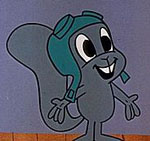
She voiced an extraordinary range of characters, from Rocky the Flying Squirrel and Natasha Fatale to Granny, Witch Hazel, and Lucifer the Cat. But while her performances were iconic, June understood something deeper about animation: voices serve the writing.
And the writing, she believed, was never meant to be simplistic.
A Conversation About What Cartoons Really Were
I was fortunate to know June Foray, and one conversation in particular has stayed with me.
We were talking about The Adventures of Rocky and Bullwinkle, and I mentioned that as an adult, I had gone back and watched segments like Fractured Fairy Tales. What struck me was realizing how many of the jokes clearly weren’t written for children at all.
June laughed.
She told me that Rocky and Bullwinkle was never meant to be children’s television. It was simply adults writing for adults—sharp, satirical humor delivered through animation. The idea that it was “for kids” came later, largely because of the medium rather than the intent. Even though the show was produced for Saturday morning children’s programming, it wasn’t
That moment reframed how I saw the entire era.
Super Chicken and the Writing You Don’t Catch as a Kid
As a child, I loved Super Chicken simply because it was a cartoon. The action kept moving, the characters felt strange and memorable, and the situations were endlessly unpredictable. At the time, that was enough. However, when I revisited the series as an adult, everything changed. I began to notice how carefully the jokes were constructed. More importantly, I finally understood who this classic cartoon writing was really written for.
One episode, in particular, captures exactly what June Foray once described about animation being far smarter than people assume. In this episode, a mad scientist creates a living toupee—a sentient hairpiece that escapes and launches a destructive rampage through Pittsburgh. As a result, buildings come under threat and chaos spreads quickly. The premise itself leans fully into surreal satire. Meanwhile, Super Chicken and Fred respond with wit and clever gadgetry. Still, the episode’s real impact comes from its finer details.
At one point, Super Chicken devises a plan to stop the toupee by worrying it until it loses its hair. The episode then delivers lines such as, “Congratulations, it’s twins. Signed, Kewpie,” followed shortly by, “Special delivery from the draft board—you have been classified 1A.” As a child, those jokes passed right by me. As an adult, however, they land immediately. These are unmistakably adult jokes, written with confidence and precision. They exemplify how classic cartoon writing trusted its audience to be smarter than expected.
That confidence is the point. Kids laugh at the chaos. Adults catch the subtext. In the end, animation was never the limitation. Instead, it served as the perfect disguise.
Animation as a Delivery System, Not a Target Audience
What June Foray understood—and what many of us only realize years later—is that animation in that era wasn’t defined by who it was for, but by how it was written.
These cartoons trusted their audience. They layered humor. They embraced irony, wordplay, cultural references, and satire. Children could enjoy the surface. Adults could appreciate the subtext.
Animation wasn’t the message.
It was the delivery system.
Why This Perspective Still Holds Up
Today, we talk about “adult animation” as if it’s a modern invention. But shows like Rocky and Bullwinkle and Super Chicken were already doing it decades ago—without branding, without disclaimers, and without apologizing for their intelligence.
June Foray wasn’t just voicing characters in that world. She was helping bring sophisticated writing to life, fully aware of what it was doing and who it was really speaking to.
That’s the legacy worth revisiting.
A Medium That Trusted Its Audience
June Foray passed away in 2017, but the writing she helped deliver still works—because it was never built on trends or assumptions about age.
If you’ve ever rewatched a cartoon from your childhood and suddenly realized, “Oh… this wasn’t meant for kids,” you’ve uncovered the same truth she was pointing to.
Some cartoons don’t age.
They reveal themselves.

June Foray in a recording session on November 29th 1965
• For more on June Foray, there’s a short biography by Charles Solomon on ASIFA-Hollywood’s website.
 David Derks is Vice President of ASIFA-Hollywood and President of the La Mirada Symphony. He works at Paramount Pictures, supporting animation, live-action, and unscripted productions across multiple brands. David also produces independent animation, digital live-action programming, and publishes String Theory Cartoons and industry commentary on



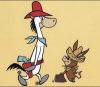
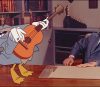


Super Chicken encountered a villain named The Zipper. Upon his escape from prison, various citizens screamed “The Zipper is loose!” and finally a guy says something about a loose zipper being dangerous. Then there was Appian Way, the Rhode Island millionaire who was one of the Ways of Providence.
My favorite line came when George of the Jungle and Ape returned to the treehouse and Ape realized Ursula had been kidnapped. He tries to explain to George that baddies have taken his Beloved Mate. George reflects. “You mean funny fellow who never shave?”
My dad heard “Friend to you and me” and thought the theme song was, “George, George, George of the Jungle / Went to U.S.C.” I, OTOH, heard a later lyric as “While Bella and Ursula stay in step.” Much later I realized it was “Fella and Ursula” because George was so dumb he thought Ursula was a boy. But they forgot to tell the theme song writers it was just one girl and so they both showed up in the credits (the ones in the end credits were wild!).
Another aspect is the celebrity voices that were impersonated. The male characters were often made to sound like personalties adults of the time would have recognized but not necessarily kids. Many of the male characters were imitations of W. C. Fields, Ed Wynn, Bert Lahr, Peter Lorre, Sidney Greenstreet, Humphrey Bogart, James Cagney, Edward G. Robinson, Ronald Coleman, or Jimmy Durante to name only a few. June Foray’s fairy godmothers often sounded a lot like Marjorie Main. She also channeled Tallulah Bankhead, Hedy Lamar, and others when voicing Natasha and the other “femme fatale” characters. These impersonations likely would have flown over the heads of children.
The Jay Ward cartoons had a look that easily appealed to young audiences. The writing was cleverly aimed so that children could follow along with the plots and characters but plenty of material was embedded for the adults who were watching. I believe this was part of the appeal to kids, knowing that the material was not “written down” to them but that a more sophisticated audience was intended, and I believe this helped to raise the “sophistication level” of my generation. It also explains why the kids who enjoyed the shows can rewatch them as adults and enjoy them in a different way.
A young friend once challenged me on the issue. He said, “I don’t know any other adults who watch cartoons!” I retorted, “I don’t know many adults who DON’T watch cartoons!” I guess the age-old question will continue to rage as to who cartoons are really for! How about–anyone who enjoys a good laugh?
Uhhh, by far, the most-imitated celebrity in Jay Ward’s and Hanna-Barbera’s cartoons was PHIL SILVERS, a great impersonation by Daws Butler. (In fact, there’s a character on SPONGEBOB SQUAREPANTS that sounds and looks exactly like the man who played Sergeant Bilko.)
Daws didn’t do every HB Bilko-based character. On The Flintstones, Jerry Mann voiced a talking Snorkasaurus and a Hollyrock producer who both channeled Phil Silvers.
My favorite use of the Silvers voice on R&B was the thinly veiled caricature of Walt Disney in a Fractured Fairytale.
Thank you for an interesting article and perspective. I’d much rather read pieces like this (and learn something) than lengthy blow by blow descriptions of old cartoon plots I know by heart.
During my first summer at music school, when I was fifteen, my roommate was an older guy, a Dartmouth man, who had brought a little collection of classic books with him. When I took an interest in them, he recommended that I start with Voltaire’s “Candide”, which, he said, as far as satire goes, was on a par with Rocky and Bullwinkle! Apparently the Jay Ward cartoons had quite an enthusiastic following at Dartmouth; my roommate said that Rocky and Bullwinkle was some of the cleverest, most sophisticated satire ever written in any medium. So I went ahead and read Voltaire that summer, and I developed a new respect for Rocky and his friends as a result.
Mark my words, the day will come when undergraduates complain about being forced to watch old episodes of “The Simpsons”.
Bluey operates the same way.
It’s a good point, but it can be overdose. I remember when the first Curious George feature length came out people praised it because there was finally an animated film that didn’t include references that were likely to be over kids’ heads.
Even in paw patrol there was an episode with rubble dreaming and the pups joked with him that he shouldn’t eat that cheese before nap time. I assumed it was a reference to Winsor McCay, which i doubt many of its audience would get.
Very interesting article, and I enjoyed reading it quite a bit.
When it comes to 1960’s cartoons that combined kiddie entertainment with adult-oriented, pointed satire, a mention should be made of the short-lived (one season) Roger Ramjet Show. Not a Jay Ward production, although it easily could be mistaken for one. Fred Crippen produced, and Gary Owens, who later went on to fame as the announcer on “Laugh-In,” played the gung-ho but constantly bumbling hero.
Not unlike Rocky & Bullwinkle, it went in for Cold War comedy, spoofing the American ultra-patriotism of the era. The flag-waving shtick was exaggerated to a ridiculous extent, as if it wasn’t being overdone in the real world already.
A number of episodes are available on YouTube, and they’re well worth checking out— besides, it’s your patriotic duty!
The dialogue is definitely the core appeal of Ward’s productions. I also appreciate the cartoony style of the George of The Jungle shows and all the Rocky and Bullwinkle animation that was produced in Hollywood.
This is why most “adult animation” gets a bad reputation these days: because the stigma of animation being a children’s medium is so ingrained, lots of people and networks still treat it as a subversive novelty. Taking what looks like a colorful and appealing kid show at first glance, and then having the characters say or do “edgy” things so the adult audience won’t feel ashamed for watching it.
Of course, there are plenty of smartly-written shows for both adult and general audiences, but it seems that there’s a “Family Guy” for every “BoJack Horseman.”
Too many boomers are both technologically and culturally ignorant, yet will fight to the death for their ignorant opinions. The sky is blue, fire is hot, deserts are dry, and animation is for kids. But animation actually was invented by weird adults, and used to entertain their adult friends. Such a simple fact to remember, but apparently early 20th Century is super esoteric territory.