



 With every one of these posts, I seem to say we’re living in a surreal world in many ways. Well, it’s true! Even as early as this year, did we think we’d have all kinds of restoration projects on the horizon (my own *cough* included)? That Terrytoons would see the light of day on MeTV Toons? The most science fiction-like fact of all is the subject of this post: Tom and Jerry: The Golden Era Anthology physically exists on Blu-ray, with all 114 of the shorts from the Hanna-Barbera MGM cartoon unit, restored and uncensored.
It’s remarkable the series has endured, given it never blazed trails in terms of content. “All you needed was a cat and mouse, and everybody knew what was going to happen,” Joe Barbera says in the accompanying booklet (but no contents list, which is being remedied as a free online print-out, the equivalent of getting a QR code at a bar). That may have been Barbera gloating in his typical fashion, because it’s no secret that despite the never-failing popularity, the lack of ideas is painfully obvious the later you get into the Tom & Jerry oeuvre. But, he and Bill Hanna really had something in the first decade of the series’ production.
For better or worst, it was the Hollywood cartoon at its purest. The prey/predator dynamic is mostly tossed (Tom almost rarely tries to actually eat Jerry) in favor of sibling rivalry, and it becomes more about how much annoyance the characters can cause each other. And the more violent that annoyance, the better and funnier. Combine that with Hanna’s timing, Barbera’s gags and unique poses, the best draftsmen-animators in the business, and the overbearing but beautiful Scott Bradley music, and you get cartoons that have endured for eighty-five years now. We had Tom & Jerry: The Complete Cinemascope Collection earlier this year, and we have all those cartoons here, too. But it was the earlier films we wanted most, restored and uncensored. And boy, did we get them!
 Their simplicity (along with the general lack of dialogue) has given Tom & Jerry more worldwide overexposure and popularity than any other theatrical cartoon series (it’s the only one whose characters still make actual money). So we’ve had the opportunity to buy these cartoons over and over and over on VHS, laserdisc, DVD, and Blu-ray. (Some of us, myself included, have them on 16mm and 35mm, too.) As a result, I’ve had no end of questions asking me about the new set. The main one is: is this really it for Tom & Jerry? Is this really the last time we have to buy them?
It’s a fair question, because past T&J collections have had serious issues, be it censorship or subpar mastering. This particular set was a collaboration between Warner Archive Collection and Warner Home Video, and neither have had the best track records with (when they exist) complete cartoon collections, where simply too much was unnecessarily messed up to be given a pass. Warner Archive Collection has been going in the right direction, proven by this year’s The Huckleberry Hound Show – The Complete Series, which is almost intimidatingly close to perfect in many ways.
Tom and Jerry: The Golden Era Anthology goes in that direction even more impressively since it was more or less put together in a few months, thanks to good sales on the Cinemascope disc and a change in direction at the company. “All 114 of the shorts […], restored and uncensored” at an astonishingly low price tag.. it’s of course a must-have!
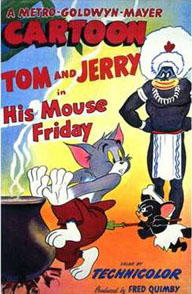 Indeed, the “cancellable” aspects of the series are fully embraced here. A long-in-development documentary titled The Lady of the House does an excellent job of contextualizing and celebrating Tom’s black owner voiced by actress Lillian Randolph (and all of those cartoons retain their original soundtracks on this set). The marketing team also made a point to answer that yes, Mouse Cleaning and Casanova Cat, the two shorts that have been prohibited from inclusion for some twenty years due to lengthy blackface gags, are included. They’ve also touted the inclusion of His Mouse Friday, a cartoon which is just a blackface gag but for some reason never reached the verboten status of the other two, given it’s all over official streaming and video-on-demand channels with no contextual warning. Never ask to make sense of this. It’s moot now anyway.
As far as the mastering/restoration, I can’t do a microscopic dissection of the history in this review, but to head off the fans’ questions: in almost all cases, these are the same exact high-definition copies you’ve seen on past collections, streaming, or MeTV. (And no, no original titles were reinstated.) Only a few transfers are brand-new. That’s mostly fine, as the picture and audio ranges from excellent to serviceable on most titles (the newly unleashed Mouse Cleaning in particular looks fantastic), so there is nothing unexpected besides some of the improvements recently made. There does appear to be some unnecessary noise reduction (read: smoothing out grain, not erasing the animation) applied to a number of the older transfers, like The Night Before Christmas, which was probably inadvisable, but it doesn’t render them unwatchable.
Readers should know that the original negatives for most of the pre-‘50s MGM cartoon library were lost in a fire decades ago, so they will never look as good as the Warner, Fleischer, and Famous cartoon restorations put out by Warner Archive. The best that can be done is sourcing them from grainier and dupier interpositive elements, and in many cases it’s daunting to figure out where the best source exactly is. Speaking from similar personal experience, I don’t envy the position WAC producer George Feltenstein and friends find themselves in with these beloved films.
 The most egregious issue with past copies, though, was that several were improperly mastered for the Tom & Jerry Golden Collection Vol. 1 in 2010 from subpar faded material (lovingly and erroneously dubbed “Metrocolor”, since these retained the black MGM lion logos from ‘60s Eastman color reissues). They were never flagged at any point in production (obviously George F. was not involved), so more than a few genuine classics (including two Oscar winners) have looked embarrassingly awful everywhere for the last fifteen years. Better source material being unavailable can’t be an excuse because all of these titles looked much better in previous collections and incarnations. Some of that has been fortunately fixed by utilizing superior sources: The Bowling Alley-Cat, Sufferin’ Cats, The Zoot Cat, The Million Dollar Cat, and Puttin’ on the Dog now look on par with the best transfers on the Tex Avery Screwball Classics discs. The rest of those “Metrocolor” cartoons, sadly, look as rotten as ever here, though technicians tried to “hide it” by getting rid of the ‘60s MGM lion, as if no one could tell the difference by what the actual cartoon looks like. (In Lonesome Mouse’s case, they forgot and left the ‘60s lion on!)
Dwelling on the few disappointments, though, misses that there has never been any kind of comprehensive home video collection where errors didn’t get through. Producers and fans need to resign themselves to the fact that even the most diligent job will have a few slip-ups when you’re talking about over a hundred short films, though the sting is worse when it’s on some of the best entries in the series. It’s not just about the severity of the errors, it’s really if, overall, the best job possible was clearly done.

The first laser disc boxed set in 1993
It’s also nice to see bonus features again on a Warner-produced cartoon collection. Porting over all the pre-existing audio commentaries is appreciated (though the embarrassing tracks pairing the late historian Earl Kress with actress Nicole Parker, part of some cynical cross-marketing scheme Warners was trying to do with its classic properties and MadTV at the time, would have been better off forgotten), and the talking head docs are harmless fun, mostly for seeing friends give their two cents and knowledge on an official product. It’s a great throwback to the days twenty years ago when we took the extras for granted.
Fearless leader Jerry Beck and George Feltenstein have intimated Tom & Jerry: The Golden Era Anthology represents a serious change in direction, and since they started off with, well, one of the main things we fans all wanted but thought we’d never see, it really does seem like anything can happen now.
 I’m breaking down the entire set in my usual review fashion, only this time each semi-weekly post will cover one disc (I’m foregoing the cartoons included on the Cinemascope Collection, as I did those already). All cartoons were, of course, directed by Bill Hanna and Joe Barbera. For history’s sake, I’m also including the cartoons’ in-house production numbers, so you can see the order they were actually started in.
Disc one is the first five years of the series, showcasing the evolution from what historian Mike Barrier called “Terrytoons in a Harman-Ising shell” origins to Hanna and Barbera never quite shaking them but still incorporating the inescapable influence of their frenemy Tex Avery. There’s a charm to the earliest in which Jerry has a “baby walk” (usually animated by Barbera’s Terry cohort George Gordon) and Tom is mostly still on all fours, but it starts to quickly run its course, and the Avery/Warner influence in the likes of Zoot Cat and Million Dollar Cat is a welcome change of pace.
PUSS GETS THE BOOT (Prod. #42)
The one that started it all, the Hanna-Barbera cartoon empire included. (Although a lot of people felt something was owed to Rudy Ising for making it happen, Ising himself included.) The cat’s called Jasper, and if he breaks one more thing, he’s going “o-w-t, out!” The mouse, unnamed, sees to it that that happens. The specificity of the acting and timing (and slapstick violence) made it stand out enough for an Oscar nomination, cementing the success of the Hanna-Barbera unit, which, after making a number of insufferable cat-and-mouse-less cartoons, would make almost nothing but cat-and-mouse cartoons for 17 years.

THE MIDNIGHT SNACK (Prod. #60)
The characters are officially christened Tom and Jerry (names suggested by animator Jack Carr). Jerry’s icebox raid is usurped by Tom, who attempts to pin it all on the mouse but ultimately takes all the blame. Jack Zander becomes the shorts’ “personality animator” with Tom’s lengthy buffet, and some unpleasant business happens with a fork and cheese grater. But my favorite bit is when Tom is called in to chase Jerry, and he gloats to the camera. It’s behavior that only someone who’s known cats could capture, and this sort of acting helped make the series so unique.

THE NIGHT BEFORE CHRISTMAS (Prod. #78)
Nostalgic-favorite with a chase around the Christmas tree that cements the series as “not your typical cat and mouse cartoon”, with some genuinely compelling staging and acting that convinces you that Tom might actually not want to kill Jerry. Later attempts at “heart” didn’t get it nearly as right. The sixth Tom & Jerry to go into production, but the third released, perhaps to make it in time for holiday season screenings. Oscar nominee.

FRAIDY CAT (Prod. #69)
Jerry preys upon Tom’s fear of the supernatural, which ends with an assault on “Mammy’s” backside.

DOG TROUBLE (Prod. #64)
The first time Tom and Jerry team up against a foe, this time Spike the bulldog in his first appearance. Early showcase for Bill Hanna’s turn-on-a-dime timing, and the beauty of a belabored set-up (Jerry rigging the house with yarn) paying off with instant destruction.

PUSS N’ TOOTS (Prod. #74)
Tom’s first failed romance, with his “gifting” of Jerry to his gal backfiring in a fabulous record-player display.

THE BOWLING ALLEY CAT (Prod. #79)
After hour antics at a bowling alley with the cat and mouse. This routine entry gets a reprieve with a stunningly nice new restoration that highlights some interesting lightning techniques.

FINE FEATHERED FRIEND (Prod. #81)
Tom pursues Jerry through the remnants of a Happy Harmony-style barnyard, where Tom and a mother hen receive quite a bit of abuse to their respective backsides.

SUFFERIN’ CATS (Prod. #85)
The introduction of Tom’s alley cat chum Meathead, who quarrels with Tom over eating Jerry in a particularly brutal fashion. As noted before, this one boasts a wholly new, colorful transfer.

THE LONESOME MOUSE (Prod. #89)
Jerry regrets getting Tom kicked out of the house, so the two stage the cat’s redemption. Unique for being the only cartoon with Tom and Jerry both talking (voiced by Bill Hanna and Harry Lang) throughout, and the only one where they treat “Mammy” with active contempt and violence. This awkward misfire’s reissue in 1950 generated a formal complaint from the NAACP (there’s also a gag where dice and a razor fall from her skirt), which probably went a long way in retiring the character (the last ones with her would have been in production at the time).

YANKEE DOODLE MOUSE (Prod. #91)
Tom and Jerry wage war in the basement in the series’ first Oscar-winner, a win owing more to wartime patriotism than anything else. This one has been missing a scene involving a wrench, Tom’s tongue, and ration stamps ever since it was cut for reissue in 1950.

BABY PUSS (Prod. #99)
Tom suffers humiliation dressed as a baby doll at the hands of a bratty girl, Jerry, and his alley cat chums (two of them, Butch and Topsy, in their first appearance). Maybe the most “queer” coded entry in the series, they certainly didn’t make one like this ever again.

THE ZOOT CAT (Prod. #104)
Tom gets hep with a makeshift zoot suit to woo his southern belle gal in this 1944-specific cartoon that’s endured as an immortal classic. The last time for any dialogue for the mouse (aside from Anchors Aweigh), but they would often have the cat talk if the gag called for it. Looking particularly ratty for years in the HD era, this one boasts a great new transfer here.

THE MILLION DOLLAR CAT (Prod. #109)
Tom will forfeit his inheritance if he harms Jerry in a story that was done a little funnier with Bugs and Elmer by Friz Freleng and Mike Maltese two years earlier, but this one has a particularly strong Scott Bradley score. Like Zoot Cat, this one, too, gets a reprieve with a great new transfer.

THE BODYGUARD (Prod. #114)
Jerry earns around-the-clock protection when he frees Spike from the dog catcher. Another where the music really carries the cartoon, and Irv Spence’s handling of Tom’s pasty gumball scheme is the highlight.

PUTTIN’ ON THE DOG (Prod. #117)
Underrated entry with Jerry seeking refuge in a dog pound, and Tom utilizing the cartoon logic that the dogs won’t recognize him so long as he wears a fake dog head at all times. The circumstances get crazier and stupider. Another 1944 cartoon sporting a new transfer.

MOUSE TROUBLE (Prod. #118)
Writer Cal Howard insisted he wrote this Oscar-winner uncredited when he worked for MGM, which I have no trouble believing. The use of the blackout gag format, centered on Tom’s using the book “How to Catch a Mouse” to destroy Jerry, and Tom’s bodily injuries carrying over to the next scenes (and the cat ultimately dying, which didn’t happen any other time besides Heavenly Puss), make this a wholly unique entry in the series—and one of its best, darkest, and funniest.

THE MOUSE COMES TO DINNER (Prod. #123)
Tom crashes his owners’ dinner party, inviting Toodles over and coercing Jerry to be their waiter, with the expected results. The funniest, unspoken aspect is that Toodles is still sitting there watching all of this carnage happen.

MOUSE IN MANHATTAN (Prod. #132)
The most lyrical cartoon in the series. Jerry seeks a better life in New York City, with Bradley utilizing “Manhattan Serenade” for nearly the entirety of the soundtrack. This always felt like a cartoon specifically made to win the Academy Award, but it wasn’t even nominated and the prize went to a more routine T&J.

TEE FOR TWO (Prod. #126)
The first cartoon that casts Tom as not a housecat but a regular “human” funny animal character, out playing the worst game of golf with Jerry as his shanghaied caddy. Noteworthy for the savage gag (animated by Ken Muse) of Tom getting a swarm of bees stinging his throat in a manner that’s both horrifying and hilarious.

FLIRTY BIRDY (Prod. #129)
This oddball entry has Tom donning the worst drag possible to reclaim Jerry from a horny eagle. It works too well, as the cat ends up married and hatching eggs. Another uncredited Cal Howard story?

QUIET, PLEASE! (Prod. #131)
Spike threatens to skin Tom alive if he makes any more noise trying to slaughter Jerry. What could possibly go wrong? Funny stuff, and an Oscar-winner, for some reason.

COMING SOON: I’ll be back to discuss Disc Two, when the series is at its peak.
 THAD KOMOROWSKI is a writer, journalist, film restorationist and author of the acclaimed (and recently revised) Sick Little Monkeys: The Unauthorized Ren & Stimpy Story. He blogs at










That’s great news that all of Hanna and Barbera’s Tom and Jerry cartoons are finally available in a single collection, and about time, too. But if I may change the subject, I want to let you know how much I’ve been enjoying the Aesop’s Fables Vol. 1 collection, which arrived in the post a little over a week ago. I’m now making my way through all the commentaries and am learning a lot about this period in animation history. This is a disc I know I’ll be watching over and over again. Congratulations, and I look forward to purchasing further releases from Cartoon Logic as they become available.
Thank you, Paul, I appreciate the kind words. Cartoon Logic has more to come in 2026!
I am always glad to read posts detailing the action in cartoons. There used to be Wikipedia pages for many of the Tom and Jerry cartoons with carefully detailed notes of all the violence that exist. Some of these are noted here, but without extensive detail, leaving the reader to wonder just what is being discussed. I’m sure many will be delighted to see the results in this collection. I’m a bit dismayed as to why “the night before Christmas” is an “inferior“ print quality, but OK, I can keep the previous Blu-ray “golden collection“. If I get rid of anything here, it’s probably going to be the spotlight collections since those are not the superior elements. I do still have my laser disk collection. That will not only be revered for what sad pointed out here, but also in the cinema scope era for the sound quality being superior on “blue cat blues“. I very much look forward to this collection.
Not all Metrocolor ones getting fixed and some having extra DNR is sure a bummer but BOY the new ones looks STUNNING!
(I’m 99% sure they won’t do it but I hope they’ll make a some kind of replacement program in the future like they did for the spotlight collection v1)
Wasn’t expecting this new multi-part approach, but hey the more he has to say about them, the better.
Did they clean up “Tee for Two” better this time?
Earlier this year, someone on Reddit asked the same question in every country’s subreddit: “Is Tom and Jerry popular in _?” Unfortunately, they were banned for violating Reddit’s rule about making the same post in multiple subreddits, so we can no longer see how many Yemeni or Peruvian fans of the cat and mouse there are. I do know that Japan probably has one of the largest fanbases for Tom and Jerry, as the characters are heavily merchandised there. For what it’s worth, Yasser Arafat was a giant Tom and Jerry fan, and video files of Tom and Jerry cartoons were publicly disclosed by the CIA as being on Osama Bin Laden’s harddrives.
I can attest that in the UK they remain hugely popular, even if they haven’t been on terrestrial TV for years. Back when programme lengths were less consistent and sports broadcasting less adept at filling time with interviews and commentary, the BBC would usually air a Tom and Jerry cartoon to fill space – though occasionally it would be a Harmon Ising Happy Harmony to the disappointment of everyone. The name Fred Quimby is ironically a lot more legendary here than Hanna-Barbera, to the extent where his name would be on the box of VHS tapes, basically as shorthand for “these are the good ones – not by Chuck Jones”.
The double standard with His Mouse Friday being widely available despite easily being the most offensive and racist Tom and Jerry cartoon never fails to be amusing. Also blacked up Jerry talks in that one, as he does in The Milky Waif, so unless you meant dialogue when he’s not in disguise, The Zoot Cat isn’t the last time he speaks. He also has inaudible dialogue in Saturday Evening Puss but that probably doesn’t count.
Baby Puss is a cartoon I hated as a young child but as an adult I find the incredibly sadistic way Tom is treated hilarious.
Maybe Mouse in Manhattan wasn’t nominated for an Academy Award (if it was submitted) because it is basically a remake of Disney’s earlier Oscar winner The Country Cousin. A favourite of my dad’s (not sure why as it’s not really a funny one, maybe he liked the music), who would always point out the continuity error where the girl’s hair changes colour.
Good catches – I wasn’t thinking of the “black” voices. Thanks!
Mouse in Manhattan IS a rip-off of The Country Cousin, but it’s unique since they made it an “MGM ballet” in the context of the series. Nothing to do with the carnage that’s usually on tap, just a haunting mood piece. It’s unlike any other T&J cartoon, and easily in my top three or four titles. I should also have mentioned in my review that they did improve the grading here, as it was very DARK in the old copy.
Just yesterday I was talking with a neighbour from India who had never heard of Garfield, but she loves Tom and Jerry!
I should also add that the U.K. boxes touting them as “The Fred Quimby Years” is not so much because of the badness of the Chuck Jones ones, but more because “Hanna-Barbera” is associated with a quarter-century of dreck there, not uncritical nostalgia as it is in the U.S.
I kind of find it hard to believe considering that Scooby-Doo is popular there.
I don’t think its unfair to say that Hanna Barbera’s TV shows are largely considered as “stuff you watched because nothing else was on” in the UK. From personal experience, the only two that people, both my age and older, have any fondness for is Top Cat. Scooby Doo is popular, but really only among young children. There was also a widely held view that American children TV shows were crass and distasteful compared to shows made in Britain for British children in mind. The BBC were generally reluctant to promote US imports over their own programmes, airing them at graveyard slots.
Even “Sesame Street”, considering the Muppets eventually made a big mark in the UK?
Funnily enough, Sesame Street was the main example I was thinking of the somewhat snobbish attitude towards American children’s TV from British broadcasters. Throughout 1970-71 there was a lot of public debate over whether it should be shown in the UK. There was even a report which compiled the assessment of educators as well as the reactions of parents and children. Eventually it was shown in a limited capacity on regional commercial TV stations (now ITV) but never on the BBC, and then on the newly created commercial station Channel 4 throughout the 80s and 90s (when I would have watched it).
The Muppet Show was different, as it was an American-British co-production that was filmed in England and employed British staff. Plus it aired in prime time and was not exclusively aimed at children.
Anyway this is way off topic. I like the bits in Tom and Jerry when the cat gets hurt.
Harvey Eisenberg’s work as a layout artist in this era is also worth noting, before he became the lead T&J comic book artist—a real match made in heaven there.
I’d also like to think that Cal Howard was involved with the writing in some capacity, from SUFFERIN’ CATS to the end of the disc. Too bad I’ve no real way of proving that!
I’m kinda curious about HB’s Tom and Jerry’s story writers. Since there were no story credit in them (not even the one-shots directed by HB) until the last entry, “Tot Watchers” (credited to Homer Brightman), it’s quite hard to know who had written them. Many sources that Bill and Joe both directed and written all of their cartoons, but even without Cal Howard’s case, I don’t think that they would write all of the cartoons themselves. There could be someone else and I’m curious, who were they?
I know I’m late with this and don’t expect much of a response afterward. However, the “writers” behind the Tom & Jerry series remain a mystery, so many of the possibilities are mere presumptions and speculation. Frankly, these should be taken with a grain of salt. Despite that, some names appear in news articles about the MGM cartoon department.
One example I can recall is Jerry Mann, who not only did occasional voice acting for a couple of MGM cartoons around 1944, but was said to have freelanced as a gag writer. I wonder if he was the one responsible for the gags in shorts like The Zoot Cat and The Million Dollar Cat?
There’s also Roy Williams, who had briefly left Disney to join the MGM cartoon studio as a storyman. However, his only credits appear to be two Tex Avery cartoons (Car of Tomorrow and One Cab’s Family). Despite the two production numbers being close, it’s a bit strange how little he had for MGM. Which isn’t too hard to believe, knowing Ben Hardaway and Cal Howard’s brief returns to the WB cartoon studio. However, Homer Brightman has been shown to have worked on both units during his time at MGM, so it’s possible Roy did a few Tom & Jerry cartoons released around the early 1950s.
Speaking of Homer Brightman, he also gets two story credits for the two Spike & Tyke cartoons, so there’s a possibility he did more T&J cartoons during that late period. I am aware of his work for Walter Lantz’s studio. However, according to another news article, he didn’t get his exclusivity contract (July 18, 1956) for Lantz til shortly after Tot Watcher’s likely start of production.
There was also a story writer named Julian Harmon, who was said to have been drafted into the army during World War II around September 1942. However, there’s no evidence suggesting which units he worked on. Pinto Colvig was also said to have worked as a gag writer twice during his time at MGM, but again, there’s no evidence suggesting which units he worked on, let alone for Hanna-Barbera.
Supposedly, Chuck Couch recreated storyboards of Jerry’s Cousin in 1987, and has apparently worked at MGM for a very brief time. Keep in mind, though, those are recreations, and his known status at MGM was sometime around the early 40s, while Jerry’s Cousin was produced when Couch would’ve likely been absent.
Lastly, an interview with Gus Arriola, led by John Province, mentions him being promoted to story artist, during which he worked sporadically with Hugh Harman, Hanna-Barbera, and Rudolf Ising. For Hanna-Barbera, he mentions working on the first two entries, though he also notes that Joe Barbera would do much of the story sketching.
Most of these I mainly got from the Tralfaz blog led by Don M Yowp’s MGM Odds and Ends, which sources out where these articles say. But again, take much of what’s been said with a grain of salt.
The only thing that would have made this set better (aside from the aforementioned Metrocolor prints utilized) is if they included restored transfers of the early H-B one shots as was done in the second laserdisc volume (e.g. Gallopin Gals, Officer Pooch).
Otherwise great to see that this was accomplished.
Thanks for the review Thad. I can take solace in the fact that while some of these shorts have DNR, it’s not to the point where the animation (lines) are erased.
That said, I still think we should get in contact with Warner to correct (some) of these problems. Maybe the Metrocolor prints on some of the shorts were used by mistake.
Looking forward to watching this set. Been enjoying the Aesop Fables v. 1 Blu-ray from Cartoon Logic!
I’m wondering if the issue with the opening titles from Puss Gets the Boot has been fixed? Probably not, since that doesn’t seem to have been confirmed, either.
It wasn’t.
What issues is he talking about?
The ‘60s “recreated” title sequence that jump cuts to Rudolph Ising’s credit.
Good to know that we’re getting basically the same non-Technicolor master that we’ve seen on Spotlight Volume 2 and Golden Volume 1. Oh, well…
Excellent post Thad but the best of the best from your -uncredited backer- was Paul H. Terry’s AESOP’’S FABLES blu ray!!!
In hoping to see a Volume 2 soon, Best regards; Martin
Good Grief. You do realize who owns this blog right?
It’s okay Nic. I believe in freedom of speech. Mr. Freesnake is entitled to his opinion.
Great review, Thad. The long awaited release of “Mouse Cleaning” alone is worth the price of admission on this set.
Interesting that you mentioned that “Mouse In Manhattan” seemed designed for an Oscar. The Hollywood Reporter published a fascinating tidbit on 1/2/46 that both it and “Swing Shift Cinderella” were screened internally at the studio as considerations for submission to the Academy (thank you to the Tralfaz blog for making this info easily accessible). Makes me wonder- did MGM end up submitting two T&Js that year for consideration? It’s possible, but I have a feeling they just went ahead and submitted “Quiet Please!” because it was a safer bet and sure-fire laugh getter. Oh well. It’s more likely they submitted “Cinderella” alongside “Quiet”- if they did, the Avery cartoon should have been nominated and won.
Anyway, here are my top five T&Js from this time period in chronological order!
“The Yankee Doodle Mouse”
This was a watershed film in the series IMO. Hanna-Barbera finally nailed the new Avery set fast-paced tone to the letter, and it resulted in one of the most iconic entries. One of the “purest” ones if you ask me, and a well-deserved Oscar winner.
“The Zoot Cat”
Not much to say about this one that hasn’t already been said- it’s a classic.
“Mouse Trouble”
Probably the most deserving T&J Oscar winner, possibly even more than “Cat Concerto”. Funny, funny, funny stuff.
“Mouse In Manhattan”
Man, this one always stood out as a demonstration that Hanna-Barbera were not one trick ponies. The music, the animation, the layouts- it’s all there. Jerry at his most charming. This short always gives me a complex mix of emotions every time I see it- wonder, melancholy, longing, hope. We’re right there with the little guy in his big adventure. Tonally, I think “Manhattan” was WAY ahead of its time.
“Tee for Two”
On the flip-side, this is just one of the funniest entries from this period. The golf course makes for a nice change of pace and the opportunity to explore new gag territory with a different set of props. I’m also partial to this one because it was a favorite of Cartoon Network back in the day when I was growing up. To me it was right around 1945 when T&J hit their four or five year apex in full force.
Looking forward to the next review!
Those are my favorites from this period, too, though I’d swap out Yankee for The Night Before Christmas. It’s the sole “heartfelt” cartoon of the series that genuinely works.
Wonderful review, Thad! It’s pretty cool and admirable that Warners finally gave the shorts “Mouse Cleaning” and “Casanova Cat” the home video release that they deserve in a very long time. Uncut and beautifully restored!
Maybe it’s too much to ask, but I would’ve loved if they included some early non-T&J shorts that Bill and Joe did, like “Officer Pooch”, “Gallopin’ Gals”, “Swing Social”, etc. Oh well, this collection looks great regardless!
Hey Thad, quick question: what ever happened to your Cartoon Logic podcast?
It’s dead.
Sad to hear that since I usually listen to it sometimes, but I enjoyed the podcast. It was good while it lasted.
I’ve listened to my share of episodes of the Extras podcast, and George is not deliberately omitting the negative aspects of WAC releases. I also believe in freedom of speech, but Free Snake’s post is beyond the pale! There are times when it’s better to be grateful, and a bit less critical
Amen to that. Besides, I expected some flaws. Rarely can anything be 100% perfect.
Tom’s toupee never fails to reduce me to tears of laughter.
Same here. It’s completely unlike any other gag in T&J because no one’s expecting it and it’s so stupid.
Is there a list identifying the 60 episodes that received additional color and cleanup work, along with the 11 that were remastered from film?
Could you please explain where the “free online print-out” is? I don’t see information about this anywhere. Am I missing something?
Thanks for the interesting article. I heard about this site through Jerry’s appearances on various podcast episodes, it’s really cool stuff! Cheers.