



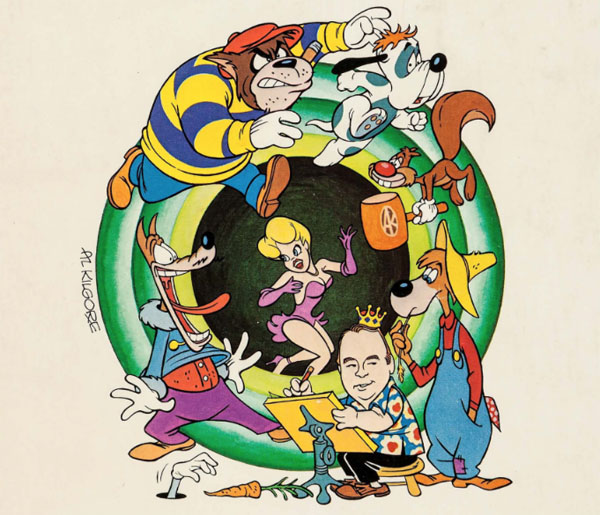
Caricature of Tex by Al Kilgore for the cover of Joe Adamson’s 1975 book, “Tex Avery: King of Cartoons”
After working on commercial advertising and briefly running his own animation studio, Avery retired in 1978. He was tired, in poor health, and haunted by both a divorce and the suicide of his son. By then, the days of animated theatrical shorts were long over, replaced by limited animation TV fare.
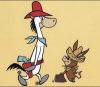
However, in 1979, Avery was given an offer by his former MGM stablemates, William Hanna and Joe Barbera. Recalling Avery’s heyday at that studio, they hired Avery to helm a new series of his own creation for the Hanna-Barbera studio with CBS as the broadcaster. Knowledgeable animation fans reacted with excitement, hoping that Avery could rekindle his former brilliance. Avery developed a character named “Quicky Koala”, and hopes ran high.

Tex Avery circa 1974
Tex Avery belonged to a time when the theatrical cartoon still flourished, and the content and sensibilities of those classic, revered shorts were vastly different. Chuck Jones once reminisced that “We made these cartoons for ourselves.” Not so in 1979.
Avery died while Quicky Koala was still in production. He created a cartoon about a Koala, voiced by writer Bob Ogle, who could avoid danger by what appeared to be teleportation; smear animation was never utilized (possibly due to expense). Danger came in the form of Wilford Wolf, voiced by John Stephenson, who seemed to want to capture Ouicky as either a collectible or to keep as a pet. Many of the 16 episodes produced had a very Chuck Jones-style flavor to them. Wilford used various ruses, traps, and machines the Wile E. Coyote might have employed. All of them were futile, since Quicky could instantly disappear and appear again at will.
 Both characters were retreads. Bob Ogle used a voice that was very similar to that of Bill Thompson, the original voice of Droopy in the theatrical shorts. Wilford Wolf strongly resembled Mildew Wolf, a character who appeared in a segment of H-B’s Cattanooga Cats (1969-1971). For Wilford, John Stephenson approximated the voice of Paul Lynde, who had played Mildew.
When Quicky Koala premiered on September 12, 1981, Avery was already gone. Hanna and Barbera changed the name of his creation to Kwicky Koala, and the show was henceforth known by that name. Avery was developing a character called Cavemouse (based on Hanna and Barbera’s beloved Jerry Mouse) for The Flintstone Comedy Show when he collapsed in the studio parking lot, ravaged by lung cancer.
Kwicky Koala followed soon afterwards. Kwicky was cancelled on December 26, 1981, after 16 episodes. Although Tex Avery’s legend lives on in the memories of hardcore animation buffs, Kwicky Koala, as one of Avery’s final works, is a footnote in Saturday Morning history.
 Martin Goodman is a veteran writer specializing in stories about animation. He has written for AWN and Animation Scoop – and lives in Anderson, Indiana.




“The belief of Americans that [koalas] are lovely, cuddly little bears is fairly well exploded when they get here and pick one of the rotten little things up. They find it’s flea-ridden, it piddles on you, it stinks and it scratches.” — Australian Tourism Minister John Brown, 1983
Minister Brown’s comments — which were very controversial at the time and are still well-remembered over forty years later — suggest that Wilford Wolf should have counted his blessings. It seems that Tex Avery’s attempt to make an elusive, lightning-fast hero out of a notoriously lazy animal that sleeps twenty hours a day was misguided at best. Perhaps he’d have been better off taking inspiration from nature. My wife used to live in a city with a large resident koala population, and she says that they had a disconcerting habit of falling into people’s swimming pools. She also says they’re very noisy during the mating season. Now that’s the sort of thing that Tex could have really sunk his teeth into.
Mark Evanier shared an office with Avery at Hanna-Barbera during this period. He has written that Avery was tremendously popular with the staffers, who would flock to his office to ask his advice, listen to his anecdotes, and generally bask in the glow of an animation legend. After all the disappointments, setbacks and heartbreaking tragedies he had suffered in life, this was probably what he needed most in his final years. So whatever the flaws of the Kwicky Koala Show, it was all worth it.
I’ve heard it said that TEX Avery also did not want to work on continuing characters; that is why he tried to “kill off“ Bugs Bunny early on. Now we are all glad that the rabbit continued under different directors, and there were flourishes of brilliance under each of those directors, including TEX himself. However, some of the brilliance at any cartoon studio, you could name came from one shot characters, memorable, though they are. It was also said that Fred Avery disliked a character that we all consider one of his high points, screwy, squirrel! Wow, we can all understand why Avery finally had to end his career, that is the character’s career, we enjoyed how far the sadism could go under that character. Toward the end of his career, Avery felt he had “done it all”, created every strange comedy bit that could be ever written for a cartoon, and I don’t know that that is true, but he has been the inspiration for so many cartoonists in later years. He will always be remembered, and his body of work from Warner Brothers to MGM to Walter Lance will always be an inspiration, or hopefully a textbook idea of what animated cartoon comedy should always be. It wasn’t the only thing animation could do, but it certainly was a large part!
I was wondering why Tex Avery didn’t have any Creative Control over Kwicky Koala as he did when he was Creative Director at MGM
Because not even Bill and Joe had creative control over their own shows. They had to kowtow to the networks and their dreaded S&P departments. Not even the mild slapstick that Huckleberry Hound or Fred Flintstone went through in the 1960s would have been acceptable in the ’70s or early ’80s
Hell, even Scooby-Doo had Velma kicking The Creeper in the knees in 1970. Unthinkable just a couple years later. I do think there has been a lack of accountability of who specifically was running these departments and why they were allowed to castrate an entire generation of cartoons while enforcing a conformist ideology. The advent of cable cartoons just made the entire issue a mute point
Which is the reason why Jay Ward focus pretty much on commercials by that point on (with an occasional pilot that the networks rejected anyway).
Life doesn’t move in a straight line and it would be tremendously boring if it did.
Cavemouse actually preceded Kwikky by a season. He was a segment of NBC’s Saturday AM FLINTSTONE COMEDY SHOW anthology, in which he thwarted Dino’s attempts to catch him. Avery touches were quite evident, even in limited H-B animation of 1980. DIno often pulled a huge take (by those standards) when discovering his foolproof trap to get ride of the mouse didn’t work. Avery was also credited with the “dance sequences” of the very bizarre1979 NBC prime-time Casper special in which the ghost interacted with classic H-B characters. This is about as far from anything one would associate with a comedic directorial genius.
Joe Adamson’s 1975 book “Tex Avery: King of Cartoons” is the first I ever read about classic animation and I’ve re-read it countless times over the decades. Kwicky Koala was a sad coda to Tex Avery’s mostly brilliant career.
Honestly, it was better than the situation with Droopy at Filmation. Glad, Tex didn’t get to see those cartoons.
There was still occasional comic violence in the Kwikky franchise- especially in the title sequence. Wilford got blown up at least twice. And the Bungle Brothers’ acts always ended in slapstick calamity, usually at the expense of the smaller, smarter one.
I helped to develop Dirty Dawg and boarded gags and did layouts for THE KWICKY KOALA SHOW – and I need to let Jerry’s audience know there is misinformation in this piece about Tex. He only wrote and directed the first CAVEMOUSE AND DINO and the first THE KWICKY KOALA. They’re the only ones that are noteworthy.
When all is said and done, it’s possible for fandom to come up with new, fresh and fascinating angles for obscure and esoteric characters … such as Crazy Claws per The Kwicky Koala Show reimagined (at least on my end) as residing now in Wisconsin Dells and finding plenty of comedic fodder therein. As well as doing a podcast over the summer months taking stock of things.
Has anybody else reimagined the treatment of the Kwicky Koala ensemble?
Avery’s first job at Hanna Barbera was injecting gags into storyboards of Hanna Barbera’s The Thing of all things. He also came up with a pitch called Wind Up Wolf that was later turned into a What a Cartoon short in 1995. His last credit is as a writer for the 1982 Hanna Barbera series Jokebook.
According to Scott Shaw, Kwicky and The Bungle Brothers were both designed and created by Tex Avery. He had little, if anything to do with the Crazy Claws and Dippy Dawg segments and both were created by Hanna Barbera’s staff.
The Kwicky short that Tex Avery directed that Scott Shaw refers to for the record is “In a Pig’s Eye” (originally rejected by CBS before finally airing, albeit with the live-action explosives scene cut out). Dunno what the Dino and Cavemouse short is. Avery also cowrote the Kwicky Koala short Around the World in 80 Seconds.
Tex Avery passed away from gastroesophageal junction adenocarcinoma. He was not ravaged by lung cancer. Please stop dramatizing his death.
If anything, Kwikie’s voice, in my opinion, sounds more like an odd mix of Droopy and Winnie the Pooh.
I thought he sounded more like Disney’s Ranger Woodlore than like Droopy – but since both of those voices were Bill Thompson I guess it’s a moot point!
I stilkl love KWIKY KOALA
KWICKY had a “Bob Ogle as his real name Robert Allen Ogle doing yet another Bill Thompson as his Wallace Wimple” charaacter that Bob himself did for DFE as Mist erjaws’s sometime prey Harry Halibut, and even Mr.Maagoo’s dog McBarker
And,as we, of course know, John Stepehnson did a shout out to Paul Lynde (who’d pass a short time after this) as would be predator Wilford Wolf(named after live actor Wilford Brmiley,perhaps,who appeared some years later in ther 1980s in OUR HOUSE,one of Shannen Doherty’s first shows..)
CRAZY CLAWS had a near Groucho Marx voice (Jim MacGeorge) with a Yosemtie Sam like hunter named Rawhyde Clyde and his dog Bristel tooth,very familiar..
BUNGLE BROTHERS were a OF MICE AND MEN like team of dogs in bumpers, with the Lennie type also like Crazy Guggenheim (think at HB Huck Hound’s prey LeRoy or At WB Bugs Bunny’s and his nephew?’s would be predator Pete Puma).
Finally DIRTY DAWG had a Howard Cosell smooth talker with rat Ratso (was Ratso’s voice Marshall Efron any relation to thwe much younger Zac:? Marshall name turned up a lot in 0s cartoons..