



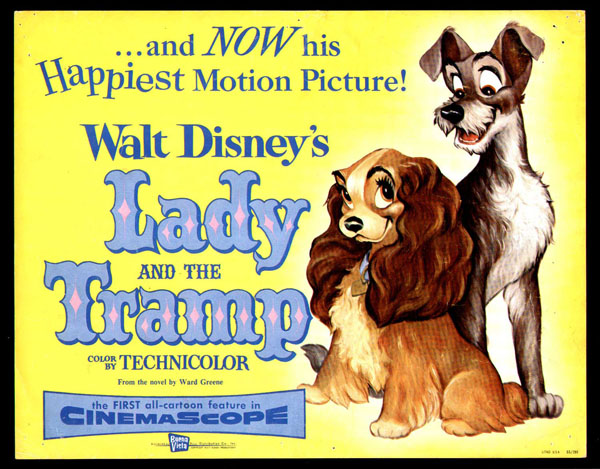
“In the whole history of the world, there is one thing that money can not buy …to wit – the wag of a dog’s tail.”
This quote from humorist and lecturer Josh Billings, which appears at the start of Walt Disney’s Lady and the Tramp, perfectly captures the charm, heart, and emotion that follow and also explains why the film is now considered a classic.
 Celebrating its 70th anniversary this month, Disney’s animated feature was produced at a very busy time for Walt and his Studio. Animation, live-action films and television production had become a big part of Disney’s world, and a new venture – Disneyland – was less than one month away from its grand opening.
Despite all these different forms of entertainment pulling the Studio in multiple directions, with Lady and the Tramp, Walt, and his artists crafted a film filled with care and sentiment that has connected with audiences since its debut.
Production on Lady and the Tramp can be traced back to 1939 when story artist Joe Grant created sketches of his springer spaniel, Lady Nell, interacting with their baby daughter Carol. They caught Walt’s eye, and he asked Grant to craft a story around the artwork.
In 1945, Walt came across the story “Happy Dan, the Cynical Dog” by Ward Greene in Cosmopolitan magazine. He liked the idea of combining Grant’s work with this for the possibilities of a romantic story. Walt also wanted the concept for their movie to come from a book, which led to 1955’s Lady and the Tramp – The Story of Two Dogs, which included a foreword by Walt and illustrations by Joe Rinaldi, taken from storyboards for the film, which was currently in production.
Unfortunately, Grant, who had left the company in 1949 (returning in 1989), never received the credit he deserved on the film.

Lady and the Tramp, taking place at the turn of the last century, centers on Lady, a lovely cocker spaniel presented as a Christmas present (in a hat box) from husband Jim Dear to his wife Darling, in the opening scenes of the film. The sequence is inspired by a moment in Walt’s life when he gave his wife, Lillian, a Chow puppy in a hat box.
 The film then follows Lady from puppy to adult, living a comfortable life with her owners and her neighborhood canine companions, Jock, the Scottie, and Trusty, the bloodhound. Her world changes when Jim Dear and Darling welcome a baby, and then when she meets Tramp, a stray mutt, who shows Lady what life can be like off a leash.
From here, a romance starts on a lovely “Bella Notte” evening, and there are adventures in which Lady finds herself in the pound. Jim Dear and Darling’s fussy Aunt Sarah comes to visit, and Tramp saves the baby from a rat who makes its way into the house.
Lady and the Tramp proved to be a true showcase for Walt’s legendary animators, the Nine Old Men. Notably, Frank Thomas’ animation of Tramp during the iconic spaghetti scene showcases the character’s personality as he falls in love with Lady.
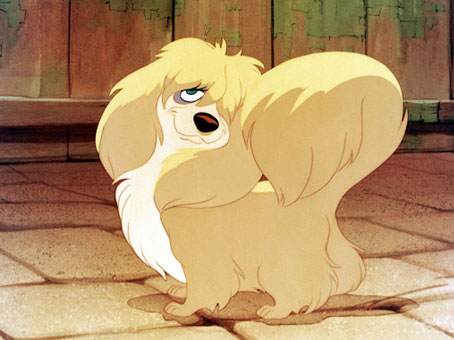 There’s also Eric Larson’s tour-de-force animation of Peg, the show dog who struts her way through the number “He’s a Tramp” in the pound while backed up by the other stray dogs.
The character and the song are among a number of songs in the film that were contributed by singer Peggy Lee, who wrote them with Sonny Burke. They include “Bella Notte,” “He’s a Tramp,” and “The Siamese Cast Song.”
Not only did the talented Lee help compose the songs, but she also voiced several of the characters, including Darling, Peg, and Aunt Sarah’s pet cats, Si and Am. In a well-publicized lawsuit, Lee sued the Disney Company in 1988, following the release of Lady and the Tramp on home video. Lee stated that she retained the rights to transcriptions of the music and that videotape editions were transcriptions. She won the case in 1991 and was awarded $2.3 million.
In addition to Lee, other voices in the film included Barbara Luddy as Lady, Larry Roberts as the Tramp, Bill Baucom as Trusty, Bill Thompson as Jock, Verna Felton as Aunt Sarah, Stan Freberg as a Beaver that Lady and the Tramp meet at the zoo, and The Mellomen as the dogs Lady meets at the pound. Also, listen for stalwart voice actor Dallas McKennon as several characters in the film.
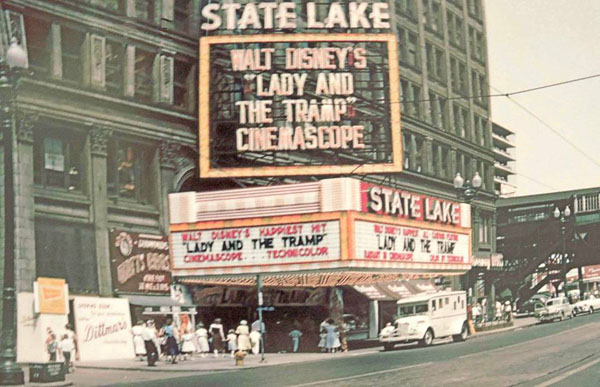 Another aspect that sets Lady and the Tramp apart from previous Disney animated features is that it was filmed in Cinemascope. This proved a challenge for the artists, who had to rethink the layout and staging in the then-new widescreen process.
Released on June 22, 1955, Lady and the Tramp connected with audiences and critics. Edward Schallert in The Los Angeles Times called the film “…delightful, haunting, charmed fantasy that is remarkably enriched with music and, incidentally, with rare conversations among the canine characters.”
In the years since its release, the feature has only grown in its appreciation. When Lady and the Tramp was reissued to theaters for the holiday season of 1986, critic Gene Siskel, reviewing the film on the show, Siskel & Ebert & The Movies said that he loved the film when he was younger and confessed that he had a cocker spaniel when he was a child. “That was my first dog. I thought she was like Lady,” said Siskel, adding, “Missy was her name. God bless her soul wherever she may be this holiday season.”
This is evidence of the close connection so many have with Lady and the Tramp, still seventy years since its release – a story of romance, family, acceptance, and, yes, the joy and unconditional love signified by “the wag of a dog’s tail.”
 Michael Lyons is a freelance writer, specializing in film, television, and pop culture. He is the author of the book, Drawn to Greatness: Disney’s Animation Renaissance, which chronicles the amazing growth at the Disney animation studio in the 1990s. In addition to Animation Scoop and Cartoon Research, he has contributed to Remind Magazine, Cinefantastique, Animation World Network and Disney Magazine. He also writes a blog, Screen Saver: A Retro Review of TV Shows and Movies of Yesteryear and his interviews with a number of animation legends have been featured in several volumes of the books, Walt’s People. You can visit Michael’s web site Words From Lyons at:




I love this movie. “Lady and the Tramp” is Disney’s first real love story, and the only one made during Walt’s lifetime; the princes in “Snow White”, “Cinderella”, and “Sleeping Beauty” are minor characters, more means of deliverance than objects of affection. It’s also uniquely without magical elements, beyond the fantasy of taking us into a world as seen from a dog’s perspective. Lady and Tramp remind me of Claudette Colbert and Clark Gable in “It Happened One Night”, another classic romance that shows what ensues when opposites attract. I loved “Lady and the Tramp” when I was a little boy; I took my first girlfriend to see it when we were teenagers; and I occasionally watch it at home with my wife today. It’s the perfect date movie for dog lovers.
Now, about those Siamese cats. As distasteful as I find Yellow Peril stereotypes, I recognise that their inclusion here stems from Disney’s decision to treat the various breeds of animal as analogues to human ethnic groups. While their portrayal is not nearly as mean-spirited as that of the cats, nearly all of the canine characters in the film are also ethnic stereotypes, as well as the thrifty, industrious Yankee beaver and many of the human beings (“Whatsa matta fo’ you, Joe? I breaka you face!”). Yet I find that the ethnic dialect in the dialogue suits the early 20th century setting, when American cities had large immigrant populations; and it also plays to the strengths of the (mostly) radio actors who made up the voice cast. (I always get a laugh out of Alan Reed’s Russian wolfhound.) Of course the cats could have been handled differently. For example, under the premise that pets come to resemble their owners, they could have been shown as feline versions of Aunt Sarah, a couple of bossy old biddies who complain about the accommodations and abuse the hotel staff whenever they travel together. The scene would have played out in exactly the same way. But the film is what it is, cats and all; and while I cringe a bit whenever I see those four squinty eyes peering out from under the lid of the basket, I wouldn’t change a thing about it. Its virtues far outweigh any flaws.
The late Jim Korkis has written elsewhere on this site about the model of Lady’s house that Claude Coats painstakingly constructed as a visual reference for the background artists. With it, they were able to work out every angle and perspective from the dogs’ point of view. This kind of attention to detail, in every facet of production, is what is needed to create a masterpiece like “Lady and the Tramp”. My wife loves that house. She want to move into it, but I’m afraid we never shall. Anyway, it would cost a fortune to heat in winter.
Thanks for making this a “bella notte”! Ciao!
I disagree. The cats were always the funniest part of the movie, to me, and the way they sucked up to Lady.
Back then I was a kid and probably didn’t know any better –but I LOVE those cats! Political incorrectness and all!
Thank God I am not American or part of the “international community” (I’m Brazilian) and therefore am completely devoid of these anxieties about race and history that Americans have; so I was and still am able to have fun not only with these Siamese cats but with several other caricatures, animated or not, without feeling the guilt or concern that I see in my friends from the First World. One of the few perks of being on a developing nation, I would say.
On the Disneyland TV show in its first season, the program “A Cavalcade of Songs” devoted a large portion of its run time to “Lady and the Tramp.” Though the show was broadcast originally in black and white it was very presciently filmed in color so that it could be rerun over the decades. It ran again in the early 70s when the film was in re-release. In the show, Peggy Lee demonstrates her recording technique for the cat voices in “The Siamese Cat Song.” There is also a delightful bit where she sings “He’s a Tramp” and the film intercuts between the live action Peggy and the cartoon dog Peg.
Though I never met Miss Lee in person, I was friends with a couple who knew her well. I happened to be present when the call came from Miss Lee that she had won her lawsuit. They told me she was quite jubilant. Though I had never met her and she did not know me at all, I gave her my best wishes. I don’t know if they passed it on to her, but that was the closest I came to an actual encounter.
It should also be noted that on a special Thanksgiving presentation of the Julie Andrews Hour, Julie very memorably sang “He’s a Tramp” to Goofy.
When LatT was re-released on VHS in 1998, I was in a crowded video retail store where the film was playing on TV monitors. Shortly after Peg’s number began, one of the clerks loudly piped up, “There’s that Disney sex!” to the guffaws of the clientele and staff.
I appreciate that Aunt Sarah wasn’t broadly portrayed as a canine-hating villain, as it would have been all too easy to do. Her character is redeemed towards the end when its revealed she sent a tin of dog biscuits for Christmas. She may have been gruff and easily manipulated, but I think she was just doing what she felt was right in regards to the baby’s safety.
Finally, the character that seemed to have the most impact with audiences is the one that had the least amount of screen time—L & T’s lone male pup, Scamp had a looong career in print media, starring in a comic book series that lasted almost sixty issues, and a newspaper comic strip that ran close to three decades. Not bad for someone that appears only in the movie’s final couple of minutes!
When I first saw L&TT, I wasn’t a big fan–but after I decided to watch it again I realized just what a classic it is, by far my favorite of the Silver Age. The characters are perfect, and the animation is not as literal as it is in the other 50s films.
Try to get away with the Siamese cats today!
My favorite Disney feature. The way they handle Trusty’s “demise” is masterful; the music and dialogue stop, and Jock’s mournful howl says it all. It always gets to me, even though (spoiler alert) I KNOW who is going to come limping up the stairs only 30 seconds later!
I recall reading that originally Trusty was going to be killed off, but when Walt went over the film during the production with Peggy Lee, she asked Walt not to have the dog killed.
I’ve heard that too; it would have to have been pretty early in production, since Trusty provides the last gag and the very last line in the film!