



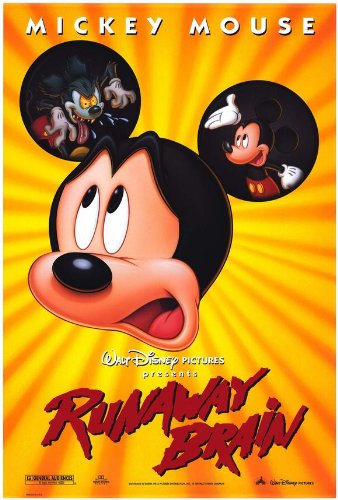
 Of all the movie references in a Mickey Mouse cartoon, The Exorcist is probably the most unexpected. And, yet, in 1995’s Runaway Brain, there it is – a scene in the cartoon that replicates an iconic moment from that horror movie masterpiece.
Completely unexpected, yes, and also one of many similar moments in the dark, daring, and hysterical Runaway Brain, which celebrates its 30th anniversary this month.
The short, an homage to classic horror films, finds Mickey Mouse (voiced by Wayne Allwine) short of cash as he looks for a way to take Minnie (Russi Taylor) on a Hawaiian vacation. He finds a way to earn the $999.99 needed when he answers an ad in the newspaper for “mindless work.”
Once there, at “1313 Lobotomy Lane,” he meets a mad scientist (Kelsey Grammer), who, in a classic horror movie trope, has a plan to swap Mickey’s brain with that of the monster Julius (Frank Welker), a large, hulking beast who looks a lot like Pete.
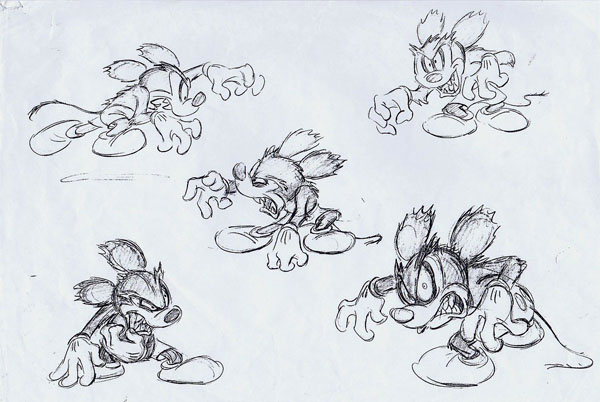
What follows in Runaway Brain is a fast-paced, dizzying ride as the brains are swapped. Julius, with Mickey’s mild-mannered persona, tries to save Minnie from Mickey, who has Julius’ brain, and has been transformed into a version of the iconic Mouse like we’ve never seen him before – fangs, green skin, bloodshot eyes, ragged ears.
 The seven minute run time of Runaway Brain is jam-packed with “Easter eggs” and inside jokes – in the opening scene, Mickey plays a “Mortal Kombat”-like video game where Dopey and the Old Hag from Snow White battle each other with martial arts moves, Mickey whistles “Steamboat Bill,” the same song he whistles in Steamboat Willie, as he approaches the scientist’s house, and when photos from his wallet unfurl, revealing a black and white shot of that debut film, Mickey notes, “Oh, that’s old.” Also, the mad scientist’s name, Dr. Frankenollie is a tribute to legendary Disney animators, Frank Thomas and Ollie Johnston, and then, there’s that Exorcist reference, as Mickey approaches Frankenollie’s house in a shot that recreates a memorable moment from The Exorcist, where Father Merrin stands under a streetlight outside of young Regan’s house (featured in the film’s poster).
All of this is deftly accomplished thanks to director Chris Bailey, who had worked as an animator for a number of years on such Disney films as The Little Mermaid (1989) and The Lion King (1994) and would go on to serve as animation supervisor for 2011’s Hop at Universal.
 Most of Runaway Brain was produced at Disney’s Paris Studio, where a number of talents contributed to the film, including Art Director Ian Gooding, who provided the film with a perfect tone, balancing Disney innocence and horror movie darkness.
Serving as supervising animator for Mickey was Andreas Deja, one of the Studio’s greatest talents in terms of draftsmanship and personality. He was the perfect choice for Runaway Brain, as he had animated Mickey in 1990s The Prince and the Pauper, and also brought to life several of Disney’s greatest villains: Gaston in Beauty and the Beast (1991), Jafar in Aladdin (1992), and Scar in The Lion King (1994).
In his blog, Deja View Andreas discussed how Runaway Brain came about after story man Tim Hauser had an idea to create a parody of Frankenstein.
 The short would be released with Disney’s live-action film A Kid in King Arthur’s Court on August 11, 1995. As the live-action film didn’t ignite the box office, Runaway Brain didn’t fare well either, despite favorable reviews.
It did receive an Academy Award nomination for Best Animated Short Film but lost to Aardman Animations’ Wallace and Gromit film, A Close Shave. Additionally, Runaway Brain was screened out of competition at the 1996 Cannes Film Festival and would receive additional theatrical releases: with the Australian release of The Hunchback of Notre Dame (1996), the UK release of A Goofy Movie, and with George of the Jungle in 1997.
In 2004, it was released as part of the DVD Walt Disney Treasures: Mickey Mouse in Living Color: Vol. Two, 1939 to Today.
As Runaway Brain was so vastly different from previous Mickey Mouse shorts, it’s been observed that the Disney Studio wasn’t sure how to handle the short in terms of marketing and promotion.
In his 2021 Cartoon Research article discussing the short, Jim Korkis noted:
“Although Runaway Brain received an Oscar nomination and was enjoyed by most of the people who saw it, many Disney Studio executives quietly commented that it was too much like a wacky Warner Brothers cartoon with its raucous action and swift pacing and didn’t like it at all.
Disney Merchandise was even more horrified. They couldn’t create items with Mickey in his huge monster body because it didn’t look like Mickey; it looked like a huge Frankenstein Pete. And if they created merchandise of Mickey’s body when Julius’s brain was in it, then they had this horrific-looking Mickey with sharp teeth and torn ears.”
 In the thirty years since its release, these decidedly different aspects of Runaway Brain have allowed a following for the film to grow (there’s even more merchandise now available).
What so many have come to appreciate about Runaway Brain is how it deftly balances homage and parody through beautiful animation, with a sly wink that’s never mean-spirited. It also takes chances, following a tradition that Walt Disney himself always wanted for animation.
Andreas summed up Runaway Brain perfectly in another of his blogs, stating: “When the film was released, I wondered about the tempo in which the story was told. It seemed a bit too fast to me. But looking at the short now, it looks perfect. A dynamic, fresh, and entertaining short which echoes Mickey’s early gutsy personality.”
 Michael Lyons is a freelance writer, specializing in film, television, and pop culture. He is the author of the book, Drawn to Greatness: Disney’s Animation Renaissance, which chronicles the amazing growth at the Disney animation studio in the 1990s. In addition to Animation Scoop and Cartoon Research, he has contributed to Remind Magazine, Cinefantastique, Animation World Network and Disney Magazine. He also writes a blog, Screen Saver: A Retro Review of TV Shows and Movies of Yesteryear and his interviews with a number of animation legends have been featured in several volumes of the books, Walt’s People. You can visit Michael’s web site Words From Lyons at:






“many Disney Studio executives quietly commented that it was too much like a wacky Warner Brothers cartoon with its raucous action and swift pacing”
That’s been the problem of too much Disney animation since Michael Eisner and Jeffrey Katzenberg walked in the building.
People in the animation department, who believe the Warner Brothers is the only style, trying to turn it into Termite Terrace 2.
The Disney characters in Roger Rabbit, the Genie, Emperor’s New Groove etc
(Huckleberry Hound will likely be shredded to bits by an occasional columnist for primarily that reason on this site next week)
Honestly, some or half of the Disney shorts from the mid 40’s to the 50’s (when the studio ended the division) were shifting to that Warners tone anyway. I don’t see any complaints for that.
From the beginning, Mickey has been problematic. Is he purely a spirit of fun, with no edge to him? Is he a role model for impressionable children? Is he innocent, or is he not-so-innocent? His early persona of outrageous mischief maker captured the spirit of the times, in an era when cartoons had not yet been labeled as “purely kid stuff with zero appeal to adults.” The early Mickey could be cruel, even sadistic, especially toward fellow animals. While never malicious, he was also not particularly a Goody Two Shoes. Many fans today find a cartoon such as “The Chain Gang” to be an anomaly, because of course Our Mickey would never find himself behind bars, but this point of view overlooks the fact that the early Mickey was capable of any number of acts that could have, intentionally or unintentionally, landed him in the slammer. His whole attitude throughout that film is that of an unrepentant sinner. He knows he is a mischief maker, so when he ends up back in prison once again at the end he is able to sing “Home Sweet Home” with plenty of good humor and of course a touch of irony.
“The Runaway Brain” was a bit of a surprise on its first release. I knew the Mickey of the early shorts and the comics, so I was better prepared for it than the average filmgoer. I remember being impressed with the number of “in-jokes” and references. Plus, it was kind of exhilarating to see a Mickey Mouse short that was free of many of the usual restraints. For those seven or so minutes, it truly feels as though anything is possible, and the cartoon could go in a number of directions.
As for the film that accompanied it, “A Kid in King Arthur’s Court” was a clever twist on Mark Twain’s original with an appealing hero and an engaging script–at least, that was my take on it at the time. My mother, who saw it with me, really enjoyed the film (in a decade when very few contemporary films appealed to her). As for the Mickey Mouse short which accompanied it–well, she had been a lifelong fan of Mickey, having been born in the same year. She had less to say about “The Runaway Brain” except that she was glad it turned out all right.
In too many of the classic Mickey Mouse cartoons, our hero is relegated to the background while other characters take center stage. This was of course part of the “problem” of what to do with Mickey, once parents had adopted him as a spokes mouse for clean living. It did constrain and limit Mickey’s scope. Which is why after so many years, “The Runaway Brain” is somewhat of a liberating breakthrough.
In “When the Cat’s Away” Mickey and all his pals come out of the woodwork to steal cheese and gallivant among giant-size furniture.
IOW, they turned him into a mouse.
youtu(dot)be/1tkeBCjoB2I?si=i-IOfU-Nv3AAiHSv
Honestly, I don’t see why this isn’t on Disney+. The tone is similar to the recent overseas Disney comics (which I’m happy are getting a regular recent at Fantagraphics). Plus, I like this way more than the even edgier Paul Rudish Mickey shorts (which started to feel more and more like parody and less than the real thing).
Many talented people contributed to “Runaway Brain” — the credits roll for nearly three full minutes — but I’d especially like to commend composer John Debney for his exciting musical score, closer to John Williams than to Franz Waxman. Over the course of a career now in its fifth decade, Debney has scored dozens of animated cartoons, as well as providing first-rate music for Disney’s feature films, television series, and theme parks. May his handprints someday adorn Legends Plaza; he’s certainly earned the honour.
I’d gladly take him any day over the sappy, pathos-filled vibratto Irwin Kostal holiday chorus.
One thing that should be added is that “Runaway Brain” is one part of Jeffrey Katzenberg’s plans for “darker and edgier” Disney content right before his departure from the company. This was the time when he wanted “Pocahontas” and “Hunchback” to be more serious and dramatic in an effort to repeat the Oscar success of “Beauty and the Beast”, and pushed for Pixar to give “Toy Story” a cynical tone (leading to the infamous 1993 “Black Friday” reel with an arsehole Woody). I even heard that he wanted Mickey’s video game to be a first-person shooter based on “Bambi”(!!), but his C-suite compadres wouldn’t stand for that. Of course, once Katzenberg left in September 1994, leaving “Runaway Brain” without its biggest cheerleader, the execs he was constantly at odds with now demanded cuts left and right.
Overall, it was controversial within the company from the start. I heard one of the film’s artists went to Euro Disneyland wearing an official crew t-shirt with the “monster” Mickey on it, and an old lady scolded him for wearing such an “obscene” image, believing it was unlicensed merch made by some punk teenage edgelord.
Anyone have the animator’s drafts?
I believe this was the short that was teased at the end of the video game, Mickey Mania.