



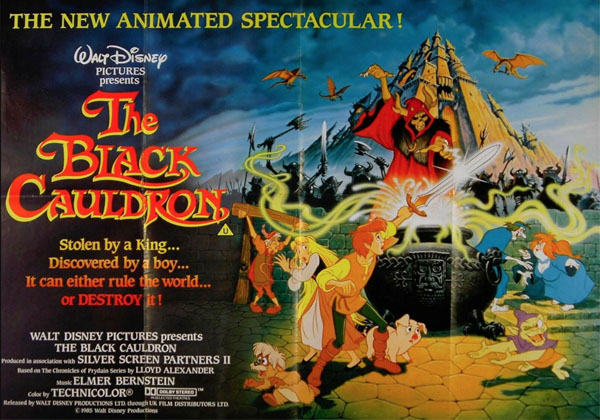
There has been a lot written and discussed about Disney’s animated feature, The Black Cauldron, in the forty years since its release, but one of the most interesting and insightful quotes may have come from Tim Burton.
 The director of numerous live-action blockbusters began his career as a Disney animator and was working at the Studio when The Black Cauldron was in production. In Bob Thomas’ book, Disney’s Art of Animation: From Mickey Mouse to Beauty and the Beast, Burton stated, “I think the company was really at odds with itself. They had this feeling of moving into the future and contemporizing, but they didn’t know how to do it. There was a foot in the past and a foot in the future and no firm footing in either. The Black Cauldron was one of the things that steered me out of animation.”
Produced at a tumultuous time at Disney Feature Animation, just after Don Bluth led a walk-out of animators, during a time when there was a significant leadership change at Disney and just before the Studio would experience a Renaissance in animation, The Black Cauldron was “stuck” between different “eras,” at Disney, as Burton noted.
Production on The Black Cauldron, which celebrates its fortieth anniversary this year, can be traced back to 1973, when initial work on the film began after the Studio secured the rights to author Lloyd Alexander’s series of five books, The Chronicles of Prydain. The fantasy adventures of a young hero battling evil forces appeared to be a tonal shift for Disney feature animation, which could potentially open up animation to a broader, and older audience.
 Artist Mel Shaw created some beautiful, dynamic conceptual artwork for The Black Cauldron during its earliest days, hinting at a film with an epic scope and a darker tone. As production moved into the early 1980s, the film looked like something that would be right at home with the high-fantasy-sword-and-sorcery genre that became popular during the decade, with films like Jim Henson’s The Dark Crystal (1982) and Conan the Barbarian (also 1982), starring Arnold Schwarzenegger.
The Black Cauldron would also be the Studio’s most technically ambitious project in some time, produced in 70mm, six-track Dolby Stereo sound, and would utilize then-emerging computer animation. At one point, there were plans for a holographic character in a scene that would appear three-dimensional and hover over the audience (this idea never came to fruition).
However, all of these ambitions were wound up in a production that unraveled. The different units on The Black Cauldron didn’t communicate as they should have; directors left the project, and the distinct, darker tone once envisioned for the film began to veer toward a more traditional fairy-tale quality.
 Co-directed by Ted Berman and Richard Rich, Disney’s The Black Cauldron, set in the mythical world of Prydain, would center on Taran, a young man who lives on a farm and serves as a “pig keeper,” but dreams of becoming a great warrior. He finds himself thrust into an adventure when the evil Horned King seeks to capture his pig, Hen Wen. The pig, as it turns out, has oracular powers, and the King wants to use them to locate the mystical Black Cauldron, which would give the owner “…the power to resurrect an army of deathless warriors, and with them, rule the world.”
Within this story was a cast of eclectic voice talent, including John Hurt as the Horned King, Grant Bardsley as Taran, comedian John Byner as Gurgi, the odd, furry creature who accompanies Taran (Byner also provided the voice of a fairy named Doli), Susan Sheridan as Princess Eilonwy, who joins Taran, as well.
Additionally, the cast also featured Nigel Hawthorne as the bumbling bard Fflewddur Fflam, Arthur Malet as Fairy King Eidilleg, Freddie Jones as Dallben, the farmer who serves as Taran’s mentor, Phil Fondacaro as Creeper, the Horned King’s assistant, Billie (“Witchiepoo” of “H. R. Pufnstuf”) Hayes as one of the Witches of Morva that Taran and the group encounter, and John Huston as the narrator of the film’s opening prologue.
 The Black Cauldron also featured an original and compelling score by Elmer Bernstein.
Into the production came sweeping change at the Disney company. Roy E. Disney, Walt’s nephew, resigned his seat on Disney’s Board of Directors in 1984, as he disagreed with the direction in which the company seemed to be heading. After leaving, Roy was instrumental in engineering a series of events that resulted in a leadership change, bringing aboard Michael Eisner as Chief Executive Officer, Frank Wells as President, and Jeffrey Katzenberg as Chairman of The Walt Disney Studios.
This new leadership team brought with them hope for the future of Disney, but also brought a tremendous amount of transformation, including a decision to move the animation Studio off of the Disney Studio lot in Burbank, CA (where it had been for over forty years), to make way for offices for the new incoming leadership.

The Black Cauldron’s Little Golden Book
The new, incoming team had never worked in animation and were wrapping their heads around the production of an animated film. After an early screening of The Black Cauldron, which didn’t go well, Katzenberg decided that the film needed to be edited and excised some of the film’s darker elements. Editing an animated film in such a manner was unheard of, as, unlike live-action movies, all scenes in an animated feature, at a certain point, were “locked in.”
The changes didn’t help, and The Black Cauldron, which was released on July 24, 1985, didn’t fare well at the box office. As noted by Don Hahn in the documentary, Waking Sleeping Beauty, The Black Cauldron made less than The Care Bears Movie, released earlier that year.
While some critics, like Roger Ebert, enjoyed the film and awarded it 3 ½ stars, writing, “By the end of The Black Cauldron, I was remembering, with something of a shock of nostalgia, the strength and utter storytelling conviction of the early Disney animators. The Black Cauldron is a return to the tradition.” Despite such glowing reviews, the film was deemed a disappointment and a low point for Disney animation by many.

“The Black Cauldron” lives on!
The Great Mouse Detective followed in 1986, yielding more positive results, and it became apparent that investing in story and artistry could strengthen the foundation on which Disney was founded.
A Renaissance followed, with blockbuster, and now classic films like The Little Mermaid (1989), Beauty and the Beast (1991), and The Lion King (1994).
All of this could never have been foreseen forty years ago, as The Black Cauldron first debuted when Disney’s past “Golden Age” was a distant memory, its present was unstable, and the bright future for animation was still unknown yet hopeful.
 Michael Lyons is a freelance writer, specializing in film, television, and pop culture. He is the author of the book, Drawn to Greatness: Disney’s Animation Renaissance, which chronicles the amazing growth at the Disney animation studio in the 1990s. In addition to Animation Scoop and Cartoon Research, he has contributed to Remind Magazine, Cinefantastique, Animation World Network and Disney Magazine. He also writes a blog, Screen Saver: A Retro Review of TV Shows and Movies of Yesteryear and his interviews with a number of animation legends have been featured in several volumes of the books, Walt’s People. You can visit Michael’s web site Words From Lyons at:





I was fascinated by this film as a kid because I could read a lot about it in various books, but I simply could not see it. Not until it got a VHS release in 98ish. That was only a couple of years since I first read about it, but that’s a long time when you’re a kid.
The film itself is fairly forgettable, but I don’t think it’s awful. Personally I think it’s more enjoyable than Atlantis or Treasure Planet, two films that were salvaged by a bit of a cult following thanks to an appreciative audience waiting for them within the then rapidly expanding home video market.
I think TBC might have fared somewhat better had it been released during the ’85 November/December holiday season instead where there wasn’t as many fantasy and sci-fi films to compete with–I mean, c’mon, Back to the Future? Also The Goonies and Cocoon. Even re-releases of Gremlins and Ghostbusters from the previous year. Not to mention all the comedies and action-adventure flicks. ‘Cauldron’ never stood a chance in such a crowded marketplace.
There was also the matter of the ‘PG’ rating (curiously not mentioned in the column), the first given to a Disney animated feature, that likely repelled timid parents. This was among the reasons Who Framed Roger Rabbit later had to be distributed under the Touchstone Pictures banner.
The summer of 1985 seemed full of promise–with two potential Disney blockbusters on the horizon, “Return to Oz” and “The Black Caldron.” Both represented major strides forward in fantasy film-making, a genre that historically has been an uneasy fit into mainstream movies, with the occasional hit offset by many box-office disappointments. In each of these films, Disney was venturing into substantially darker realms than had previously been the norm.
“The Black Caldron” is thus a mixed bag of unconventionality and conventionality in the same film. On the one hand, the Horned King is probably one of the most visually fearsome villains, and the quest upon which Taran embarks is one of the more serious quests–yet these elements are played against the comedic blundering of Fflewddur Fflam, the ultra-cute antics of Gurgi, and the eccentricities of the Witches of Morva. To the point where the film can’t decide if it’s a sword and sorcery epic or a family-friendly comedy. It tries to be both, and thus ends up being neither.
There is much to like and praise about “The Black Cauldron.” It is, in its way, a bold step for Disney animation. The story is more involved than a simple fairy tale. Certain portions of the animation stand up with the best examples from the Disney classics. It contains intensity, power, magic, and even sheer beauty.
Yet it’s not an easy film to warm up to. The main characters are likable enough, but not particularly compelling. Who is the main point of identification? Is it Taran? He’s a little underdeveloped for us to fully relate to. Is it Eilonwy? She’s nicely animated, but she’s hard to get to know in the midst of all that is going on in the plot. Arguably it could be Gurgi’s film, but he is more of a sidekick and doesn’t contribute materially to the plot until his self-sacrifice near the very end.
The threat of the Horned King seems strong at the outset, but as the story unrolls he seems to be more threat than substance, and he is defeated almost too easily while the film still feels like it’s getting underway. I keep expecting the film to go longer than it does, and so the Horned King’s defeat feels somewhat rushed–compared, for example, to the climax of “Lord of the Rings.”
“The Black Cauldron” looks like a case of “too many cooks spoil the broth.” A single vision might have dovetailed the film into a steadier purpose. A purer sword and sorcery approach might have been better than diluting it with attempts at being family friendly. In any case, it’s an interesting film and is definitely worth a look.
Wow, those forty years just flew by….
I have very fond memories of this film. I saw it with a friend who loved the Lloyd Alexander novels (and has since written a series of fantasy novels of his own). He had been looking forward to its release for years, and I couldn’t help getting caught up in his excitement. I remember him telling me, before we saw it, that one of the original animators from “Snow White”, now very old and nearly blind, had come out of retirement to supervise the animation; that was Eric Larson, one of Disney’s Nine Old Men. Another two of the Nine, Frank Thomas and Ollie Johnston, both great admirers of the books, were responsible for Disney securing the rights to the Chronicles of Prydain in the first place. If done properly, they felt, “The Black Cauldron” could be as great an achievement as “Snow White”.
So why wasn’t it? Certainly the animation is impressive, a giant leap upward from the nadir of “Robin Hood”. Elmer Bernstein’s musical score, as you say, is compelling and dramatic, and the film doesn’t suffer from a lack of Disney-style songs. The exquisitely detailed background art is absolutely breathtaking, equal to Disney’s finest. The story is fast-paced and gripping, the characters distinctive and interesting, and the Horned King a terrific villain. I’ve been a fan of John Hurt ever since he played Caligula in “I, Claudius”, and he definitely had what it takes to play a menacing figure of consummate evil.
The main problem, as Frederick observes, is that the final defeat of the Horned King feels rushed; Gurgi’s sacrifice negates the threat of the undead army before they have a chance to engage in battle. Of course I’ve never seen what was in the ten or so minutes of footage that Jeffrey Katzenberg excised, and neither has anyone else; but there’s no escaping the conclusion that this cut is responsible for the film’s hurried and unsatisfying ending. Having committed to making an epic heroic fantasy with a darker, more adult tone than ever before, the management suddenly backed away at the last minute from the prospect of a violent battle scene involving an army of demon-possessed warriors. Perhaps Katzenberg was worried about losing Disney’s traditional family audience, or maybe he feared getting caught up in the “Satanic panic” of the 1980s. Either way, “The Black Cauldron” turned out to be a greater risk than a company in a state of flux was willing to take.
Nevertheless, it has a special place in my heart. I’ve owned the DVD for years and find that it stands up to repeated viewings. I’ll probably watch it again later today. Thanks for this positive reevaluation of a film that has been unfairly derided and neglected for far too long. “The Black Cauldron” may represent a low point in Disney history when viewed from the perspective of box office alone; but artistically, it’s an achievement that deserves to be recognised and celebrated.
One groundbreaking thing about The Black Cauldron was that it had no songs, a tradition in Disney animated movies since Snow White. I found that very refreshing.
Also, Pat Carroll was the voice of one of the other witches in the movie. She later voiced another Disney witch, Ursula, in The Little Mermaid.
Pat Carroll was never in “The Black Cauldron”.
My mistake. I hadn’t looked at the Black Cauldron voice cast for a long time. I thought she was the voice of the other non-buxom witch.
I received the original novels as an adolescent at Christmas one year. This would have been in the late 90s/early 00s, around the time this film received its initial VHS release. I wish I still had those books, because I enjoyed reading them very much and to this day can still remember certain passages. When I finally did see the film, on video during a stint of babysitting one afternoon, I realized how this was a mashup of the first two of Alexander’s novels (‘The Book of Three’ and ‘The Black Cauldron’) and ultimately came away feeling rather underwhelmed. Knowing how in the books The Horned King was merely a pawn of a much bigger villain undercut the menace.
I consider it a crying shame that this adaptation fared so badly and gained such an infamous reputation that even now there seems to be no motivation to try again to film Alexander’s epic saga. As fondly as some might hold Bakshi’s Tolkien adaptations, I’m grateful that Peter Jackson was able to give us a fully realized filmic depiction of ‘The Lord of the Rings’. It’s a mystery to me how the same can’t be done with ‘The Chronicles of Prydain’. With every studio in Hollywood seized with remake and reboot fever, you’d think a ground-up reevaluation of this source material (whether animated or live-action) would be a no-brainer.
The deleted scenes still exist. Putting them back will improve the movie at least a little. Someone in charge over at Disney is afraid to admit the company ever made a mistake. This is about shame and nothing else. That is the only reason a complete extended version was not released to this day.
Those used to be my favorite novels growing up. I recently re-read them and still thought they were great up to the 4th entry, Taran Wanderer. I don’t know the story behind their publication, but I get the sense the publisher was demanding a lord or the rings style ending and that’s all he gave them with the high king. But the 4th one is really neat. It transcends the YA adventure genre to be more of a Bildungsroman. Taran learns how to govern, negotiate treaties and train at various lines of work after vanquishing the villain.
But I think, if they were going to adapt just one of the novels, the best pick would’ve been the Castle of Llyr. Each novel has its own villain and could be read on its own, but that one would have fit best for a Disney movie. The princess would have had a more central part. There would have been a witch villain and some more funny characters like a cowardly giant and Fflewdur’s giant pet cat.
And yet I still l liked the movie. For a long time it was the only Disney film I wanted to see but nobody could. I’ll still take that over anything from the post-little mermaid Disney renaissance.
I disagree as I thought most of the characters didn’t have much personality compared to what came before or after the film including a certain small screen project that came out a few months later (which also had a medieval setting).
I think perhaps one of the most on-point reflections of the ultimate legacy of the film appears in a recent Mickey Mouse episode among the Paul Rudish output for Disney TV (somebody help me with the episode title, as the sheer number of episodes and randomness of the gag defies my memory as to precise identification). For some reason, Mickey reaches deep into the glove compartment of his little car in search of something needed in his adventure. We see a close-up of his hand inside the glove compartment, as he finds what he is looking for buried among old junk packed in the back of the compartment. Among the objects buried farthest in the back of the compartment is an old VHS tape, sans box, of The Black Cauldron! Mickey’s a secret fan, but either thinks he has to keep this a secret by burying the tape where no one would look for it, or hasn’t bothered to watch it himself in a long, LONG time, I have the feeling there are many Disney fans (myself included) with a similar old VHS or DVD copy buried deep within the holdings of their own house, which continues to gather dust and dirt from lack of use. It’s something you almost own or see for the sake of completeness, and just to prove you’re a fan of the studio’s work. but seem to find very little need to see again over the course of time.
I largely agree with most of the comments made above, including the lack of engaging depth of the characters (did we mention the cute yet somehow unappealing pig, who, at least over time, I can’t help but think of as a knock-of of Babe), the way-too-sudden and pat defeat of the Horned King, etc. When I could see the sword-and-sorcery angle was falling way short of an acceptable mark. I was pretty glad that at least a few sequences of Gurgi, Fflewddur Fflam (thanks for the spelling above), and the witches held up, to at least give us something to watch besides the mere art of the drawings and backgrounds themselves. Lackluster. forgettable, and underwhelming are unfortunately words that fit the final production like a glove. Shall we also mention, padded? Whether or not it might have been in the book (which I never read nor felt inclined to after seeing the film), what was the plot purpose of the journey to the elf world? You could chop the whole sequence out, and never notice it was missing in the continuity. Wouldn’t this have been one of Walt’s first comments, had he been alive to critique the final storyboards? It would have disappeared from the film faster than the Soup Song from Snow White. (Likewise, though I digress, I’ve always felt Disney would have cut the Gabble Sisters from the script of The Aristocats. despite their memorable comedic value, unless the writers found some way to integrally make them necessary participants in the final fight, which never happened.)
I had to search well out of my comfort zone to ever see the film in first run. The PG rating was a real obstacle to its distribution in the Los Angeles area, and it seemed like the only theater carrying it was one buried around Santa Monica Mall, with no ready street parking. I had to hike in blocks to get to it, and came away somewhat wondering if the exercise had been worth it. I saw it with a very small house, the audience only filling about one-third of the seats. Either the rating or the advance reviews must have taken their toll. I remember being quite conscious (no, the film didn’t actually put me to sleep) during the screening of watching carefully to figure out why the film had gotten its PG rating. I’m inclined to say the dark aspects of the film’s villains and the Horned King may not have contributed to the rating – given their overall failure to scare or impress – but that the rating came from a few buxom lasses in a sleazy tavern setting, and the obvious problem of Fflam, transformed into a frog, getting stuck in the cleavage of the fattest witch’s bosoms. It is odd that it would thus seem that the PG rating could have been avoided with two easy cuts from the script. Were the Disney staffers just seeking the rating because of the growing consensus for live-action films that a G-rating was box-office poison? If they were watering down the ending anyway, why not stick with a traditional G-rating? There were some pretty horrific scenes in Snow White that never lost that film its general rating, so it seems like, if the studio had not pushed for a more-adult crowd, they could probably have influenced the censors to keep the rating at G had they not included the few “adult” shots referenced above. Thus, it is likely Disney brought the ratings controversy upon themselves without artistic necessity therefor. If so, I’d say they deserved every loss of ticket sales the problem brought on.
The bosomy barmaids in Beauty and the Beast, “The Bimbettes”, didn’t keep that film from obtaining a ‘G’ rating. However, I do recall their presence was the basis of a minor controversy shortly after the original release by some parents and feminist groups. The kerfuffle even made a segment of Entertainment Tonight where Frank Thomas good-naturedly complained that “we weren’t allowed to do anything like that” ( I guess he forgot about top-heavy characters like Pauline from Duck Pimples or The Adventures of Ichabod and Mr. Toad‘s Katrina, among others).
For some reason I was ardently following Disney’s attempts to reinvent itself during the late seventies through mid eighties and this was perhaps the one I was most keen for. The pre-production art that had been trickling out in the seventies looked very encouraging but what we got was, sigh, Disney at its saddest and most fossilized. The script was cluless, the design so uninspired and dated you could have brushed cobwebs off of it. It was all so discouraging and one of the main reasons I pretty much gave up on the studio by this point, although I do have a soft spot for “Return to Oz,” for all its shortcomings.