



 Some films have behind-the-scenes stories that are more compelling than the film itself. Tubby the Tuba is one of them.
What began as a children’s record album three decades before its release turned into a production that would involve a University in New York, a former children’s TV show host, veterans of the animation industry, a voice cast of well-known actors and comedians, and the future founders of Pixar in a serpentine path that led to the film’s production.
In 1945 songwriter Paul Tripp and composer George Kleinsinger released a children’s record album entitled Tubby the Tuba, narrated by Danny Kaye. It tells the tale of the title character, who is sad that he doesn’t get more to do in the orchestra than play “oom-pah” and wants a melody all his own. For more on the extensive history of the song, see Greg Ehrbar’s 2021 article.
In addition to his skills as a songwriter of Tubby the Tuba, Tripp was also an actor who appeared in a number of TV shows, including The Twilight Zone and The Dick Van Dyke Show. He’s probably most well-known to an entire generation as the host of the popular children’s show Mr. I. Magination, which aired from 1949 to 1952.
The animated possibilities of Tubby the Tuba were first realized by filmmaker George Pal, who adapted the story in his 1947 stop-motion Puppetoons short subject, which was well-received and went on to receive an Academy Award nomination.
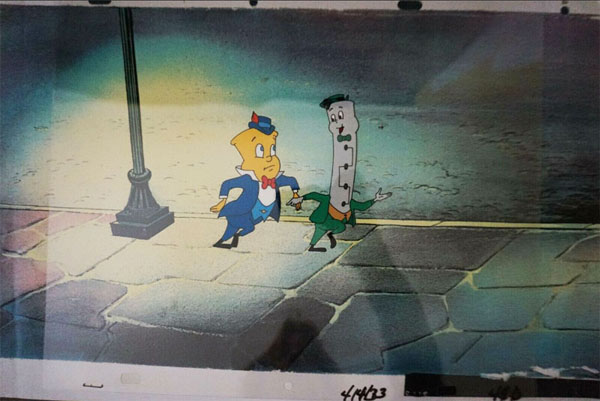
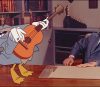
A cel set-up from TUBBY THE TUBA (1975)
The film’s production would be done at the University’s animation department on the campus. However, as work on Tubby the Tuba progressed, there was a need to bring in more seasoned animators and filmmakers.
Schure brought in animator and producer Sam Singer, best known for his TV show Courageous Cat and Minute Mouse, as well as a number of veteran New York animators, including John Gentilella and Jack Dazzo, who worked on classic Popeye cartoons.
As production of an animated feature can take some time, Schure also looked to speed up the process by turning to a field still in its infant stages: computer animation. A number of scientists working at NYIT in the emerging realm of computer graphics were brought in as consultants. Two of them were Ed Catmull and Alvy Ray Smith, who would go on to be two of the founders of Pixar.
 Tubby the Tuba could have been the first film to use computer-generated imagery, but ultimately, no computer animation wound up being used in the film, and it was completed using traditional animation. The studio Avco Embassy acquired the rights to Tubby the Tuba, releasing it to theaters fifty years ago this month on April 1, 1975.
Tubby the Tuba opens with an orchestra in a symphony hall tuning up, but as the camera gets closer, we see that this orchestra is comprised of anthropomorphic instruments. As the conductor is about to begin, Tubby the Tuba becomes disappointed that all of the other instruments have such nice melodies to play while he has nothing but the same “oom-pah” notes again.
Laughed at by the other instruments, a despondent yet determined Tubby sets off to find a melody to play on an adventure that leads to fame and fortune as he learns a lesson about being true to who he is.
Tubby the Tuba boasts an impressive voice cast, including Dick Van Dyke as Tubby, Pearl Bailey as Mrs. Elephant who he meets when he decides to join the circus, Jack Gilford as The Herald of Singing City, which Tubby visits, David Wayne as Tubby’s best friend, Pee-Wee the Piccolo, Jane Powell as Celeste, the orphaned melody, Hermione Gingold as Miss Squeek, the leader of the orphaned tunes, Cyril Ritchard as Mr. Frog, who befriends Tubby and Paul Tripp as the Narrator.
Broadway veteran Lehman Engel crafted songs in the film.
Even with all of this talent, the result of 1975’s Tubby the Tuba is best summed up by Jerry Beck in his book, The Animated Movie Guide, as he writes, “Visually the film is a mess – but a relatively pleasant one.”
It may not have hit any high notes at the box office or in animation history, but fifty years later, Tubby the Tuba still provides a compelling behind-the-scenes story.
 Michael Lyons is a freelance writer, specializing in film, television, and pop culture. He is the author of the book, Drawn to Greatness: Disney’s Animation Renaissance, which chronicles the amazing growth at the Disney animation studio in the 1990s. In addition to Animation Scoop and Cartoon Research, he has contributed to Remind Magazine, Cinefantastique, Animation World Network and Disney Magazine. He also writes a blog, Screen Saver: A Retro Review of TV Shows and Movies of Yesteryear and his interviews with a number of animation legends have been featured in several volumes of the books, Walt’s People. You can visit Michael’s web site Words From Lyons at:





I would have been all of fifteen when this movie was released, but I don’t recall hearing or reading about it–and I kept up with the latest animated releases. However, fifteen-year-olds have much else on their minds than animation, plus I was transitioning from reading children’s books to adult novels. And from animated fare to more live-action and grown up movies.
Still, having always been a fan of Dick Van Dyke, I’m surprised I didn’t know about this film till now. He seems just the right voice for Tubby. The rest of the cast list is, as mentioned above, very impressive as well.
The circus sequences seem to have a strong resemblance to comparable scenes in “Dumbo.” The Ringmaster looks a lot like Dumbo’s ringmaster, and Mrs. Elephant bears more than a passing resemblance to Mrs. Jumbo. However, this familiarity does not seem out of place, but rather works in its favor by showing a circus that seems vaguely recognizable.
From what I have seen of this film, it seems well-crafted and entertaining. It’s unfortunate it didn’t become a ‘Schure” hit!
When I visited the NYIT’s NYC campus to take part in the Columbus Day Parade (BS/MS Alumni, Staff, Part-time Non-Credit teacher), it was plating on a continuous loop. Around 1983 I had one od the CGL staff do a lecture and show some of their work.
Huh, I used to own a copy of the George Pal version (which I got just because it was on a VHS that included Balloon Land but ended up liking as well). Can’t believe I’d never heard of the feature before.
I confess to being somewhat frustrated by children’s stories about anthropomorphic musical instruments because my own instrument, the viola, is invariably portrayed as a whiny, morose pessimist who never stops complaining (q.v. Ernest LaPrade’s “Alice in Orchestralia”, etc.). At least “Tubby the Tuba” didn’t do that, because its creators decided instead to ignore the viola section altogether — which, if it were a better movie, would make me feel whiny and morose. But I’m not complaining.
The premise behind “Tubby the Tuba” doesn’t make much sense, because the orchestral tuba gets to play melodies all the time. Granted, these are usually in conjunction with other bass instruments, but a melody is a melody no matter how many people are playing it. Even so, there are plenty of melodic tuba solos in the orchestral literature: Mussorgsky/Ravel’s “Pictures at an Exhibition”, Shostakovich’s Leningrad Symphony, Gershwin’s “An American in Paris”, Wagner’s Prelude to “Die Meistersinger”, most of the orchestral works of Prokofiev and all of the symphonies of Mahler, and many others.
It’s true that when the original “Tubby the Tuba” album came out in 1945, there was no such thing as a work for solo tuba with orchestra. The first tuba concerto was written by the English composer Ralph Vaughan Williams in 1954, when he was in his eighties. Nowadays, however, there are dozens, probably hundreds, of them. Film composer Bruce Broughton, who wrote the music for the “Tiny Toon Adventures” theme, has written a very fine one. So has John Williams, in the mid-1980s while taking a break in between Indiana Jones film scores. As an orchestral musician I’ve played in three different tuba concertos in my life. One of them was the Vaughan Williams, and the other two weren’t.
Really, the idea that the symphony orchestra is a hotbed of rampant anti-tubism is ridiculous. Tubists are proud of their role as the fundament of the brass section, as we appreciate them for it. Since orchestras only have one tuba (some of the more bombastic scores, like Stravinsky’s “The Rite of Spring” and Holst’s “The Planets”, call for two), competition for jobs is very stiff. Sometimes years at a time go by without a tuba position opening up in any professional orchestra in the world. When that happens, auditions typically draw between one and two hundred applicants (and pity the poor committee who has to spend a whole weekend listening to them all). Thus the standard of musicianship among professional tubists is incredibly high. These are people who go for entire careers without ever making a single audible mistake — and if you make a mistake on the tuba, believe me, it’ll be audible.
Thanks, I guess, for including a link to the complete movie, which I had never seen before. But I couldn’t sit through to the end of it. It was just too awful to bear. “First you take an OOM, then you take a PAH, you put them both together and get OOM PAH PAH!” To see the great Dick Van Dyke reduced to spouting such drivel was more depressing than I can say. But there goes that whiny violist, complaining again.
Well, what do you expect from a Sam Singer production? He never had a good track record.
I got my start in animation there in March of 1975. I started as the first inbetweener hired, and worked my way up to being an assistant animator. I left 14 months later to be an assistant animator on Raggedy Ann and Andy.
I’m not really sure if Tubby the Tuba WAS released in 1975 by Avco, as websites and reference books say. A newspaper story from February and March of 1975 stated that Dick Van Dyke was signed with Avco to star in the picture. The earliest listing I could find for a screening for Tubby is in December of 1977 and all of the ads I could find for it that HAVE a distributor credit say that G.G. Communications distributed it (among the films they also distributed include Once Upon a Time (1976), Pippi Longstocking movies and some screenings for Journey Back to Oz) , not Avco!
It was the movie that created Pixar. Because its failure convinced software pioneers Ed Catmull, Alvy Ray Smith, Jim Clark and Ralph Guggenheim to abandon ship and go west to work for Lucasfilm.