



Like a fun friend who visits each year, bringing with them sunshine, fireworks, and blockbuster movies, summer is always welcome. But, like all fun friends, summer eventually has to leave, and as it does, one of the hallmarks of the change of seasons is students and teachers heading back to school.
It’s the perfect time of year to watch classic cartoon shorts that have been themed around school, like these:
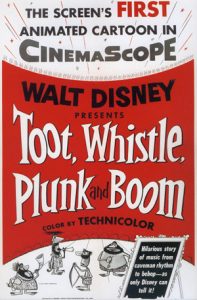 Toot, Whistle, Plunk, and Boom, 1953 (Disney)
This Disney Oscar winner, the first cartoon to be filmed in Cinemascope, serves as an entertaining lesson in the history of musical instruments.
A sequel to Disney’s first “Adventures in Music” series, Melody (1953), this follow-up also features Professor Owl (Bill Thompson) who flies into his birdhouse/schoolhouse at the start of the short to teach his classroom of bird students about four sections of an orchestra: the brass, the woodwind, the strings and the percussion.
The Professor starts the discussion with early man using primitive versions of the instruments and then transitions to how instruments have evolved through time to the current day.
One of Disney’s most stylized animated shorts, Toot, Whistle, Plunk and Boom, with backgrounds and layout created by Joe Hale, art direction by Ken O’Connor, color styling by Eyvind Earle, and Ward Kimball and Charles A. Nichols directing, has a unique look that accentuates the subject matter (of note is a sequence where ancient hieroglyphics dance to swing music).
Coupled with this, the music in the short by Joseph Dubin, with songs by Sonny Burke and Jack Elliott spanning the entire short, entertainingly educates the audience.
Toot, Whistle, Plunk, and Boom was also named one of the 50 Greatest Cartoons in Jerry Beck’s 1994 book (coming in at number 29) and has also become a staple in school music classes over the years.
 From A to Z-Z-Z-Z, 1954, (Warner Bros.)
From director Chuck Jones comes this Looney Tunes short that creatively captures a student daydreaming in class.
We follow a young boy named Ralph Phillips (Dick Beals), who is a student at Valley View school, and as the short opens, he is sitting in class with other students reciting the times tables.
Ralph spots a bird out the window and begins to imagine himself flying, but his Teacher (Bea Benaderet) asks him to finish a math problem on the chalkboard.
Once up at the front of the room, Ralph daydreams again that the numbers are laughing at him, which is when a chalk drawing version of himself appears on the blackboard and begins battling the numbers.
The Teacher brings Ralph back to reality again and advises him to get some fresh air and mail a letter for her. As he walks to the mailbox, Ralph imagines himself in the Old West as a Pony Express rider, and eventually makes his way back, again, to the reality of the classroom.
 The Teacher moves on to geometry, and Ralph stares at the fish tank in the classroom, daydreaming that he is in the Navy and has to rescue a downed sub by diving into the water and raising it with his bare hands. As an octopus grabs him in its tentacle, it turns out to be the hand of the Teacher, dragging Ralph to a punishment of standing in the corner.
But even this doesn’t stop his daydreaming, as he imagines being a boxer, and when the bell for his fight rings, it turns out to be the bell for the end of the school day. As Ralph marches out of class, he finally imagines himself as Douglas MacArthur, turning to the camera, declaring, “I shall return.”
The character of Ralph Parker would return in another Warner Bros. short, Boyhood Daze (1957). In From A to Z-Z-Z-Z, (which was nominated for an Oscar), the stylized layout by Maurice Noble and backgrounds by Philip DeGuard, include such imaginative images as numbers imposingly stacked on a blackboard and Ralph, as the Pony Express rider, assaulted by arrows that flood the screen with color.
This is all a perfect backdrop for the story from Michael Maltese, which includes witty dialogue, such as when Ralph is about to rescue the sub, he tells the ship’s captain, “Even though I got a C in arithmetic, you can count on me.”
With his traditional partners working with him, Jones delivers a highly entertaining seven minutes with From A to Z-Z-Z-Z that speaks to all of us who have found our minds in our daydreams instead of our textbooks.
• Check out this full episode of Cartoon Network’s TOON HEADS devoted to Ralph Phillips.
 Little School Mouse, 1954 (MGM)
In this Tom and Jerry short from directors William Hanna and Joseph Barbera, the student becomes the teacher.
In it, Jerry is the teacher in a school that helps his fellow mice (we open on a school room where there is a certificate awarded to Jerry Mouse for the art of outwitting cats).
Nibbles the mouse is in the classroom, waiting when Jerry, being chased by Tom, comes running in, and he proceeds to teach Nibbles by showing drawings on a blackboard. Each shows a progression: cat chases mouse, cat catches mouse, cat eats mouse. He then shows an alternative diagram where the cat chases the mouse, the mouse runs into a hole, and the cat says bad words.
It’s eventually time for practical training out in the field, as they prepare to leave the mousehole. Jerry brings a training book, which states that the lesson is to remove the cat’s whisker without waking the cat.
This goes well for Jerry, but Nibbles winds up pulling Tom across the floor, and Jerry winds up taking the brunt of Tom’s wrath.
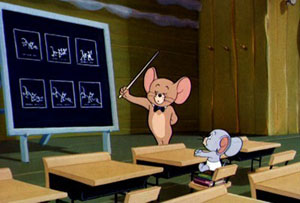 They then embark on the next lesson to get cheese from the cupboard without waking the cat. Jerry receives a small piece, while Nibbles simply wakes Tom, who, in his sleepy state, gets the cheese for Nibbles and hands it to the young mouse.
The last lesson is to tie a bell on Tom. Jerry’s attempt results in him being wrapped up in the bell by Tom and sent back to the mouse hole. Nibbles craftily wraps up the bell as a gift, and Tom gladly accepts it.
This causes Jerry to give up and throw out his diploma. And, in the last scene in the short, Nibbles is teaching class, with a statement on the blackboard that cats and mice should be friends. Jerry, now sitting at a desk with a dunce cap on, shakes his head no, while Tom nods yes as the bell around his neck rings over and over as the short ends.
Directors Hanna and Barbera, along with such animation talents as Ed Barge and Irv Spence, set up and execute the scenes with the mice vs. Tom with the usual creativity – Jerry uses a coffee cup and spoon to cross a water filled sink, as if he’s in a canoe. They also build each segment for full comic payoff (action happens off screen with a beaten Jerry appearing back in the mouse hole as a punch line).
In Little School Mouse, it’s also interesting to see tables turned between the classic cat and mouse pair; not only is Jerry consistently defeated, but he and Tom get along in the end, as everyone learns a valuable lesson straight out of a schoolroom.
• Watch LITTLE SCHOOL MOUSE on Facebook.
 Bye Bye Blackboard, 1972 (Universal)
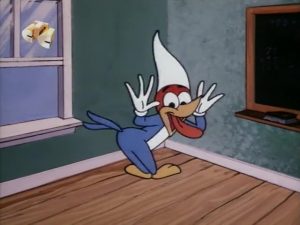
Directed by Paul J. Smith, this final cartoon from Walter Lantz Studio takes the Woody Woodpecker plot paradigm, where the character spends a cartoon taunting someone who deserves it, and places it in a schoolroom setting.
As the short begins, Woody (Grace Stafford) is running late to school, and his dog Alphie wants to come with him. Woody tries sneaking into class, but his teacher, Mrs. Meany (also Stafford), catches him. She immediately kicks Alphie out of school and raps Woody on the palm with a ruler (which she does a few times throughout the short).
Woody and the teacher continue their back-and-forth, which includes scenes where Woody gets blamed for using a slingshot, and he rings the bell for recess, tormenting Mrs. Meany on the playground.
Mrs. Meany in Bye Bye Blackboard is perfectly named, as she is a cruel villain and a perfect foil for Woody, who gets his comeuppance at the conclusion, but not before giving this teacher a lesson in his distinct style of cartoon revenge.
These are just four of many cartoon shorts themed around school. Each one is a “textbook example” of perfect viewing for this time of year. (Drop some of your favorites in the comments).
Wishing all teachers and students a wonderful school year!
 Michael Lyons is a freelance writer, specializing in film, television, and pop culture. He is the author of the book, Drawn to Greatness: Disney’s Animation Renaissance, which chronicles the amazing growth at the Disney animation studio in the 1990s. In addition to Animation Scoop and Cartoon Research, he has contributed to Remind Magazine, Cinefantastique, Animation World Network and Disney Magazine. He also writes a blog, Screen Saver: A Retro Review of TV Shows and Movies of Yesteryear and his interviews with a number of animation legends have been featured in several volumes of the books, Walt’s People. You can visit Michael’s web site Words From Lyons at:






Oh indeed, there are many cartoons that deal with the school room or characters learning a vital lesson. You left out one really good one, and that would be the very first “flip the frog“ cartoon. I will leave it to somebody else to also mention this title, along with its plot outline, which has some great schoolroom gags throughout. I think the name of the cartoon is “fiddlesticks“.
And some might recall that “little school mouse“ wasn’t the only Tom and Jerry cartoon in which one character is acting as the professor to teach the little pupil something they should know. Let’s not forget “professor Tom“, Who chooses to teach a little kitten how to chase and eat mice. Of course, the cat does not want to chase and eat the mouse, but make friends with the mouse. This enrage is Tom and the usual chaos continues.
Another such cartoon might be MGM’s “blackboard jumble“, its title being a mock up of the title of the film, “blackboard jungle“. Only in this case, it features a class of droopy, dog types, menacing the professor, the wolf who claims that it’s not so hard to train on really students! Of course he learns a very powerful lesson there.
One of the earliest favorites of mine is “I haven’t got a hat“, possibly the first color appearance of porky pig. It might even be considered the very first appearance of porky completely! It is a class of students who get up to perform. One of them is porky Who tries to recite “the charge of the light brigade“, stammering with almost every word.
Oh and one of my other MGM favorites, the second of two cartoons featuring a bookworm, and what is either a crow or a very dumb raven. In this installment, the bookworm gets embroiled along with the Raven in a very strange experiment by a mad doctor resembling doctor Checo. In the cartoon, the good doctor, if you wish to call him that, is trying to swap personalities between the Raven and the bookworm. He succeeds in not only changing personalities, but exchanging the sizes of the creatures themselves! At the end of the cartoon, the bookworm is Trying to teach the Raven a lesson! The Raven size and acknowledges “A W, who needs a brain anyhow!“ At least I think that’s how line goes.
These are some good examples of great cartoons that bring the school room in some form, to the plot line of the cartoon.
Flip’s first cartoon, “Fiddlesticks”, doesn’t take place in a schoolroom, but his twenty-first, “School Days”, does.
A fairly comprehensive coverage of this subject has been previously presented in my series of articles, “Back to School”. which may be found in the back-entries of my “Animation Trails” column on this site by checking out the :Gardner” back-files on the “Go To” box at the head of the home page of this website.
Charles, thank you for directing readers to your series, which are always the definitive version on any theme. Really enjoying the current series on baseball. Thanks again.
Since it’s been Terrytoons Week here on Cartoon Research (or at any rate Carlo Vinci Week), might I mention a few academic offerings from that often-derided studio:
THE LION’S FRIEND (1934): The animal children come to the schoolhouse, where their German-accented schoolmaster edifies them with the fable of the lion and the mouse.
HEY DIDDLE DIDDLE (1935): Schoolmarm Mother Goose and her classroom of nursery rhyme characters show the prim ladies of the PTA how to swing.
SCHOOL DAZE (1942): The schoolchildren convince their teacher (in song) that there is educational value in Ernie Bushmiller’s “Nancy” comic strip.
SPARE THE ROD (1954): Mighty Mouse battles juvenile delinquency in a tough school.
Here are a few of my favorite back-to-schoolers:
Disney:
“Donald’s Better Self”
“Truant Officer Donald”
“Teachers are People”
“Paul Bunyan”
Warners:
“Old Glory”
Famous:
“Pest Pupil”
Hanna-Barbera:
“Truant Officer Huck” (Huckleberry Hound)
“Elroy’s Mob” (The Jetsons)
“The Missing School Bus” (The Flintstones)
“Flintstone of Prinstone” (The Flintstones)
“High School Fred” (The Flintstones)
“Gridiron Girl Trouble” (Pebbles and Bamm-Bamm)
“Frog for a Day” (Pebbles and Bamm-Bamm)
Peanuts:
“You’re in Love, Charlie Brown”
“It was a Short Summer, Charlie Brown”
“There’s No Time for Love, Charlie Brown”
“You’re Not Elected, Charlies Brown”
To name a few favorites!
and howzabout the great grandaddy of them all : “Katnip Kollege” (WB)
Marian Richman did the teacher,not Bea Benaderet..Keith Scott, where are ya..Ralph Phillipps! (LOL great short)
Thanks so much for the note, “From A to Z-Z-Z-Z” is indeed great! In their book, “Looney Tunes and Merrie Melodies: A Complete Illustrated Guide to Warner Bros. Cartoons” by Jerry Beck and Will Friedwald, they credit Bea Bernadette as the voice of the teacher.
Understood, Michael, understood!
Steve C
Keith Scott’s Cartoon Voices book backs up Coop’s claim.
Thanks for the great article! I especially love “From A to Z-Z-Z-Z” — a perfect back-to-school short.
Thank you!
Sorry, *Benaderet* auto correct took over!