




A short TB Thursday today again! School is taking over my life, plus getting a bunch of orders out the door for Rainbow 2 and special discs, so I’ll keep it short. Looking forward to sitting down and writing about some of the current projects getting the most work right now. We have a whole bunch of stuff up our sleeves that we’re looking forward to getting out — so more soon!
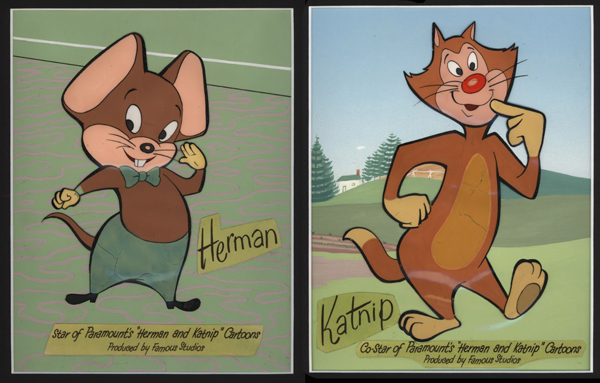
Today’s cartoon kicks off Halloween early!
There really should be a advent calendar for Halloween so we can each get a piece of candy with a new film for each countdown.
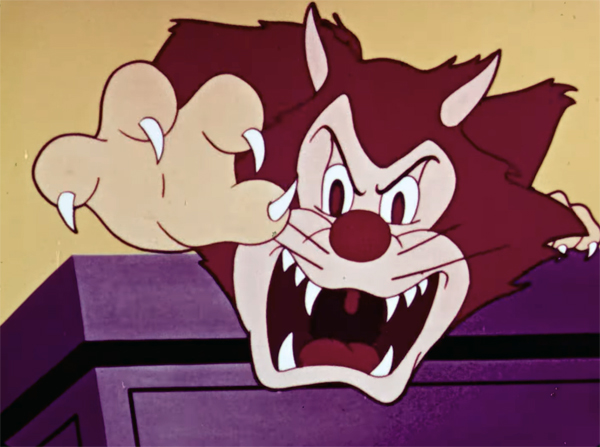 I don’t know about you folks, but I really enjoy the little period in Famous Studio’s history where they’re trying to be ‘modern’ in their design sensibilities. Their commitment to coming up with a new style in this period is a sort of half-commitment— there’s some color styling and background ideas that are interesting- but the characters themselves are nearly the same, except for cornering off arms and legs a little. It’s a strange idea of what making the films ‘modern’ meant, but sort of fun to see them carry on otherwise.
Frighty Cat (1958) isn’t much different than it would have been five years earlier in the studio’s timeline, honestly, except for the backgrounds and blocky characters. There’s not a whole lot here to be excited about, but I did enjoy seeing the two mice carrying around skulls and dancing, and Katnip playing a bar from ‘It’s a Hap-Hap-Happy Day’. I wonder if that song was still ringing in the Famous animator’s heads all those years later (since it shows up in so many later films).
A few years after this the studio would be producing the TV Popeyes, and other TV things. They’re another step down in simplicity, but they’re pretty informed by this particular era of simplifying the animation.
This 16mm print courtesy of my friend Tommy Stathes, who probably has scared audiences showing it at some point.
Have a good week all!
 Steve Stanchfield is an animator, educator and film archivist. He runs Thunderbean Animation, an animation studio in Ann Arbor, Michigan and has compiled over a dozen archival animation DVD collections devoted to such subjects at Private Snafu, The Little King and the infamous Cubby Bear. Steve is also a professor at the College for Creative Studies in Detroit.









I don’t believe I’ve ever seen “Frighty Cat” before, and I was very interested to see a cartoon from the 1950s set in an abandoned sanatorium. There were once hundreds, perhaps thousands, of sanatoria all across the United States, dedicated to treating tuberculosis, mental illness, alcoholism and other ailments, or for isolating people with various disabilities. Most of them were closed down in the 1950s because, frankly, they were hellish places, more like prisons than health care facilities. (The “Illside Sanatorium” in the cartoon appears to be one of the nicer ones, with its pool table, library, and functioning fluoroscope.) My father spent the summer of 1955 working at such an institution that was in the process of closing down under court order, and it was one of the most unpleasant experiences of his life. It was also the town’s biggest employer, and the community bitterly resented the government (and outsiders like my dad) for interfering with what they unanimously considered a good thing. Some abandoned sanatoria still stand, unsuited to any other purpose and too costly to tear down. They’re very popular with ghost hunters.
In the end, Herman attaches Katnip’s tail to a full-length mirror manufactured by “Owen Glass” — a little self-plug from background artist Robert Owen. Most of the cartoon’s “modern” sensibility is courtesy of his stylish work. But with stalwarts like composer Winston Sharples and animators Tom Johnson and Frank Endres, not to mention Izzy Sparber at the helm, it really is very much like a Herman and Katnip cartoon of five years earlier. That’s not necessarily a bad thing, you know. Skiddle diddle dee! Skiddle diddle day!
I vividly remember seeing this one on TV, but I probably still had a black-and-white television at the time. I remember the outlines of the characters being sharper and darker than usual, but other than that I loved this cartoon! I actually didn’t mind the simplified form, because we would get that with the television “Felix, the cat“ cartoons which probably had some of the same artists doing the drawings, but this one is good, and oh you’ve gotta love that music! I remember it so much in “Herman and catnip“ cartoons. And you have to love a print with the complete syndicated Harveytoon openings and closings.
While the animation is not as strong as the earlier Herman shorts, the design work looks fine for the most part.
I remember a Herman and Katnip short from this later era (You Said a Mouseful, about a pizzeria) where Jack Mercer voiced Katnip, which he did on rare occasion.
This copy is of excellent quality—thank you so much for sharing it.
Unfortunately, it’s truly a shame that, despite the cartoon’s high quality, the character designs—especially those of Hermann and Katnip—are still just as hideous as ever. The Famous studio clearly didn’t know how to design attractive characters; their designs were either extremely generic (Casper, Little Audrey) or downright hideous (Hermann, Katnip, Baby Huey, as well as the Turtle and Rabbit characters whose names I’ve forgotten).
In comparison, the character designs for Terrytoons created by Connie Rasinski during the 1950s were much more beautiful and elegant.
Hideous? Generic? I thought the designs are rather decent, and they fit right in with the comic characters of Harvey.
All the characters I mentioned were created by Famous Comics long before they were acquired by Harvey Comics in 1959.
And I’m not quite sure what you’re getting at, because there are plenty of examples of comics with characters that have appealing designs without being generic, such as “The Little King”.
But Harvey created Rchie Rich, Little Dot, Hot Stuff, Little Lotta, etc.
A couple of musical questions:
“Hap-Hap-Happy Day”, so far as I know, is the only song from either of the Fleischer features to be used thereafter. Was it the only one they had rights to, or just the only one Winston Sharples liked.
The most familiar music cues, like “Casper get weepy” and “danger that ends in Dum Dum Da Dum” — Did they just using existing recordings, or did they re-record along with any new music for that short?
“All’s Well” likewise became a Fleischer/Famous standard.