




When The Reluctant Dragon debuted, the review in The New York Times stated that half of the movie “…is nothing more than a super de luxe commercial film showing Disney’s sumptuous new diggings out in San Fernando Valley.”
Eighty-five years later, that half of the film is part of the charm of this different entry in the Disney movie catalog. The Reluctant Dragon is a live-action/animated feature that showcases charming animation alongside a tour of the Disney Studio lot, which now serves as a portal back in time.
 With live-action directed by Alfred Werker, and animation directed by Hamilton Luske, Jack Cutting, Ub Iwerks and Jack Kinney, the film opens with a title card that announces what we’re about to see: “This picture is made in answer to the many requests to show the backstage life of animated cartoons. P.S. Any resemblance to a regular motion picture is purely coincidental.”
We then segue into live action, in glorious black-and-white, where we see the humorist Robert Benchley in his pool, shooting suction-cup arrows at fake ducks while his wife (played by Nana Bryant), lying near the pool, reads The Reluctant Dragon by Kenneth Grahame. She tells Benchley that he should pitch the idea of The Reluctant Dragon as a film to Walt Disney and drives him over to the studio, dropping him off for a meeting with Mr. Disney while she goes shopping.
As Benchley then wanders onto the lot, we get a glimpse inside the Disney Studio circa 1941.
Benchley is met by a very efficient tour guide named Humphrey (played by Buddy Pepper, who would later go on to a successful career as a songwriter of such songs as “Vaya Con Dios”). Benchley soon breaks away on his own, and heads into an art class, where a group of Disney artists including Wolfgang Reitherman, Eric Larson, Retta Scott, Jack Kinney and Ken Anderson, are sketching an elephant, who is the model in the room.

Florence Gill and Clarence Nash
Here, he meets up with an artist (Francis Gifford, one of several actors who portray studio employees alongside the actual artists) and watches sound effects and Foley artists add sounds to a cartoon featuring Casey Jr., the train. The conductor for the sound effects team is played by actor Frank Faylen (who would later play Ernie the cab driver in It’s a Wonderful Life and the father on TV’s Dobie Gillis).
After outrunning the tour guide again, Benchley ducks into the multiplane camera department. Here, the black-and-white in the film now segues to color.

Benchley meets Norm Ferguson to the dismay of Humphrey (Buddy Pepper). Click to enlarge.
Next is the “Rainbow Room,” for a trip through the Ink-and-Paint Department (and a montage of different paint colors) as Benchley gets to see a cel of Bambi being painted.
He then passes through the Character Model Department, where, among the many sculptures, we see early versions of Captain Hook from Peter Pan and Si and Am from Lady and the Tramp, both of which were in production but wouldn’t reach theaters for over a decade.

Robert Benchley (center) with Frances Gifford (left) explore the Character Model Department. Click To Enlarge
While learning about the Character Model Department, the artists present a caricatured model/bust of Benchley to the humorist. He then wanders over to the Story Department, meeting up with the artists, one of whom is played by actor Alan Ladd, and they walk Benchley through the storyboard for their newest film, Baby Weems. Disney sketch artist and inbetweener John Dehner is seen sketching in this scene – Dehner would go on after this film to have a very successful career as an actor in radio, movies and television. He would return as an actor to Disney for the 1957 TV series Zorro (as the Viceroy) and as narrator for two shorts, Aquamania (1961, with Goofy) and The Litterbug (1961, with Donald Duck).
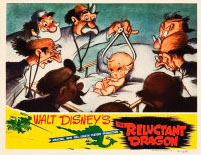 In the style of an “animatic”, essentially told using still storyboard drawings, Baby Weems tells the tale of an infant who is born able to speak and quickly becomes a worldwide sensation. This section itself caused a sensation among the artists in the animation industry – and it was not forgotten. It proved a charming, original animated film could work for an audience using only very limited movement, a technique that was used during the war to produce animation faster for military, educational – and later on, cartoons made for television.
After Weems, Benchley once again avoids Humphrey by ducking into a room where animators Ward Kimball and Fred Moore are working. Kimball sketches Goofy and flips the animation paper. On a Movieola, they then give Benchley a preview of Goofy’s latest cartoon, How to Ride a Horse.
 After, Norm Ferguson animates Pluto for Benchley when Humphrey arrives, taking Benchley to see Walt, who is in the screening room.
Just as Benchley is about to pitch his idea for adapting The Reluctant Dragon, the house lights dim, and the projectionist starts to screen Walt’s latest finished cartoon short… The Reluctant Dragon.
The animated short tells the tale of a young boy (voiced by Billy Lee) who, after reading a book about dragons, encounters one (Barnett Parkett). However, this dragon isn’t fierce; he’s a gentle creature who wants to recite poetry and sing.
The boy becomes concerned when Sir Giles (Claud Allister), the famed dragonslayer, comes to town, but when the boy brings Sir Giles, who is an old man, to meet the dragon, it turns out that the knight enjoys poetry, as well.
The knight and dragon agree to stage a fake fight to satisfy the villagers.
After the animated film ends, The Reluctant Dragon concludes with Mrs. Benchley driving Robert home, scolding him for not getting the story to Walt sooner. Benchley responds in Donald Duck’s voice with a “Phooey!” and Donald’s famous squawking as the movie ends.

The animated segments in The Reluctant Dragon demonstrate the Studio’s artistic range during this time. The charming Baby Weems reveals the power of story, even with limited movements. How to Ride a Horse displays great cartoony action (especially in its slow-motion segment). The Reluctant Dragon shows how the Disney artists could craft well-designed characters and personalities in full animation.
 And, while the behind-the-scenes segments at the Studio are staged, they are still fascinating to see this era in animation captured on film.
Celebrating its 85th anniversary this month, The Reluctant Dragon was released on June 27, 1941, during a challenging time at the Disney Studio. Pinocchio and Fantasia (both 1940) did not do well at the box office, and The Reluctant Dragon was made as an inexpensive, quickly produced film to generate some box-office revenue. Also, an animator’s strike had started the month before. When The Reluctant Dragon opened, a number of strikers picketed the film’s premiere.
In the years that followed, The Reluctant Dragon itself was shown as a standalone short on Disney’s weekly TV show and was also released in that format on VHS. The full-length feature would be shown on The Disney Channel and eventually released on DVD, as part of the Walt Disney Treasures collection. It’s actually available on blu-ray as a hidden Bonus Feature on a double bill release of Ichabod And Mr. Toad and Fun & Fancy Free. The full 1941 feature is also currently available on Disney+.
Since its debut, however, The Reluctant Dragon has faded from many discussions, and for Disney and animation fans, in particular, it deserves better. Leonard Maltin noted this in his book, The Disney Films: “The film does not really deserve such obscurity. It is an interesting footnote to Disney’s career, and, if only for Baby Weems, should be more widely shown.”
NOTE: For a deeper dive into the characterizations in “The Reluctant Dragon” short itself, please read a series of posts here by Esther Bley – here is part 1.
 Michael Lyons is a freelance writer, specializing in film, television, and pop culture. He is the author of the book, Drawn to Greatness: Disney’s Animation Renaissance, which chronicles the amazing growth at the Disney animation studio in the 1990s. In addition to Animation Scoop and Cartoon Research, he has contributed to Remind Magazine, Cinefantastique, Animation World Network and Disney Magazine. He also writes a blog, Screen Saver: A Retro Review of TV Shows and Movies of Yesteryear and his interviews with a number of animation legends have been featured in several volumes of the books, Walt’s People. You can visit Michael’s web site Words From Lyons at:



The full-length film version of “The Reluctant Dragon” is actually a precursor or template for Disney’s television work in the 50’s and 60’s, which frequently offered glimpses into the working life of the Disney Studio. Often, actors and actresses would step in as studio employees, or scenes from the past would be recreated, as in Disney’s story conference on “The Three Little Pigs” which formed one segment of “A Cavalcade of Songs.” Disney and his artists play themselves and re-live the creation of one of the most memorable of the early shorts.
Critics of the film generally look for it to be something other than what it is, yet the opening title card says it all, that it is a tour of the Studio. And it is more besides. Anyone familiar with Robert Benchley’s live action short subjects will see this feature as an extension of a typical Benchley outing. He is rarely off camera during the live action portions and his trademark wry humor works its way into every scene. Using Benchley as the audience identification point was a masterful concept for the time, considering he had already made himself a sort of Everyman character. (Nana Bryant, on the other hand, comes off as shrewish and obnoxious. For a more sympathetic character portrayal by Ms. Bryant, I would recommend “Out West with the Hardys” in which a kinder side of the actress emerges.) The film also bridges the gap between black-and-white films and color. While black-and-white would persist in feature films up to the mid-60’s, though becoming less and less the norm, color was gradually becoming more and more pervasive. Disney would release 4 further black-and-white features–“The Shaggy Dog,” “The Sign of Zorro,” “The Absent-Minded Professor,” and “Son of Flubber” before leaving b & w for full-on color. This trend toward color was of course embodied in the title of Disney’s anthology series in the early 1960’s, “Walt Disney’s Wonderful World of Color.”
It should be noted that there is a definite progression in the sequences of the film. From sketches to sound effects to color to animation models to storyboarding to a fully animated cartoon to a complete animated featurette. Plus, the film has a nostalgia value today which it didn’t have when it was first released, although I am sure that diehard Disney fans of any generation would have embraced a hands-on look at the Disney Studio in full working mode.
Years ago I found a Disney Store-exclusive VHS tape of THE RELUCTANT DRAGON. I still have it!
I got one of those, too, and I also still have it! Mine was in a box set with “The Walt Disney Story” and “Frank and Ollie.” Still in near-mint condition.
I happened to watch this the other night.
I’m still looking for a photograph of Ford Beebe, Jr. who was an assistant director on this film. Anybody have any ideas on how I could find a photo of him?
This picture is a snapshot of a unique period in Disney history. It showed off Walt’s then-new cartoon plant as he thought it would be – one big happy family on a robust creative playground, combining artistry and technology to tell the most unique and entertaining screen stories. Disney had set the gold standard in animation and had lofty goals to create even bigger and better films thanks to the phenomenal success of SNOW WHITE. Characters like Donald Duck and Mickey Mouse were beloved international stars, the features DUMBO and BAMBI were on the horizon, and the studio was preparing future projects like PETER PAN and what would become LADY AND THE TRAMP.
But on the other hand, it revealed a studio in dire need of a box-office hit. A big chunk of their revenue stream was cut off thanks to the then-called “European War,” and the expenses of building the Burbank lot, combined with the underperformances of PINOCCHIO and FANTASIA, led to the need to produce a fast-tracked, inexpensive feature that was part live-action. A third of the picture was in black-and-white, an entire sequence was presented as an animatic, and a short scene featuring Mickey was replaced by a complete Goofy short in the hope it would bring more people in. Of course, Walt wouldn’t allow his people to do half-assed work no matter the assignment, and the picture still has the unmistakable Disney quality.
And of course, fate couldn’t be crueler in that it was released in the midst of a bitter studio strike that would change the fate of the animation industry at large. The friendly studio atmosphere as presented in the film was far from true that June night as those same artists picketed the RKO Palace in protest of a boss who willfully looked the other way. In all, it’s a bittersweet affair that illustrated the studio’s at its creative peak, looking forward with optimism, and at its financial valley amid a dispute that ensured things would never again be the same.
Minor note: one of the other actors playing Disney employees is longtime bit player Lester Dorr, often cast as a newspaperman, who here plays the multiplane cameraman.
Bits appeared in the premiere episode of the Disneyland show, and I remember an episode or special where the Donald Duck sequence spliced in Dick Van Dyke to replace Benchley.
Then in 1966, 25 yrs.later, Disneyland records issued that album (covered in 2016 by Greg Ehrbar) ALL ABOUT DRAGONS, which had the dragon from RELUCTANT DRAGON, (played by Thurl Ravenscroft here) hosting/narrating a variety of elements: an extended version of the RELUCTANT DRAGON song, as sung by himself, the song by Peter, Paul, and Mary, PUFF THE MAGIC DRAGON,the on the other side, the Madame Mime (Martha Wentworth,as in the film SWORD IN THE STONE but re-created from the 1963 Disney film album!) faceoff with Merlin (Karl Swenson), as well as Wart (Ricky Sorenson?) and Archimedes the old owl (Junius Matthews)(all of the previous were just clipped from the SWORD..STONE album recreation of the movie soundtrack!) then THE LOCK NESS MONSTER with Thurl R., who’s done the dragon in an original, unique style not resembling either the original (Barnett Parker) or his own, going even deeper than Tony the Tiger on that last. As Greg E. noted in his 2016 article here, the dragon appears on the record cover, identifies the cover on side two as him when telling kids how to do a DIY dragon but sings about the dragon in the third person on side one!
We found a trailer for this film on 8mm film. It has been scanned in 4K and available to watch on our YouTube channel:
https://www.youtube.com/watch?v=BA0rDEunEKE
Thank you for posting that trailer – I’d never seen it before!