




Bugs Bunny had Elmer Fudd. Tweety had Sylvester. Jerry had Tom, and Popeye had Bluto. Most animated stars had a dedicated antagonist during the classic animation era, and Woody Woodpecker was no exception. In his case, it was an obese walrus with a Swedish accent (well, most of the time) named Wally.
 Walter Lantz and animation veteran James (Shamus) Culhane created Wally Walrus in 1944, four years after Woody made his debut. Wally made up for lost time rather quickly; in his first cartoon, The Beach Nut (1944), he is seen pummeling Woody in front of a crowd in revenge for the humiliations seen in flashbacks.
Culhane directed the first four cartoons featuring Wally, and the character design never seemed to be settled, and his voice would change over Wally’s first ten cartoons. For one thing, Wally’s tusks were rarely consistent. In Culhane’s shorts, Wally has one full tusk, but the other seems broken off at the halfway point. In his fifth and sixth cartoons, Bathing Buddies (1946) and The Reckless Driver (also 1946), Wally has no tusks at all. Considering that the principal animator, Grim Natwork, worked on both, this is puzzling. Surely there was a model sheet?
Also in these two 1946 shorts, Wally lost his Swedish accent. In his first ten cartoons, eight different voice artists voiced Wally, beginning with Jack Maher and ending with Mel Blanc. Wally Walrus was one of the most inconsistent major characters to appear in the Lantz cartoon stable. In his seventh appearance, Wally had two full-length tusks, which he kept in further shorts. Wally was never an attractive character. With his enormous belly and fat, flippered feet, his design was further complicated by a misshapen cranium that shifted constantly and suggested the character lacked a solid skull.
 Sometimes Wally was dark brown, at other times light-skinned. He was best animated by Grim Natwick, who animated many of Wally’s cartoons. Natwick possessed greater facility than Paul Smith or Les Kline and handled Wally’s heft and girth in a more realistic manner than either of them.
One detail was consistent. After Disney veteran Dick Lundy took over directorial duties from James Culhane in late 1946, Wally was basically set as a character, and writer Ben Hardaway stuck to the script: the walrus was a dupe, a boob who existed for the woodpecker to humiliate, abuse, and steal food from. Wally’s closest equivalent was Elmer Fudd. He was even fooled by Woody in drag in Chew-Chew Baby (1945), much like Elmer was in Rabbit Fire (1951). Of course, Chuck Jones’ cartoon came later, but being suckered by this ruse was not unusual.
Because the cartoons featuring Wally were so uneven, the cartoons mostly suffered from poor timing. The gags in The Dippy Diplomat (1945) and Banquet Busters (1948) were both predictable and slow to develop. In Wally’s first few cartoons, the action takes place mostly in the last minute of the short, where it seems to run at twice its previous speed.
 Wally claimed victory over Woody twice over his first ten cartoons, once in Smoked Hams (via an automated “Tit for Tat” machine) and also in Well Oiled (both in 1947). Bob Clampett, who directed cartoons in which Bugs Bunny met defeat, might have done this, but his cartoons were far stronger and better animated. Under Lundy and Hardaway, there is a sense that the story structure rushes to Woody’s comeuppance.
Eventually, it felt like Woody overmatched Wally, so the woodpecker needed a more dangerous adversary. As Warner introduced Yosemite Sam to challenge Bugs Bunny, Buzz Buzzard was born in 1948, unfortunately, without stronger scripts. But the writing was on the wall for the walrus.
From 1948-1951, Wally Walrus disappeared from Lantz’ cartoons. Dick Lundy was phased out of Woody cartoons. When Wally reappeared in 1951, La Verne Harding was lead animator, changing things considerably.
Harding did some animation on previous Wally shorts, but she animated “cute” scenes. Under her, the violence and frenetic pace, which Harding never liked, slowed down and softened. Wally Walrus was “retired” from Lantz’ cartoons by 1953 and used sparingly afterward. His 1961 team-up with Chilly Willy was of no significant consequence. Wally found his way to comic books, but never truly starred again in the “classic age” theatrical Lantz cartoons.
In retrospect, Wally Walrus suffered too many inconsistencies to be a great antagonist, and the limitations of the Lantz studio did little to help him. In the modern era, Wally made a comeback in a TV adaptation of Woody Woodpecker, even gaining a girlfriend named Wendy. His classic appearances, however, were short-lived (1944-1953, a total of 24 cartoons). It vas nice vhile it lasted, yah?
 Martin Goodman is a veteran writer specializing in stories about animation. He has written for AWN and Animation Scoop – and lives in Anderson, Indiana.






One of the things I always liked about Walter Lantz cartoons when I was growing up was that they featured a more interesting mix of animals than most other cartoon studios did. Instead of the usual cats, mice, and dogs, there were woodpeckers, pandas, and walruses. I liked Wally more for the fact of him being a walrus than for any personality traits he displayed, though as cartoon walruses went, he was a far cry from Tennessee Tuxedo’s pal Chumley.
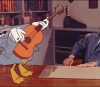
It’s worth mentioning the two Musical Miniatures, both completely Woody-free, in which Wally played the conductor of an animal orchestra, especially since an image from one of them appears at the beginning of this article: “The Overture to William Tell” (1947) and “Kiddie Koncert” (1948), one of many cartoons built around Franz von Suppé’s “Morning, Noon, and Night in Vienna” overture. In each instance, Wally enters with great pomp and dignity but it ultimately humiliated in the end: trapped inside a bass drum in the former cartoon, and stripped to his underwear and stuck in a spider’s web made of bubble gum in the latter.
You’re quite correct to note that Wally speaks with a Swedish accent “most of the time.” In “What’s Sweepin'” (1953), he plays a cop on the beat and has an Irish brogue to match.
I’m impressed with the Wally Walrus merchandise shown here: trading cards, coloring books, puzzles, and who knows what else! It’s probably for the best that he was phased out well before the studio’s long, sad senescence in its final years. He may have been a feckless boob, but I can’t help liking the big Swedish meatball. Ikea or Volvo should license him as a mascot; I’m sure he’d be available for cheap.
Say what you will about the Lantz shorts, I kinda like how his star characters (Woody, Andy, Wally) are unconventional animals/birds that haven’t been used by other studios yet. Not gonna lie, it’s pretty cool.
I always enjoy getting inside information on the Walter Lantz Studio and productions. As I’ve mentioned ad infinitum, one of my favorite shows as a kid was the original Woody Woodpecker Show, the version that included live action segments. The interaction between Walter Lantz and Woody was priceless.
In the comic books, Wally Walrus was less of an antagonist and more of a friend. The cartoons are another story. Which begs the question–are Woody and Wally friends or enemies? It seems that the word “frenemy” could apply to their relationship. Interesting to note about the tusks–I confess I never really noticed before. Definitely a detail worth paying attention to. What baffled me most about the character when I was young was the Swedish accent. I was raised without much awareness of various cultures or cultural differences. I couldn’t distinguish between accents. All I knew was that it sounded a little unusual to my ears. Now, of course, I get the gag that since walruses live in the northern climes, one of them might speak in an accent of the Scandinavian regions. It seems stereotypical now.
The Lantz stable of characters definitely had its own vibe. This was best evidenced in the Woody Woodpecker Show and in the comic book series New Funnies (which was defunct by my time but I had inherited a few issues). I recall a play set I had which was a flannel graph of the Lantz “family” of characters. In addition to the main headliners it also included Carrie Pigeon, Miranda Panda, and Winnie Woodpecker. Of course, Woody, Buzz, Wally, Andy, Homer, Chilly Willy, and the rest were all present. Not sure what happened to it, but I think I might have worn it out from playing with it as much as I did. However, once I started school, some of my old playthings had a way of “disappearing” and such seems to have been the ultimate fate of this set. In the 60’s the Lantz characters could often be found. I came across a coloring book in a drugstore which had an intriguing cover featuring a gathering of these characters, and I ever afterward wondered what delights awaited inside. But I never got a chance to find out, nor did I ever see that coloring book anywhere else. Although a couple of months later, I was given a “Spook-a-Nanny” coloring book which I greatly enjoyed. Speaking of which, it’s almost Hallowe’en so there’s one opportunity to revisit the Lantz characters coming up!
No one can tell me that Woody’s later foes Dapper Denver Dooley and Mrs. Meany were half as much fun as Wally Walrus. He was the perfect schnook for Woody’s antics.
Some of your spellings of names are questionable, it’s Grim NatWICK, not NatWORK. Also, it’s not Jack Maher, but Jack MATHER, who was one of Wally’s voices. Jack Mather did practically all of Wally’s cartoons in the 1940s, with the exception of “Smoked Hams”, where Wally’s voice was provided by Walker Edmiston (this information is from Cartoon Voices, Volume Two by Keith Scott). Also in “Smoked Hams”, the funniest animation of Wally was done by Grim Natwick, where his bed is changed into a pipe organ. Most of the animation of Wally in the earlier cartoons was by Emery Hawkins, who drew Wally very well. In “Wacky Bye Baby”, Fred Moore animated Wally in many scenes, and Les Klein did the sequence where Wally is playing hide and seek in the barrels with the “Come-Back Ball” loaded with dynamite! Grim’s handling of Wally was very loose, hardly constructed at all; Fred Moore and Emery Hawkins drew him with very definite shapes and great attention to his facial expressions.
True that about the names. I am a terrible typist and, of course, my proofreading tools are of very little use for names. I the future iwill tryto speilchook my own typingrather than freeotchichabble……….
I always thought Wally Walrus was such a funny contrast to Woody’s shenanigans. He should have been used more often then he did to really flesh him out.
I just had a look at all of Wally’s early Culhane-directed cartoons. Apart from “The Reckless Driver”, in which he has no tusks at all, Wally’s broken tusk is consistently the left one. He’s never shown to have a broken right tusk, or both broken or both intact. There is a painting error in “Chew-Chew Baby” where his broken tusk disappears altogether for a couple of frames, after Woody, dressed in drag as “Clementine,” kicks Wally across the room and he swoons “Ah, she loves me!” But that’s literally a blink-and-you-miss-it moment. Evidently Culhane exercised a high level of quality control over the cartoons he directed for Lantz.
By coincidence, the default language on my Woody Woodpecker DVDs is Swedish!
An enjoyable analysis, Martin.
Dick Lundy didn’t have any choice in being “phased out.” The studio closed.
The Musical Miniatures are fine cartoons with top-flight animation and musical coordination. Paul mentioned the finale of “Kiddie Koncert.” Lantz constantly complained in the press about the cost but he shelled out money for good people and, I suspect, higher budgets on the Miniatures.
Wally was also in the 1999 Woody Woodpecker Show, once again as a foil to Woody. “Ja, you bet!” Billy West voiced both characters.