




Ah, fellow toonsters! You let me slip up again, bypassing quite a few eligible titles, all without a peep of questioning. So we’ll start this week’s coverage with a number of out-of-sequence leftovers, then continue with Arabian material from 1957 and forward. There is, by the way, a LOT of Bugs Bunny this week, including three titles and a brief discussion of a fourth that doesn’t quite make the grade of this topic. Also among the highlights are an Oscar-winner from Disney, an almost-lost Fox and Crow, and a well-made rarity from David Hand’s short-lived studio in England.
 How did I (and everyone else) forget another of those Arabian-imposter stage magicians, who become a formidable foe for Bugs Bunny in Case of the Missing Hare? (Warner, 12/12/42 – Charles M. (Chuck) Jones, dir.). One of the earliest films to follow the Jones canon of making Bugs non-confrontational until fired upon – then, heaven help his opponent, as all hell breaks loose. (Notably, the near-opposite of Bob Clampett’s approach, who seemed to prefer making Bugs into another Daffy, causing chaos for the fun of it.) And one of the earliest Jones-Bugs efforts to deliver a goodly share of laughs and surprises.
Magician Ala Bahma, turban and all (though he also wears his tall silk hat as part of his street clothes when not on stage) is intent on not missing any possible opportunity for advertising his performance in town, and is plastering every available inch of space on any surface with handbills announcing his theater engagement. This includes a tree with a hollow trunk – which just happens to be the current (though uncharacteristic) abode for Bugs Bunny. The second that one of Ala’s handbills is nailed over the hole that is the entrance to the trunk, Bugs nonchalantly bursts right through the paper, passes Ala, and excuses the interruption he’s caused, declaring that he’s fresh out of carrots. The puzzled Ala is left waiting while Bugs plucks a new batch of carrots from the ground nearby, then returns to the tree hole with his groceries. Before disappearing inside, Bugs drops to Ala the information, “I live here. This is my home…such as it is.” Frustrated Ala re-hammers a new sign over Bugs’ hole double-quick. Bugs pops out again, now addressing Ala eye-to-eye with a new degree of irritation. “Look, doc, do I go around nailin’ signs over your house? Do I?” While Bugs lectures (as he would in several Jones films to follow) on the sanctity of the American home, Ala smugly asks for forgiveness, and asks if Bugs likes blackberry pie. In delayed reaction, Bugs responds, “Yum yummy.” “Well have some!” replies Ala, magically producing a pie from under a handkerchief, then smashing it in Bugs’ face. Bugs utters his Groucho Marx catch phrase (though uttered once before in a different voice in “Elmer’s Pet Rabbit”): “Of course you realize this means war.”
 The evening’s magic act is turned into a fiasco. Ala’s first trick (after having his cape hang itself up on air as if on a hanger, then tiptoe of its own power offstage) is announced as to pull a live rabbit from his silk hat. I wonder which of Bugs’ relatives was employed for the position? Nevertheless, the unseen hare seems to have been convinced to take the night off, as all Ala draws out of the hat is a carrot. Then, a wriggle up Ala’s sleeve, and a second head poking out of Ala’s collar, and we find the volunteer rabbit for the night is Bugs, who breathes in Ala’s face, “Ya didn’t expect to see me again, eh, Svengali?” Ala implores him to go away, as he is ruining the act. On the contrary, Bugs claims he’s here to help. To assist in the hat trick, Bugs stands on Ala’s head, dives into the hat as if off a diving board, then repeats Ala’s magic words within: “Rootah Voootah Zoot!” Bugs pulls himself out of the hat, lifting himself against gravity by clutching his own ears. He kisses Ala, and braids his moustache with a blue ribbon attached, then disappears into the hat again. A sign pops out of the hat: “Try tempting me with a carrot.” Ala lays one on the brim as bait. Jones repeats Tex Avery’s gag from “A Wild Hare” of having Bugs’ hand seek out the carrot, this time drawn with five fingers to resemble a sniffing dog. Ala whams down with a mallet, but Bugs’ hand has already moved to catch the mallet by the handle, and clunk the magician with it instead. (Jones uses on a one-time basis an interesting color idea, depicting stage-curtain detail in the backgrounds in solid layers of color without black borderlines – and changing the colors selected radically every time there is a violent impact, explosion, etc.) Ala reaches his whole arm deep into the hat, grasps something, and claims, “I’ve got him.” “On the contrary, I’ve got you”, says Bugs’ voice within. Indeed, Ala is pulled entirely into the hat, while Bugs slowly squeezes his way out past Ala’s girth. But Ala’s hand grabs him by the throat, yanks him back inside, and an unseen fist fight ensues within. Ala slips back out, and hammers multiple layers of wooden boards over the hat’s open hole, to keep the pesky rabbit trapped inside.
 For his next trick, Ala requires the assistance of a small boy from the audience. “I will be happy to assist you, sir”, says a small voice. It is really Bugs, dressed in a classic “Buster Brown” suit. (How he got out of the hat is a magic trick that only those in the industry will ever learn the secret of.) Ala announces he will place the boy in a basket, then run razor-sharp swords through it. However, he whispers to the boy that it is a trick – the swords do not penetrate. Bugs drops into the basket, sharing a secret wink or two with Ala, and the act begins. Ala can sense trouble, when the first blade barely begins to enter, and a series of ultra-painful sounding moans begins to emit from the basket. Jones plays the scene with facial nuances predicting later Wile E. Coyote work, as Ala beginning to sweat bullets, his eyes apologetically seeking the understanding of the audience. He slips the second blade in with deliberate slowness and delicate care, receiving no further moans as it is placed all the way in – then a delayed moan that sounds twice as excruciating. Ala jumps with fright, then flashes a weak, sheepish grin at the camera, wishing there were any way out of this nightmare. A hand passes off to him a third sword, and Ala’s face visibly ponders just how to approach inserting this one. But Ala gets even more startled when the moaning begins again, before the sword has even touched the basket. Ala drops the blade, and decides to turn to see who his stage assistant is. To his amazement, it is Bugs, who is turning out to be a better magician than Ala ever was, by escaping the basket unseen, and moaning up a storm of “Oh agony, agony” from behind Ala. Ala soon makes Bugs realize the charade is over, by slipping up behind Bugs’ shoulder, and asking, “Does it hurt very much, sonny boy?” Bugs seeks a quick escape, diving for the magic hat – but forgets its entrance has been boarded up, smacking face-first into the wood. (A nice touch of storytelling continuity, rather than having old props disappear – something Jones would use to surprise advantage is several Wile E. Coyote situations later.) Ala selects his largest sword, and advances on Bugs. Bugs stalls for time, breaking into a childish game of counting and hollering “Red light”. Gullible Ala keeps halting whenever Bugs hollers, freezing him momentarily in strange, awkward poses. Then Bugs performs a split-second change of costume, dressing in a professional fencing outfit and wielding a fencing foil, challenging Ala to duel in broken-French. Ala meets the challenge, diving into battle with Bugs in a whirlwind of flashing steel. But Bugs is again the better illusionist, not within the whirlwind at all, but seated in a balcony box applauding the show, and shouting, “What a performance, D’Artagnan! What a performance!” Ala, huffing and puffing, has reached his limit. Producing a double-barreled shotgun from nowhere, he fires point blank into the balcony box, then smiles, assuming the rabbit as been obliterated. Wrong again. Bugs pops out from the now un-boarded hat on the table next to Ala, stuffs a cigar into Ala’s mouth as a prize for his fine shooting, then lights it. An exploding cigar – leaving Ala’s face charred and blackened. Then Bugs reaches into Ala’s pocket, produces the handkerchief seen earlier, and produces from under it another blackberry pie. Quoting Red Skelton’s “mean widdle kid” character, Bugs states to the camera, “If I dood it, I get a whippin’. I dood it!” Smack goes the pie in Ala’s face, leaving its filling dripping all over the drip. Revenge is complete, and Bugs produces from nowhere a Hawaiian ukulele, and makes a graceful stage exit back into the mysterious hat, singing “Aloha Oe, farewell to thee!”
Legacy of this film seems to have been long, with its frequent re-screenings in the television era, and its obvious influence on one of the last stage-magician theatricals, Pixar’s “Presto” (2008), similarly pitting a magician at war with his hat-rabbit in Warner-like gags and pacing.
 Mysto-Fox (Screen Gems/Columbia, 8/29/46 – Bob Wickersham, dir.) has been discussed from time to time on the pages of this website. It is the only Fox and Crow title for which no surviving color elements have been found, and seems to exist only in a 16mm black-and-white source without titles. It again pits a turbaned stage magician against his rabbit – except that this time, the rabbit is really Crow in a cheesy disguise, trying to muscle-in on a want ad for a magician’s rabbit offering free room and board. Crow minces no words at trying to do his best impersonation of Bugs Bunny, right down to asking at the door, “Eh, whadd’ya know, doc?” He is the only rabbit to attempt to eat a carrot while simultaneously chomping upon a cigar (though he actually has no taste for the vegetable, and keeps spitting out the pieces unseen behind doorways and furniture, as if hitting a spittoon). Fox is at first unconvinced that Crow is the genuine article, until Crow displays his “rabbit” appendages – one at a time, disconnected from his body – including a “rabbit’s foot” that is on a chain. Crow is hired – two minutes before showtime. Fox tries to shove Crow into a magic hat, but Crow’s head and big feet keep popping out the top and sides. So Fox improvises, grabbing a long strip of fabric, knotting it around Crow’s waist, then spinning Crow like a top, creating a turban around him, which Fox places upon his own head.
 Fox makes his entrance on stage, taking bows to the audience. He becomes a bit upset when the figure of Crow is seen through the turban fabric, attempting to upstage Fox with his own bowing. Fox cures this unwanted behavior by smacking the turban with a mallet. Fox begins with an attempt to pull the rabbit from the hat, but can’t get enough of a pull upon Crow’s feet to extricate him. Grabbing the mallet again, Fox attempts to remove Crow from the turban with a golf-swing of the implement. His blow only succeeds in unraveling the turban, its fabric entwining itself around Fox’s torso instead, leaving him bound and with the appearance of a worm, while Crow stands atop him and takes another bow. Crow decides to play his stage presence for all it’s worth, and announces the next trick himself. “For the first time in magical history, a rabbit will saw a magician in half.” Swinging the mallet, Crow bats Fox into a wooden box, nails the lid shut upon him, and calls for “Music.” Taking up a saw, Crow begins dissecting the box, not into halves, but quarters. Fox’s protruding head displays a sickly expression, as he tells the audience. “Just call me Shorty.” As Crow saws through the last section, Fox cringes, and the saw blade makes contact with something solid enough to warp the saw’s teeth. Crow reaches into the gap he has made in the wood, and pulls out Fox’s pocket watch, nearly severed in two, with hands spinning and springs popping. Crow attempts to discern the time, and decides its his lunch break, so piles the four box segments vertically, with Fox’s head on top, and hops away to get something to eat.
 Fox, however, is not done in, and bursts out of the topmost box segment, all scrunched up within. He stops Crow’s exit, telling the baffling bunny that he can have lunch right here. Fox magically produces a pie, repeating Ala Bahma’s trick of splatting it in Crow’s face. He then adds a multi-layered cake, and a half-dozen eggs, all splattered atop Crow’s head. With a shot of a magic pistol, Crow is cleaned up and emerges, waving a pair of small flags. Another bash from the mallet, and Crow is reduced to a small cylinder. Fox announces the grand finale, and stuffs the cylinder down the barrel of a huge artillery cannon. Then, he vigorously tamps Crow deep within with a large ramrod. He exerts too much force in this effort, and Crow emerges at full size, forced out the rear hatch of the cannon barrel. Moving quickly, Crow replaces his own volume within the cannon chamber with several kegs of gunpowder, closes the hatch, and pulls a firing pin. The cannon sounds with a massive recoil, and Crow hops away, thinking that is Fox’s end. But Fox is also a master of escape, and now stands directly in Crow’s path, unhurt, and with wand in hand. “Abra-cadabra-cadabra”, chants Fox, as sparks emit from the wand at Crow. Crow’s disguise becomes markedly more convincing, as Fox has unleashed a spell which really transforms Crow into a genuine, furry rabbit. Then Fox turns the cannon upon him, apparently declaring his own open season upon rabbits. The film ends with a perspective shot, as Crow exits the tent through a hole blasted by the first cannon shell, dodging artillery fire all the way to horizon line, for the fade out.
 The Ostrich (David Hand, Animaland, 5/10/49 – Bert Felstead, dir.) – As I often contend, cartoons can teach you something. Ostriches, you might ask, in Egypt? We’ve had at least one prior sighting of one in an earlier cartoon, though it might have been presumed that this was merely a rare bird collected in some exotic palace garden. This cartoon, however, shows them as native to the desert area surrounding the ancient palaces. This was certainly not a phenomena I was familiar with at time of writing, which caused me to look it up. The reason for my unfamiliarity became obvious – the last populations of wild ostriches in Egypt went extinct in the 1990’s! But in 1949, they were commonplace. Thus, this film stands today as an historical artifact of a bygone era – almost as poignant as if someone had animated a nature study of the dodo bird in its heyday, without intending to present an episode of “The Flintstones”.
The David Hand “Animaland” cartoons were, as we’ve discussed on occasion on this website, created in an effort to take advantage of a temporary trade war in film rentals, under which imports of American films were saddled with costly extra charges in British markets to promote the home-grown film industry, while domestic cinema could be obtained for much lower rates. Two rival American animators, David Hand and the competing George Moreno Jr., tried forming British animation studios to corner the island’s cartoon market (while Halas and Bachelor, the only studio in the kingdom founded by residents of the UK, would ultimately be the only one to survive on). However, once arrangements were reached with the American film industry to lift the prohibitive charges upon the American product, the Hand and Moreno studios cold no longer effectively compete, and gave up the ghost. The Hand studio’s disbandment was regrettable, as his was some of the most polished animation to ever grace the screen from the isles, though some have observed that his gag sense was not cutting-edge, being more attuned to gentler humor, much in the manner of Myron Waldman, with sometimes exceptional posing, facial nuances, and personality animation. His years of Disney training are quite evident in the quality of drawing, backgrounds, and smoothness of motion. Bert Feldstead, who appears to have received most of the studio’s directing credits, must have been an avid student of Hand’s style and animation mastery.
 The story begins upon an unusual, and not necessarily documented by nature study records, premise that the ostrich is a bird who is born out of the egg intelligent, but grows more stupid with every passing day into maturity. We are thus presented with a character study of an unusual pair – a young ostrich, waiting to hatch out of its enormous eggshell, and a dense and dumb Papa, saddled with the task of egg-sitting. (Heaven only knows where Mama is, but we can only guess she is off somewhere gallivanting, engaging in conduct as equally stupid as what we will soon see from Papa.) Dawn breaks, and an unseen alarm clock rings inside the egg. The sun rises behind the shell, revealing a “candle” view of shadow inside the egg, of the rise and shine of Baby ostrich, who performs a vigorous regimen of morning calisthenics, then relaxes, leaning in a standing pose against the side of the eggshell. The shell rolls sideways from his leaning weight, out from under the tail of Papa. Papa plops to the ground, but remains oblivious to the egg rolling away, and reseats himself – upon thin air. The egg is rolled back by the chick within, and the shell taps gently at Papa’s feet. Papa opens his sleepy eyes, and doesn’t know what to make of this persistent orb, as he assumes he is already sitting on one. He gives it a kick, cracking the shell, and revealing the happy Baby ostrich clinging to his foot. Still confused, Papa kicks again, launching Baby briefly away. But Baby returns, smiles, points to himself, and points between Papa’s legs at the spot where his egg used to be. Still slightly bewildered, Papa finally looks down, discovers he is sitting on nothing, and falls down headfirst, his head getting buried in the sand. Unable to get his bearings, Papa proceeds to trudge along the sand in a forward direction, all the while forgetting to lift his neck, so that his head remains submerged and burrows a path in the desert sand. Baby realizes the only way to straighten this out is to run on ahead, dig a hole in Papa’s path leading to an upward slope of dirt, and have Papa’s head follow the upward slope to raise his neck above ground level. The idea works, but Papa continues to leave his head at the level where it reached the top of the slope, races forward, and catches his head in the crotch between two branches of a low dried-up tree near the ruins of a temple. Shifting his feet into reverse, Papa’s head repeatedly gets caught between the branches. Only after considerable struggle does Papa get smart enough to raise his neck vertically – but he only does so to crane his neck around the wood for a forward view of the two branches to assess the situation, then replaces his head where it was to get stuck all over again. His body twists and spins, until his neck and one leg are braided like the rubber band of a kid’s balsa-wood airplane. Suddenly, his head spins like a propeller, and he is driven backwards, flying through the air (I thought the ostrich was a flightless bird), then into a top-spinning nose dive into an old slab of wood near the temple. His beak drives into the wood, carving up a mountain of wood shavings, and when Baby looks at the outcome, Papa has taken on the appearance of a bird-headed sphinx with curly locks.
 Papa is finally seen standing, free of shavings, and walking past still-standing segments of the ruined walls of the temple. He reacts in terror and retreats behind a wall when he sees upon another wall the painted image of a ferocious lion. Baby observes this, and, being smarter than Papa, approaches the painted image without fear, points out to Papa that the lion is not moving, then gives the image a swift kick, all without retaliation. Papa still isn’t quite sure he has really seem what he’s seen, and slowly advances forward, giving the painting a wide berth of distance as he passes, then timidly backs his way toward the painting’s rear-end, and barely lays a tap on the painting’s shoulder with one toe. Nothing happens. Papa suddenly brightens (in a slightly cross-eyed, dim-witted smile that exudes all the mental confidence of a Mortimer Snerd), and he continues onward with a cocky air, kicking at every new painted lion that he encounters. But a new painted image makes him stop in his tracks, bringing on a whole new set of emotional reactions. A painted image of a female ostrich with long eyelashes! (The initial drawing of her is quite expertly executed, exhibiting scratches and discolorations that make the image really feel as if it has endured the weather-beating of time. However, these unique features are soon abandoned in the footage that follows.) Papa turns his head and blushes from neck to brow in bright pink. Baby approaches Papa’s feet, and tries to understand what Papa’s fascination is all about, but Papa feels Junior is cramping his style, and gently but insistently pushes Junior away with one foot, as if to say “None of this until you’re older.” Baby can only shake his head, having had just about enough of Papa’s stupid shenanigans, waves his hands as if to wash them of the whole situation, and walks away. Papa is now free to do some courting. (Again, where is Mama when you need her?)
 A delightful production number follows, sung by a vocal group called The Radio Revellers (who sound like a twin to the harmonies of Disney’s The King’s Men), entitled “Don’t Hide Your Head In the Sand”. Papa lays a smooch upon the cheek of the painted ostrich, who suddenly comes to life, moving in stilted, often two-frame cycles suggesting her static, angular life as a hieroglyphic image. Her head bobs along with Papa, their craniums clunking together several times, producing a spray of little hearts with each impact. Suddenly, the female becomes the aggressor, winding her long neck around Papa’s, and dragging him into the hieroglyphic world with a continuing two-frame sashay. Papa takes a brief time-out to meet Cleopatra, who gives him a few caresses under his chin, then a playful slap on the cheek. A painted palace guard tries to take a swipe at Papa with a sword, but the smitten Papa takes a leap for joy into the air, bursting through a painted floor level out of the guard’s reach, and getting his head stuck halfway through the line of another floor. A male and female pair of Mummy Cases join in the dance, while Papa and the female ostrich engage in a few jitterbug moves. A parade of other painted images, both animal and human, passes in review on two levels (Hand perhaps remembering the parading images of Disney’s “Egyptian Melodies” and attempting to replicate them in simpler form but in Technicolor). One image of the Pharaoh is humorous, showing him with a much larger wife and stuck with the duties of rocking an infant son, who takes time out to vocally observe in the song lyric that even the Pharaoh couldn’t dodge Cupid’s arrow. The celebrating continues, until the female ostrich spies something ahead, and freezes in her tracks in a shock pose. Ahead of them on the wall is another of those ferocious-looking lions.
 But Papa has experience in such things by now, and waves to the female not to fear. Papa strides forward, and delivers upon the lion a good kick right in the jaw. But Papa forgets that he is now within the lion’s plane of existence, and the lion responds with a savage chomp of his powerful jaws at Papa, and preparation to advance. Papa spins about and retreats for his life, the lion following at tremendous speed but still moving in hieroglyphic two-frame cycles. A painted palm tree approaches along one side of Papa’s path, behind which the female has already taken refuge. She sticks out her long neck, snagging Papa in it again, and yanks him behind the tree, letting the lion pass. With the danger gone, now Papa does the neck-dragging, emerging from behind the tree and proceeding back in the opposite direction, dragging along the smiling female as his new chosen-one. They reach the end of the ruined wall, and Papa steps off the stone face into the real world, still tugging the female along. But once off the stone, the female reveals her shortcomings. She is merely a flat coat of paint, so thin that when she is turned at a 90-degree angle, you can’t even see her. Baby appears, demonstrating this to Papa, then positioning her visible to the camera again, where the thin expanse of paint wobbles, curves down like a scroll of paper, and drops the head of the painted image into the desert sand upon which she stands. Papa again knows not what to make of this, and can only think to bury his own head in the sand near hers to join her. Baby is left wondering what to do, being the only one remaining standing in this situation and feeling left out – so he too tries to submerge his head in the sand. Unfortunately, his head hits a rock buried shallowly under the surface, causing him to fall backwards, dazed and confused. Could be that some of Papa’s stupidity is starting to rub off upon him, to stay with him into his ripe old age?
 I’ll just make a mention of Bowery Bugs (Warner, Bugs Bunny, 6/4/49 – Arthur Davis, dir.), and why I’m not technically including it. Though about two-thirds of the cartoon are spent looking like they are in Arabian trappings, we have another of those cases where animation studios can’t draw a visual distinction between the magical traditions of the Middle East and those of India. Bugs’ latest disguise has him posing as fortune teller Swami Rabbitima, advisor to down-on-his-luck Steve Brody to provide him with a good luck charm (and in the process avoid Brody’s threat to take one lucky rabbit’s foot if the charms don’t work). It turns out that the term “Swami” derives from Indian culture and not from the Middle East. (My apologies, thus, to such past oversights as including Popeye’s “A Balmy Swami”.) Deferring to the writers’ wishes of depicting Bugs as posing as from India, despite no visual imagery that would give this away, I’ll thus classify this cartoon as outside our subject scope. By the way, Bugs’ efforts succeed in inducing madness in Brody, causing him to commit his historic jump off the Brooklyn Bridge in a flashback sequence. The whole thing, however, turns out to be a tall tale concocted by Bugs in the present day, as part of a sales-pitch in the old con-game of selling a hayseed farmer the Brooklyn Bridge.
• “Bowery Bugs” is on FaceBook
 Toot, Whistle, Plunk, and Boom (Disney/RKO, 11/10/53 – C. August (Charles) Nichols/Ward Kimball, dir.) – An Academy Award-winning masterpiece, pushing the envelope in a “modern” direction in several respects. On the technical side, it was the first cartoon short produced in Cinemascope (no doubt contributing to its visual appeal in the Oscar contention). Artistically, it is the second of Disney’s nods to pure UPA visual-styling and flat, angular characters, much to the credit of the wild imagination of Ward Kimball. (Many forget that it was actually a sequel to the much less frequently screened, “Melody” from earlier in the same year, another title shooting for technical breakthrough by release in 3-D – and in fact, still shows artifacts of also being originally conceptualized for 3-D format, particularly in the filming of the “Concert Tonight” finale using depth perspective upon entering the theater and approaching the stage.) And, it is something of a landmark in mixing entertainment with education, gingerly blending both in nearly equal doses, so that it teaches its lesson without boring the adults or letting on to the kids that there really is a lecture going on. This format would provide a general template to be followed frequently in Disney television to come, such as the Jiminy Cricket segments of the Mickey Mouse Cub, and many an episode of “Disneyland” and its successor anthologies. It is in fact surprising that the education becomes so effective in this ten-minute long special, as the previous “Melody” really taught us almost absolutely nothing.
 Professor Owl’s bird-house little red school, with an all bird student body, receives a lesson on “the study of musical instruments.” The Professor (voiced by Bill Thompson) covers a lot of ground in ten minutes, both in subject matter and geographically. He traces all four families of musical instruments (brass, woodwinds, strings, and percussion) back to the first cavemen to invent primitive versions of them, the lecture being framed by returns to their performances as a pre-historic jazz quartet. Each orchestral family is then treated separately, tracing its development up to the modern era. Brass perhaps receives the lion’s share of the footage, the other musical branches receiving quicker coverage. In the course of the brass study, origin is traced to a caveman blowing through a cow’s horn, before metallurgy provided a way of manufacturing horns to fit man’s musical needs. The switch to brass is illustrated by time-transporting the caveman to the banks of the river Nile in ancient Egypt, where he enters the royal palace to play his cow-horn solo before the Pharaoh. His sour tooting receives a simple reaction from the ruler – a sound conk on the head, delivered with a new instrument fashioned in brass. The old music is “not good enough for the old Pharaoh”, and even the caveman sees new possibilities from the device with which he has been clunked. He starts blowing up a storm on the metal wonder, and the Egyptian figures painted on the palace wall immediately engage in a dance of wild abandon – as does the Pharaoh. The caveman has enough of a well-developed embouchure to become the hit of the palace, and the camera pulls back from the Professor’s scrollable visual-aids to find the Professor himself vigorously performing the same dance.
The cavemen, by the way, keep getting projected forward through the eras, and end the film leading the four sections of a modern symphony orchestra in a concert hall.
 Now we’ll pick up where we left off last week. Popeye can’t resist one more misadventure in middle-Eastern garb, in yet another cheater, The Crystal Brawl (Famous/Paramount, 4/5/57 – Seymour Kneitel, dir.). Not much in the way of plot. Popeye shows up at Olive’s door, set to take her for a date to the fair. Before Olive can open the door, Bluto shows up, snags the limb of a tree into the collar of Popeye’s sailor suit, and flips him up in the air, out on a limb, while Bluto pretends Popeye couldn’t make it, and talks Olive into going to the fair with him. As the two leave the house, Olive remarks to Bluto that she’s dying to find a fortune teller at the fair and have her fortune told. Popeye in the tree above overhears. Popeye somehow not only manages off-camera to extricate himself from the tree, but to beat Olive and Bluto to the fairgrounds. (Convenient how all this unseen action saves on animation budget.) He spots a fortune teller’s tent with a sign hung out reading “Out to lunch.” Along come Bluto and Olive, and miraculously, a bearded and turbaned fortune teller is now seated in front of the tent, playing a snake charmer’s flute.
 Bluto and Olive enter, and the teller follows them inside, then seats himself behind a table bearing a crystal ball. “Abra-cadabra-cadoucher. Crystal ball, show me this lady’s future”, says the teller’s gravelly voice (not too far distant from the voice Jack Mercer would eventually mold into that of the Professor for Felix the Cat). Olive can really see images within the ball, and we are shown extended clips from “Alpine For You” and “Quick On the Vigor”. Odd that these clips are presented as if visions of the future – when all past cheaters have referred to the clips as definitely events of the past or present. The ball only shows events where Bluto gets unexpectedly fresh with Olive (as if Olive by now wouldn’t know that Bluto is always prone to do so). She walks out, stating she never wants to see Bluto again. The laughter from the fortune teller gives away the obvious to Bluto – that it is really Popeye in disguise. Bluto socks the sailor, who flies through the tent roof, and lands in the middle of a farm tool exhibit, pinned down to the platform by pitchforks, shears, picks, axes, etc. Bluto pursues Olive, and they both disappear in a chase though the Tunnel of Love. Popeye meanwhile spots bushels of blue-ribbon spinach on display in the next booth, and, grabbing the handle of a pitchfork between his teeth, manages to scoop up and toss to himself a good mouthful. He frees himself from the tools, then gazes into his own muscle, which serves as a crystal ball to reveal Olive’s predicament inside the tunnel. Popeye darts into the tunnel, socks Bluto, and leaves him hanging from the pitchfork of a statue of the devil, held over a fire-pit from Hades that repeatedly shoots flame at Bluto’s rear end, as Popeye and Olive exit on one of the tunnel’s boats, laughing.
 International Woodpecker (Lantz/Universal, Woody Woodpecker, 7/1/57 – Paul J. Smith, dir.) is an extended collection of historical spot gags, framed around Woody showing to nephew and niece Knothead and Splinter the woodpecker’s role in history, via an old volume in Woody’s library. It features one brief gag falling into our subject theme. An Italian ancestor of Woody receives a thumbs-down from a Roman audience after showing off with a lion in the coliseum. The lion bites the woodpecker’s topknot feathers off. The startled woodpecker leaps for safety – right through a sixth of the coliseum’s outer wall. For this “remodeling” job, “Italy gave him the boot” – depicted by the woodpecker receiving an out-of scale kick in the tail feathers by the boot-shaped outline of the Italian border on a map. He soars across continents, and lands in Egypt, where he proceeds to “make a few changes on the map – especially, this map”, as he lands upon the face of the Sphinx, which displays a sculpted nose almost as long as Pinocchio’s. The woodpecker cracks the stone nose right off the sculpture’s face, leaving a flattened hole. The Sphinx’s eyes stare cross-eyed at the marring of his facial appeal, as we fade out on the sequence.
• “International Woodpecker” is on Archive.org
 Show Biz Bugs (Warner, Bugs Bunny, 11/2/57 – Friz Freleng, dir.) is another well-known classic in the Bugs and Daffy team-ups, combining a mix of both old and new Freleng gags for a competitive vaudeville show between the two stars. Daffy can’t believe that his marquee billing is in minuscule letters on the theater, dwarfed and second to the name of the rabbit – or that his dressing room is the Men’s room with its sign flipped over to pencil in his name. He is told by the theater manager that they bill according to drawing power, and remarks in reply that the rabbit “couldn’t draw flies if he was covered with syrup.” Daffy accepts the challenge, stating that tonight’s performance will prove that HE is the star.
The film presents a landmark in visual style, Bugs and Daffy’s soft-shoe tap duet providing the blueprint for the classic opening credits of the original “The Bugs Bunny Show”. Then Daffy goes into competitive mode, attempting to upstage the rabbit at every turn – fatally, if necessary. One sequence falls within our subject, as Bugs too becomes a turbaned stage magician. He informs the audience that he will now saw a volunteer in half. “WHAT! Don’t tell me you’ve got the gall to pull that old sawing in half routine?”, complains Daffy. To show the rabbit up, Daffy offers to be the volunteer, while attempting to verbally inform the audience why the whole thing is a fraud. “Fake feet out one end, and I’m all scrunched up in this end. The oldest trick in the book. His turban’s a fake, too. Just a hotel towel.” Bugs separates the sawed halves of the box, and the audience responds approvingly. “Don’t applaud him. I’m not cut in half”, insists Daffy, leaping out of one end of the box. As he does so, his top half bounces independently from his bottom half on every leap. Daffy stares downwards, observing this unexpected twist of fate, then remarks as he makes a quiet exit, “Hmmph. Good thing I’ve got blue cross.”
In case you don’t recall, Daffy ultimately proves his point of being the world’s greatest entertainer, with an act where, dressed in a devil suit, he ingests all manner of explosive substances, then swallows an ordinary match. All that is left is a charred mark on the stage floor. Bugs applauds from the wings in recognition of Daffy’s talent. “That’s terrific, Daffy…They want more.” The transparent spirit of Daffy, floating up to the theater rafters, gets the curtain line: “I know, I know. But I can only do it once!”
• Show Biz Bugs can be viewed on Vimeo
 Hare-abian Nights (Warner, Bugs Bunny, 2/28/59 – Ken Harris, dir.) – No idea how or why Harris takes the director’s chair here, for what might be his only such credit for Warner (while also receiving simultaneous credit in his normal animation berth). But, being that this is another of those quota-filling cheaters, there wasn’t that much needed to direct. Actually, the new footage is far above-average for what it is, being unusually written by Michael Maltese, and vastly superior to some episodes of similar vintage such as Freudy Cat, Tweet Dreams, and (dare I say it, Friz?) Devil’s Feud Cake. Within the throne room of a sultan’s palace, a command performance is in progress. A square stage rests in the center of the room, upon which the current performers (an off-key Arabian dixieland combo called the Timbuk Two Plus 3 (a gentle dig at Disney studios’ in-house animator band, the Firehouse Five Plus Two) beat out a rendition of “Sweet Georgia Brown”. The sultan (who, until the cartoon’s end, is never seen by his face – only from rear views of the throne or profile shots from the neck down) raises his index finger to a red button, upon a golden control box on which is engraved the words “Crocodile Pit”. A buzzer sounds as the button is pushed, and a trap door opens under the band, depositing them with a splash into the unseen pit below. “They did not entertain the sultan”, observes a palace emcee conducting the affair, who claps his hands, ordering “Bring on the next performer.”
 A palace guard stationed just outside a velvet curtain (who looks identical to Chuck Jones’ “The Crusher” wrestler – so this is what he does between championship bouts) opens the curtain, and orders the next in line to “Perform!” He sends in a rock singer/guitarist named “El-Viz Prezlii”, who, after swallowing hard when seeing the sultan’s hand already hovering over the button, breaks into a brief rendition of his own composition, “You Ain’t Nothin’ But a Hound Camel.” A number like that could only mean a quick trip to the crocodiles. The parade of talent goes on, as we dissolve to an exterior view of the desert, and that inevitable gopher trail of kicked-up dirt in the sand that heralds the arrival of our favowite wabbit. His trail takes a few unusual turns, tunneling under a camel’s feet and toppling him on his belly, splitting through the wooden planks of a moat drawbridge, and upturning a double row of floor tiles in the talent waiting room. Bugs finally pops out, observing that this looks nothing like Perth Amboy. (Bugs always chooses such off-the-beaten-path travel destinations!) He for once determines he should have taken a left turn at Des Moines (mispronouncing it phonetically). Believing he is in a theater lobby, Bugs asks Crusher what time the cartoon goes on. Crusher tells him to get back in line with the other performers, but when the call comes from within for another performer, Crusher gets a better idea, and shoves Bugs into the throne room first. Since Bugs hasn’t announced any act, perhaps the staff within gets the order of intended performers confused, as a sign is placed next to Bugs on the stage reading, “Teller of Tales.” The master of ceremonies warns him to make his stories entertaining, or it’s the crocodile pit.
The one flaw in this setup is the fact that Bugs, from his vantage point on stage, can obviously see what we don’t of the sultan – his face. Yet, he proceeds ahead with his storytelling, as if he does not know the identity of his audience. Extended clips follow to illustrate Bugs’ stories, including from “Bully For Bugs”, “Water, Water, Every Hare”, and finally, “Sahara Hare”, where Bugs refers to Yosemite Sam as “the stupidest character of them all” and a “maroon”. The payoff of the film is supposed to parallel the surprise reveal of the unseen animator in “Duck Amuck” and “Rabbit Rampage”, but just doesn’t work in its reveal of Yosemite Sam as the sultan, who is finally seen from a forward view in full lighting. (This, by the way, marks what I believe is the only time in classic Warner history that Sam was not directed by Friz Freleng – and it shows slightly, in less expressive than usual facial reactions.) Perhaps this could have worked if Sam’s throne had previously been seen only in severe shadow, with only the hand poised over the control button in full lighting, and a mere pair of menacing eyes visible to Bugs in the blackness. Sam, insulted for the last time, pushes at the control button, muttering “Down to the crocodil-lees ya go.” But the button won’t buzz or respond, no matter how many times Sam pushes. Why? Bugs has already pulled a power switch on the wall to “off” position. Frustrated Sam begins stomping on the empty stage, shouting, “When I say, down, I mean…” Bugs returns the switch to “On” position, and the trap door opens immediately. “…Down???” states Sam, completing the thought, as he falls helplessly into the darkness, then scrambles out, with a crocodile chomping upon his rear end, and both of them exit the palace. Bugs is now seen seated upon the Sultan’s throne, each ear wrapped up in a separate turban of its own, as Bugs gives his reaction to the fleeing Sam. “Not a bad act, but, eh, don’t call us, we’ll call you. And I can think of a few things I’d like to call him!”
• “Hare-abian Nights” is at Ok.Ru.
NEXT TIME: Delayed a week due to catching up on missed titles, we’ll trek into the desert epics of the 1960’s.
 Charles Gardner is an animation enthusiast who toils by day as a member of LA Law – but by nights and weekends indulges in classic jazz and ragtime as a performer; and studies classic Hollywood cartoons… maybe a little too much.



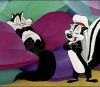


“Peek-a-boo, I can’t see you.
Everything must be grand.
Pook-a-bee, they can’t see me,
As long as I’ve got my head in the sand.
Peek-a-boo, it may be true,
There’s something in what you said.
But we’ve got enough troubles in everyday life;
I just bury my head.” — Michael Flanders, “The Ostrich”
It’s true that ostriches were present in Egypt until fairly recently. They appear frequently in the art of the Pharaonic period, though perhaps less often than ibises, jackals, or falcons. Ostriches also inhabited the Arabian Peninsula until they were hunted to extinction in the last century, and their fossil remains have been found as far afield as India and Eastern Europe.
Ostriches gained a reputation for stupidity as a result of their unfortunate habit of gobbling any bits of rubbish that zoo visitors threw at them; as cursorial omnivores in an arid climate, their instinct in the wild is to swallow anything that moves. That, and the fact that the ostrich’s brain is smaller than either of its eyeballs.
One fact the Animaland cartoon got right is that the male ostrich does indeed tend the nest at night, when its black plumage provides better camouflage in the dark than the female’s. Another fact that it got wrong, along with practically every cartoon about ostriches ever made, is that only the adult male ostrich has black feathers with white wing and tail plumes. Adult female ostriches are brown, and young ostriches are buff-coloured with dark speckles.
Of course you’re free to include or omit any cartoon you please in this series, but as the case of “Bowery Bugs” illustrates, all of these old cartoons are such a mishmash of culture and geography that it’s hard to know where to draw the line. To cite another example, in “The Beach Nut” (1944), Woody Woodpecker disguises himself as an Oriental fortune-teller in the mode of Popeye in “The Crystal Brawl” or Bimbo in “Is My Palm Read”. However, he calls himself “Yogi Yoyo,” and a yogi is a practitioner of yoga in Indian religions, which would disqualify this cartoon on that basis alone — even though Woody sports a turban (the standard headgear of Sikhism) bearing a Turkish crescent moon, and enters on a flying carpet straight out of the Arabian Nights. Growing up in the Detroit area, I knew better than to refer to Persians or Chaldeans as “Arabs” (because they got very offended if you did), but the cartoonists of animation’s Golden Age were evidently oblivious to such fine distinctions.
Two Japanese animated features I hope you’ll look at are Toei’s Sinbad The Sailor (1962), written by Osamu Tezuka and Tezuka’s own 1001 Nights (1969), codirected by Eichi Yamamoto.
Also, if you are going to discuss tv cartoons, there’s H-B’s Arabian Knights segment of the Banana Splits show.
The lobby cards for the Bugs Bunny cartoons aren’t nearly as wretched as Bela Rieger’s poster art for MGM, but the ones shown here are a mixed bag. The card for “Show Biz Bugs” works because it perfectly encapsulates the dynamic between the two leads. On the other hand, the card for “Bowery Bugs” tries, and fails, to convey a sense of depth and perspective; it looks as if Bugs is being pursued, not by a big brute in the distance, but by a tiny leprechaun. The first card for “Hare-abian Nights” at least captures the Middle Eastern setting, though the scene occurs nowhere in the cartoon itself; but the second had me wondering: “What happened to Bugs Bunny’s ears? Why are they covered in bandages?” Then it dawned on me: “Oh, I get it! They’re turbans! TWO turbans! One for each ear, as worn by the well-dressed wabbit in Hare-abia!” Maybe the artist thought that Bugs would be unrecognisable as a rabbit with just a single turban, but the fact is, he doesn’t wear a turban at all in the cartoon, much less two. A better composition would have Bugs surrounded by a scimitar-wielding Crusher on one side, and the crocodile pit on the other. Anything but those weird twin turbans.
Technically, it should be better to said that “Hare-abain Nights” is the only time in classic Warner history that Sam was not made by Friz Freleng’s unit, as Sam’s last classical appearance “Dumb Patrol” (1964) was directed by Gerry Chiniquy, but the latter one was still made by Friz’s crew (maybe it could be possible that Friz planned “Dumb Patrol” like Chuck did in “Woolen Under Where” and “The Iceman Ducketh”, but it hadn’t been confirmed yet). And also a scene of Sam from “Piker’s Peak” was re-used in Bob McKimson’s “Dog Tales” (1958)
It’s true that the scene of Sam with the St. Bernard dog from “Piker’s Peak” was reused in McKimson’s “Dog Tales”. However, in the latter cartoon Sam was redrawn, to resemble a generic Swiss mountaineer, so I wouldn’t count that as an appearance by Yosemite Sam.
Well, it still looks resemble to Sam to me. But yeah, even if it was, Sam didn’t really have a role there.