




Some short visits to the lands of burning sands in several films today, but at least four more dedicated stories straight out of the Arabian mold, including two classics from Bugs Bunny, another romantic adventure with Pepe Le Pew, and a tale of the foreign legion starring the red-headed trouble-maker, Woody Woodpecker. Also visits from the wacky mind of Tex Avery, the near-finale for Goofy, and a far-out departure from the norm for Donald Duck by director Jack Kinney.
 Little Johnny Jet (MGM, 4/18/53 – Tex Avery, dir.) – An Academy-Award nominee receives honorable mention here for a brief Arabian gag. What is life like after WWII for “an old, burnt out B-29? This riveting question is answered in high-polished detail by gag king Avery, providing his own spin on the basic idea of Disney’s “Pedro” segment of “Saludos Amigos”, coupled with a splash of his own previous success at updating similar automotive material from the Warner days (“Streamlined Greta Green”) into his own “One Cab’s Family”. Planes thus come to life (long before the Disney CGI feature), with eyes instead of windshields, minds of their own, and full domestic lives to attend to. The film opens on a decorated fighter plane of the great conflict (masterfully voiced by Daws Butler) descending wearily to his home airfield, lifting the door of a hangar like the garage door of a house to admit himself in. His missus, a female plane of similar design, greets him and asks how his day went. (Notably, the respective planes are named John and Mary – allowing for a running gag of repetitions of their names in all manner of variances of mood and intonation, paralleling Daws’ frequent partner Stan Freberg’s hit comedy recording “John and Marsha”, consisting entirely of the two names in varying emotional reads.) Despite displaying his war record, and even his beating purple heart inside his bomb bay, no airport in town has any openings for work for John. Our hero plane has found himself outclassed by the latest thing – jets, which are all the airports will hire. To make matters more complicated, he finds Mary concealing an item of knitting – the equivalent of a baby bootie, shaped like a little plane. A blessed event is on the way. Good news, and bad news, as this means “Another propeller to feed.” Now the prospective Papa has to get a job. Mary suggests that he could always reenlist, which raises Papa’s patriotic fervor. “Back to the old Air Corps!” But he receives no more welcome at the recruiting office than in the private sector, as they rubber stamp his tail “Rejected” and boot him out the door, as they are only recruiting jets.
 As John trudges home, grumbling over his hatred of jets, he spies the arrival of a helicopter shaped like a stork, dropping a bundle through a hatch in his hangar roof. The new addition to the family is here. John opens the bundle to get a look at his offspring, but is absolutely startled when the fledgling takes off out the hangar door and across the field at nearly supersonic speed. John and Mary duck for cover as the baby makes several more passes in and out of the hangar, then finally comes in for a landing. John is about to praise his son’s skill, when he observes for the first time, “No propeller”. Mary breaks the news to him that Junior is – what else – a jet. At the top of his lungs, Papa screams, “JETS! JETS! I can’t STAND JETS!” Papa drops out of the realm of parental pride, into his own world of solitary sulking, and loathing of the invention that has cost him his livelihood.
 A typical morning finds Papa mulling over the morning paper, barely tolerating the constant fly-bys of Junior, who never seems to put his wheels on the ground. Mama adjusts to the new routine, holding up spoons of baby food for Junior to swallow on every pass, then changing diapers by grabbing one off him as he swishes by, then holding up another for him to fly into on the next pass. Meanwhile, John reads the latest aviation news, announcing in headline a round the world air race, with the winner to receive a huge government contract. Of course, the world’s fastest jets are expected to compete. But John, seeing only through eyes red with rage, takes off toward the site of the starting line, grumbling, “I’ll show ‘em.” Mama can’t understand his sudden departure, until she also reads the headline. Placing Junior in a baby carriage, Mary tells her son that they have to stop his father, or he’ll kill himself in that race.
 At the event site, John is pleasantly surprised to see a familiar face – another similar bomber, wearing the hat and glasses of General Douglas MacArthur and smoking his style of pipe. Saluting him, John asks, “Morning, sir. Are you flying today?” Paraphrasing MacArthur’s famous quiet about “Old soldiers never die”, the plane responds, “Old planes never fly. They just fade away” – which the general then does, right before our eyes. The sleek streamlined jets line up at the starting line, while John sputters his way into position. Mary and Junior arrive, and Mary tries to dissuade John out of this foolhardy plan, not noticing that Junior has opened the door in the side of Papa, and stepped inside. (This always seemed to me a little unnerving – would this qualify as a male pregnancy?) As the racers are told to get on their marks, Mary spots Junior waving to her from the inside of a glass gunner’s turret in Papa’s roof. But she is unable to stop John in time, and the two take off into the blue together – though not quite as planned. As John strains to bring his engines up to speed, the force of the exertion pulls both propeller pods right off his wings, and they each go sailing off into the sky without their owner. With no propulsion, John falls helplessly like a stone. Inside, Junior realizes Papa’s plight, and struggles with Papa’s door to push it open. At the last second, Junior emerges from the side, grabbing hold of John’s tail, and pushing him back into the air, inches from collision with the ground. He waves to his startled dad, and a truce and admiration society are finally struck between father and son, who just saved his Papa’s life. Noting Junior’s tremendous speed despite the extra weight of Papa, John pushes his gunner canopy forward as if wearing a hat at a rakish angle, and says, “Let’s get ‘em, son.” Now, Avery cuts loose with a potpourri of his trademark sight gags on the round the world jaunt. Other jets are passed so quickly, one has to leap into another’s wings to dodge out of the way. Another is “scalped” by Junior’s passing, revealing a bald spot along the top of its fuselage. A skywriter’s advertisement “Drink Zippy Cola” is converted by Junior’s passing into the word “Burp”. A rainbow is tied into a bowknot.
 The smog cover is lifted off of Los Angeles. A U.S. Navy blimp is cut in two, revealing its center to be made of watermelon. The leaning tower of Pisa is tilted by Junior in the opposite direction. In our random Arabian gag, the Sphinx in Egypt receives a crew cut by the zip-pass of Junior. The Eiffel Tower spreads its “legs” to let Junior through. (I’ve always wondered if one gag is missing here, as two gagless aerial shots of Junior turning and changing direction over the continents are oddly placed back to back – could Avery have originally planned a gag on Africa, which he was usually fond of including in many a cartoon?) Junior passes over a long ocean liner, compressing it from the force of his passing into a tugboat. As they enter the home stretch, Junior blows up the skits of the Statue of Liberty, revealing a pink bathing suit underneath. John and Junior soar to the finish line unopposed, receiving the cheers of the crowd. “That’s my boy”, John proudly points to Junior. The government contract is awarded – with an unexpected proviso – the Air Force needs ten thousand baby jets immediately! “Ten thousand!” shouts a dismayed John, and nervously looks at his wife. Mary blushes deeply, but is up to the task – revealing that she has already been knitting a string of ten thousand airplane baby booties! The order is on the way.
 How To Sleep (Disney/RKO, Goofy, 12/25/53 – Jack Kinney, dir.) – This would mark Kinney’s final theatrical Goofy cartoon, expected at the time to be the wrap-up of the series (never anticipating that the Goof, still with Pinto Colvig voicing, would be brought out of moth balls in the early 1960’s for a new, Academy Award nominated experimental short to test the Xerography system of cel inking (“Aquamania”) and two educational shorts on freeway safety (Freewayphobia #1 and #2), as well as more modern reappearances such as in “Mickey’s Christmas Carol”, “The Prince and The Pauper”, and “How To Hook Up Your Home Theater System”).
Kinney was far from through as a vivacious Disney director, and still had several tricks up his sleeve to display in later years. But it was true that his Goofy work seemed to be running out of some steam. Was he tiring of the character, or just running short on good situations for him? Thus, this film would have marked a saddening anti-climax had it truly been Goofy’s final appearance. While it follows the “How To” format first introduced in 1940’s “Goofy’s Glider”, the Goof himself seems more modeled after the “everyman” mold Kinney had forced him into since 1950’s “Motor Mania”, and just doesn’t have anywhere near the zing of the 1940’s model. The gags are not exceptionally clever, and mostly fail to rely upon the Goof’s natural awkwardness or stupidity, so draw next to nothing from the original lovability of the character’s personality. In all, the short just feels “off”, and, while not the worst in the series (that crown might go to “Man’s Best Friend”, in my humble opinion), it is certainly at the low end in close proximity.
 The history of methods of slip is shown through the ages. Cave Goof tried to sleep on bare stone, softening it up somewhat by using a club to crack it into pebbles. Hay is used next, but leaves the sleeper with a case of sneezes. Wood is next choice – but the termites keep him awake. Finally, an Arabian Goof is shown trying to sleep on a metal bed of nails. Dissatisfied, he uses a stone to smash each nail into a coiled spring – inventing the form-fitting mattress.
There isn’t much else relevant to our present discussion. The Goof battles insomnia – too sleepy to perform at his job, he stumbles home with a car curb-feeler attached to one leg to keep him from walking into walls. He drags himself into his bedclothes, but once he has made his bed, he can’t sleep in it. He tries an electric blanket, but pops up from it like a piece of toast. He counts sheep, but is frightened awake when they “Stampede!” Science is called in to address the problem, in the form of a little professor-type. Placing Goofy in an anti-snore strap, head warmer, and anti-toss and turn straight jacket, the Professor reads the Goof’s thought patterns with a seismograph, which first plays a game of tic-tac-toe between its two sketching needles, then draws the outlines of the Goof and a shapely babe, with the Goof image bending to kiss her, but receiving a slap from the female, which instantly wakes the Goof up again. Science uses every available research source, including the occult, astrological charts, and star-readings with an azimuth – and comes up with the never-fail solution – a blow to Goofy’s head with a mallet. The Goof finally passes out in deep slumber, and Science packs up its bags and marches on.
 Socko in Morocco (Lantz/Universal, Woody Woodpecker, 1/18/54 – Don Patterson, dir.) – Lots of action, some fine smooth animation, and many original gags highlight this classic Woody Woodpecker/Buzz Buzzard confrontation – not to mention the closest thing Lantz ever produced to a 50’s reappearance of the seductive Miss X. An initial note is the classy title cards (opening and closing), the originals of which I have actually held in my hands when they were in the holdings of the UCLA Film Library. They were without registration pins, and slightly smaller than normal camera vision – being created upon standard sheets of construction-grade sandpaper, with some form of inking process to embed the lettering right onto the texture of the sand, rather than by cel overlay, to retain the paper’s grainy appearance. Their size presumably meant that the cameraman had to manually center them on the camera mount, and zoom in the lens just right to avoid showing the edges. A nice extravagance for a studio just rising from a multi-year budgetary crisis. Lantz must have been exceptionally pleased, as this appeared to be one of the few sets of original title art retained among Lantz’s original artwork collection.
Woody is cast as a private in the Foreign Legion, normally liking to goof off sleeping under a palm tree, using the shoulder strap of a human-sized rifle as a convenient hammock. His sergeant gives him a rude awakening, pulling the gun’s trigger. The sergeant announces that he is going to the Casbah, and Woody is assigned the job of guarding the Princess Salami in his absence. The veiled and shapely Princess is frequently seen in silhouette shadow against the wall of a tent, where her garments project the same transparency as Miss X’s pantaloons – yet, this film never received the same censorship from television as Miss X’s two episodes. Woody is ordered to guard her with his life – or be boiled in camel oil. However, Woody is warned that Sheik El Rancid (we’ll just call him Buzz) will stop at nothing to add the Princess to his harem. A wanted poster notes he is already wanted for harem stealing and nonpayment of alimony to 750 wives. Before his departure, the sergeant puts Woody through a close-order drill. Every shift of Woody’s bayonet-tip has consequences for the sergeant – cutting off his moustache, depositing cocoanuts from the tree on his head, and nearly decapitating him. The sergeant hastily gives a final command of “As you were”, and hops on his horse for a getaway, Woody once more swinging the bayonet and jabbing the horse in the rear end, hastening the sergeant’s retreat.
 A remarkable beast approaches over the sands. A living camel, who appears to be entirely hollow, as Buzz not only rides in a passenger compartment inside the camel’s single hump, but the beast can open his mouth, allowing Buzz to peer outside, right through the camel’s throat. Buzz spots Woody in the process of acquainting himself with the Princess, doing Tex Avery-inspired springing eye-pops, bouncing around in somersaults, and being hit by the plunger-arrow of a miniature Woody-cupid, the arrow transforming into a matchstick, to burn Woody up with love into a fine powder of ash. Woody finally is seen inside the Princess’s tent, swaying with her in attempt to match her dance moves, Woody performing some of the sways standing on his hands upside down. Suddenly, Buzz is seen as one of the shadows within the tent wall, sneaking up upon and grabbing the Princess. Woody and Buzz play tug-of-war over her, but Buzz wins. As Buzz turns to exit, he is stopped in his tracks by the sight of another shadow – that of a menacing, snarling dog. Or so it appears, as the camera pulls back to reveal that the shadow is not from inside the tent at all, but cast from the outside, by Woody performing shadow-puppet tricks with his hands. The camera pulls further back, to reveal Buzz, wise and now on the outside, standing behind Woody. Buzz maneuvers his own hands to cast a shadow of an even bigger dog, which snaps at the first shadow, seemingly biting the first dog’s head off, and leaving a jagged stump of a neck, which actually matches the shape of a shadow of Woody’s topknot.
 Buzz gallops off with the Princess across the desert to his palace, with Woody giving chase on foot. Buzz tosses the princess into an arched doorway of a room marked “Harem”, then pushes a button that lowers four doors, locking the outer one with a key. Buzz attempts to swallow the key (meaning it might be awhile before he can get into the room himself), but the hand of Woody enters the frame, doing a quick switcheroo between the key in buzz’s hand and a stick of lit dynamite. Buzz spots Woody attempting to turn the key in the lock, and grabs the key away, but then realizes, what did I just swallow? A quick case of indigestion ensues as the dynamite explodes. Buzz slashes at Woody with a scimitar, but Woody places a rope in the way to be cut, bringing down a candle-lit chandelier upon Buzz, a candle burning him in the rear. After Buzz extricates himself from a glass bottle in which he lands, Woody begins a game of keep-away with the key. He first tosses the key upon an expanding table. As Buzz leaps atop to grab the key, Woody pulls the halves of the table apart, causing him to fall through. When Buzz stands up, Woody slams the table-halves shut on Buzz’s midriff. The key slides under a door. Woody opens it, to find a snarling panther inside, which attempts to catch Woody with his claws. Woody slams the door, and for a brief moment joins forces with Buzz in search of a plan. In pantomime, Woody proposes that Buzz, with a longer arm, reach under the door for the key. Buzz forms the fingers of one hand into the letters “OK”, and reaches under. The panther is at first confused by the strange searching hand – but when he gets the idea that the hand is after the key, the panther chomps his jaws onto the key. Buzz also grabs the shaft of the key, and pulls and tugs – so hard, he wondrously drags the entire panther out under the door. The panther pursues Buzz – a chase which Woody converts into an exercise of running-in-place, by soaking the room’s floor with a coating of camel oil from a jug. Then Woody pulls a lever on the wall, opening a trap door under the two into a pit. Both buzzard and panther fall, but Buzz escapes by imagining there is a flight of invisible stairs leading from the pit, and climbing them out upon thin air. Buzz keeps right on climbing, taking refuge clutching to the top edge of a giant suspended gong. Woody can’t very well resist taking a mallet to the gong’s other side, and giving Buzz a royal shaking-up with a few well-placed hits. The key again goes flying – right into the top of a glass hookah water pipe. Both Buzz and Woody take up a smoking hose apiece, and compete to suck the key out to their side. Neither can seem to gain an advantage upon the other, and all the while, they are repeatedly ingesting that sickening smoke, turning them both green. Finally realizing they are getting nowhere, the two simultaneously hit upon a solution. Instead of inhaling through the tubes, they blow. The key shoots out the top of the hookah, and is propelled to the ceiling of the palace – confusingly, somehow making its way past the roofing and outside, to rest balanced upon the very point of the palace’s highest conical tower.
 Buzz races for a convenient local “U-Fly Yourself Carpet” rental office (If Ali-Kan, U Can), and rents the latest model. As Buzz takes off, Woody waits at the agency doorway, and grabs at a loose thread of the carpet as Buzz passes. The rug begins to unravel, with Woody tugging at the trailing thread and merely dropping it on the ground behind him, where it magically re-stitches itself into carpet shape. Poor Buzz has his ride disappear out from under him. Woody swoops up upon the reformed carpet, grabs the key from the tower, and turns the lock on the harem door, revealing the Princess. Buzz arrives immediately behind him, grabs up Woody, and tosses him down a manhole in the floor. Buzz approaches the Princess, and lifts her veil for a kiss. But it is the old gag that what is not seen can be deceiving, as the Princess’s face looks like that of a witch. Buzz can barely keep from getting nauseous, turns away, and reaches down the manhole to retrieve Woody. “Take her away, pal. She’s all yours,” says Buzz graciously. The amazed Woody is over-excited at this turn of events, and zips into the Princess’s arms, as if he knows something Buzz doesn’t know. Once there, Woody too raises the Princess’s veil, but reaches for the witch’s nose within, grabbing it and pulling. With Buzz not looking, Woody reveals that the Princess has just been wearing a Halloween mask to fool Buzz, and is really the ravishing beauty everyone first thought she was. Woody lowers the veil, placing his own head within with the Princess’s, and begins to kiss her in loud smacks. Buzz hears the sounds, turns around, and again almost has his stomach turn at the thought of what Woody is doing. “Some guys will kiss anybody!”, he grumbles, while Woody continues to enjoy himself, giving us his trademark laugh as always.
What’s in a name? Plenty, in terms of sales. This film had an interesting shelf history on the home movie market. Castle Films had its own opinion that the original title wasn’t appealing enough for inking on the generic Woody boxes of the day without illustration from the film, and so, in a case of quite poor judgment, retitled their editions, “The Roaming Romeo”, giving no clue what the film was about without reading the catalog. Sales appear to have been poor, and it rarely shows up in collections today. However, decades later, when Super 8 sound versions were the new craze, the German branch of Castle films requested a revival of the old “Romeo” negative, this time in color sound and with German subtitles superimposed over the original English track version, but with a new title on the box, roughly translating as “Woody Saves the Princess”. Purchasers probably thought they were buying a medieval epic instead of a desert picture – nevertheless, the new version appears to have become a best-seller, and is among the most common German titles encountered on the resale market today.
• “Socko In Morocco” is available via Archive.org
 Donald’s Diary (Disney/RKO, Donald Duck, 3/5/54 – Jack Kinney, dir.) – When Jack Kinney would cross-over the directorial borderlines to direct the duck instead of the Goof, the results were almost always “different”. Usually, different in a good way, or at least notably strange from what was normally expected. After the “sameness” that sometimes permeated the Jack King output of the mid-1940’s, this variety could be welcome, even if sometimes taking a little getting used-to. Some prior examples would include 1945’s “Duck Pimples”, a film where Donald becomes more of a Porky Pig-style reactor to wild and maddening goings on that embroil the duck into the middle of a pulp/radio murder mystery, and “Der Fuehrer’s Face”, an Oscar-winning nightmare casting Donald as a rank-and-file Nazi peasant at the mercy of the work shifts of a German assembly-line ammunition plant. In only slightly more subtle ways, the cartoon reviewed here is similarly twisted in its study of the duck, avoiding many of his most-cliche character points, and casting him in a romantic entanglement that harkens back to the terrors that were “Mickey’s Nightmare” in 1932.
Set for no particular reason in San Francisco, Kinney allows his background staff free rein to provide impressionistic, slightly UPA-styled scenics of urban street scenes and a few views of the bay, with everybody seeming to walk around town at an inclined slant. Donald abandons his sailor suit (except in the main title card) for street clothes and a straw hat (Kinney just loved to make everybody an “everyman” – and would have done the same to Mickey Mouse in the nearly complete but never released “Plight of the Bumblebee”), and plays an eligible bachelor but with no romantic inclinations, unaware of the existence of Daisy Duck. His thoughts are narrated to us as if entries in his diary, in the Ronald Coleman-style voice used on multiple occasions by Jack King for Donald’s doubles or alter-egos. Daisy plays it differently, too. Her appearance is altered, with new hairdo with small black ribbon tying her feathers behind her head, a slightly pinkish-peach complexion, blue eyes, and for much of the cartoon, a flashy dress revealing bare shoulders. Her usual voice is also abandoned in favor of a performance by June Foray, giving her a read more sultry, street-smart and seductive. (Notably, when the film received television broadcast as part of “This Is Your Life, Donald Duck”, wraparound animation of Daisy used her usual voice, yet the Foray recording from the original cartoon footage remained unaltered.) Most of all, her motivation is different than in any other film, as she is found reading a volume entitled, “How To Catch a Husband”. Spotting Donald with a set of binoculars out her window, her sights are set on our hero as her target.
 Daisy tries every trick in the book to attract Donald’s attention. A mix of “Bewitched”, “Bothered” and “Bewildered” perfumes. (Thank you, Pal Joey.) Dropping a hankie. Fainting on the street. Pretending to drown in a park pond. All of it goes unnoticed by Donald, whose thought-narration nevertheless has the feeling he is “missing something” in life. Forget the further subtlety. Daisy catches Donald in a snare trap, and introduces herself as she cuts him down. A whirlwind courtship begins. Donald carves their names in a heart on a tree – not realizing Daisy’s name is already carved with those of dozens of other ducks on the back side of the same tree trunk. (The first of multiple “adult” jokes slipped in by Kinney, in spite of Disney’s usual “kid friendly” reputation.) Donald meets the family. Huey, Louie, and Dewey, recast as Daisy’s younger brothers! A mom who is a twin for Whistler’s Mother, who looks Donald up the minute she learns his name, in the latest edition of Dun and Bradstreet (a well-known financial profile publication). And a dizzy father who spends his time cutting out paper dolls.
 Time to pop the question. Donald buys a ring, but is left waiting forever in the living room while Daisy finishes a shower. While he waits, Mom and Dad are taking no chances for any future breach of promise – ready to collect evidence of the proposal, by means of a camera concealed by Dad behind the curtains, and Mom’s old Edison cylinder recorder for a voice recording. (Another joke which would have gone over the heads of the kids.) Donald dozes off to sleep, and we lapse into his dream of what the future will hold. Finally meeting with Daisy upon a puffy cloud, Donald can barely get out the words, “Will you be my…” before Daisy interrupts him. “Would I? Baby!”, and leaps into his arms. The happy couple are next seen exiting the church while wedding bells peal on their big day, as Kinney throws us another adult joke. Six sailor ducks from the fleet line the exit aisle, all weeping, and waving, “Good bye, Daisy!” Are these the types Daisy used to take out for carving sessions behind that tree? The ducks head for their car, but Daisy helps “plan the honeymoon” by kicking loose a trailer hitch from the car’s rear, carrying Donald’s fishing boat and a load of sporting equipment. Donald, however, gets to eject something too – Huey, Louie, and Dewey, who have stowed away in the back seat. Donald observes that Daisy exhibited a “keen sense of value” – as she notices her “gold” wedding ring tuning copper green. They drive to a honeymoon cottage – only to find Mama already set up within in residence, telling Donald to wipe the mud off his feet.
 Donald tries to adjust to married life. He gets to know Daisy better – getting scared out of his wits by the view of her in the morning, disheveled, smoking, and in curlers. (Fenton Crackshell’s Mama looked better!) He comes home from work at night, having to punch a time clock as he arrives. Instead of receiving an embrace from her, Daisy immediately goes for Donald’s wallet, taking more than her fair share. A burnt dinner is served – and completely devoured by her visiting family, leaving Donald to nibble on a single bloom from the flower vase centerpiece. Don tries to settle in his easy chair but is yanked away to take care of “the garbage, Buster”. Instead of taking out the trash, Don tries to slip away for a night out, but is yanked back into the house with a cane, and locked in stocks to wash a mountain of dirty dishes. “I was losing my identity. I had become…a robot!” A giant wind-up key magically sprouts out of Donald’s back, and his face becomes glazed and expressionless, as we are transported into a flat, modern-design nightmare montage of rapid-fire shots of Donald performing every household chore imaginable, many at the same time, highly-resembling Kinney’s similar dream montage which provided a finale for “Der Fuehrer’s Face”. Multiple Donalds collide with one another, and all explode, transporting us back to where Donald sleeps, still waiting for Daisy. “Dreamer boy. Wake up”, coos the real Daisy. (In an animation inconsistency, Daisy is first seen in the house dress she wore in the last half of the preceding dream sequence, yet in the next shot is wearing her red shoulderless gown again!) One look at Daisy after the dream, and Donald completely freaks out, smashing his way right through the front door for a hasty exit.
The final scenes show Donald writing a last entry in his diary. “Though I was born when I kissed her, I died when we parted.” Suddenly, a bugle is heard from somewhere behind him, and Donald answers the call. His narration voice continues, “But I live for a little while”, as the camera pulls back, revealing Donald now dressed in the uniform of a Foreign Legionnaire, patrolling the wall on a lonely desert fort, having finally found a place to “forget” his narrow escape from “wedded bliss”.
• “Donald’s Diary” can be viewed on DailyMotion.
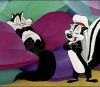
 The Cat’s Bah (Warner, Pepe Le Pew, 3/20/54 – Charles M. (Chuck) Jones, dir.) – Pepe returns to the middle East, via flashback. The framing of the retelling, however, is perhaps the most clever part of the episode. The entire opening sequence is presented via POV-camera angle, as if we are an attractive female, invited into Pepe’s abode for a rendezvous. Glasses of champagne are poured, after which Pepe carefully places the bottle and its remaining contents on ice. Pepe, smothering us in complements, invites us to sit down with him on the opposite end of a sofa, and hands us one of the glasses of bubbly, though stating that he has never needed the stuff himself to get warmed up. Just when it looks like Pepe is ready to make his amorous moves, the purpose of the rendezvous is blown, as Pepe states that he is aware we are here to interview him upon the subject of the greatest love of his life. “Come with me to the Casbah…” he begins, prompting the flashback to him grooming himself in Arabian hat before a mirror in his newly-acquired bachelor’s quarters, and leaving the premises with the warning to the world, “En guard, mon cheries, wherever you are.”
 At the docks, an American girl is disembarking from a ship, followed by her cat Penelope on a leash. The dock workers nearby are applying a coat of white paint to the ship’s side, and a splash from a paintbrush deposits the requisite white stripe on Penelope’s back. When Pepe spots her, the usual wooing commences, with the twist of phrase, “You do not have to come with me to the Casbah – we are already here!” Pepe casts away Penelope’s bonds of slavery (her collar and leash), and the chase is on. Penelope hides in one of about forty jugs before the shop of Peter the Potter. Pepe believes she is playing the game of Ali Thief and the Forty Babas, and selects a jug by a modified version of the “Eeny Meeny Miney Mo” rhyme with romantic phrases added – finding her on the first try. “Love will find a way”, he explains. Penelope races for a camel, jumping upon a hump and trying the shake the reins to get him started, but no luck. Pepe shows up on the camel’s second hump stating, “You look sweet upon the seat of a camel built for two.” Penelope zips off, and Pepe follows, while our view briefly remains upon the camel, who speaks to us as if out of “Road to Morocco” or “Speaking of Animals”, stating matter-of-factly, “If you’re a camel, you soon learn to put up with anything.” Pepe next springs out of a basket, hissing gently and curling his torso like a serpent, stating, “I am a snake, and you have charmed me.” A dash into the shop of Omar the tent maker finds Pepe seated inside on comfortable pillows and wearing a fez like a wealthy merchant, equipped with “A loaf of bread, a jug of wine, and me?” Finally, Penelope dashes into the door of “Le Cabaret Tres Vicious”, only to find Pepe inside, seated at the piano, playing and singing the memorable theme from “Casablanca”, “As Time Goes By”. Our camera view flashes forward to the present, placing us back with Pepe on the sofa. Pepe explains that though he and his lady love have had their little differences and quarrels, they have now become inseparable. A pan of the camera reveals an anklet and chain clamped upon one of Pepe’s legs, and a further pan across the room reveals Penelope, similarly locked into an anklet on the other end of the chain. Penelope nods in agreement with Pepe that they are inseparable, but the minute Pepe’s back is turned, she reveals that this might soon be remedied, as she works in frenzied fashion upon the chain with a metal file, for the iris out.
• “The Cat’s Bah” is part of an hour-long VHS compilation, beginning at 42:05, on Archive.org
 Sahara Hare (Warner, Bugs Bunny, 3/26/55 – I. (Friz) Freleng. dir) – Our scene opens on an endless panorama of sand dunes. A small sign appears in Arabic lettering, as a subtitle appears below it reading “The Sahara Desert”. A second such sign appears, with subtitle, “Keep Off the Grass.” A familiar-looking mole trail kicks up the desert sand, with interesting special effects that make the kicked-up dirt appear realistically granular. Three shots of animation are completely lifted from a previous Chuck Jones episode featuring Bugs in the exact-opposite extreme of climate: “Frigid Hare” (1949), as sunglasses, a “Fun on the Beach” book, chair and beach umbrella are tossed out of the hole, and Bugs appears in bathing suit, shouting “Miami Beach at last!” This time, however, instead of leaping into a freezing ocean as in the prior episode, Bugs keeps right on running, searching for the waves. A fade-in denotes the passage of time, and Bugs, still attempting a weak cheer, trudges along in near-exhaustion. “Dig this crazy beach. Must be low tide.” Spotting a few palm trees at an oasis, he wonders if that’s where the water is. He finds a small pool, barely larger than a puddle, and mutters, “So this is the big pond Big deal.” (And not even a wrong turn at Albuquerque!) He tries it on for size, and winds up face-deep in a muddy bottom.
 Appearing over the dunes comes a camel, with a diminutive but ornery rider – Riff Raff Sam (the riffiest riff who ever riffed a raff). He is shocked to observe that someone has been getting “footyprints all over my desert”, and follows the trail to the oasis. Bidding his camel to whoa (a command which only becomes effective with the added punctuation of a blow from the butt of Sam’s rifle, causing the camel’s hump to shrink and reappear as a lump upon his head), Sam encounters Bugs just coming out of his dip in the oasis. Seeking something to dry off with, Bugs tears the back off of Sam’s sheik hat as if a paper towel from a dispenser – and another piece of fabric automatically clicks into place. When Sam announces his own identity. Bugs distracts him – “Your slip is showing.” An angry Sam takes aim with his rifle, but is a terrible shot. Bugs walks calmly away with his back to the little sheik, disappearing over a dune, as shot after shot misses him entirely. One last shot is so far off target, it burrows a bullet hole into a sand dune. Unfortunately for Bugs, it’s the dune he’s standing behind – and the only shot that makes a blind direct hit. Bugs runs for it, and has the unusual fortune of finding a bright red antique sports car in the middle of the desert. He jumps in and guns the ignition – only to have the whole vehicle fade away as a mirage. So Bugs takes refuge in an abandoned legion fort (a sign inside reads, “For Rent or Lease”).
 The remainder of the film consists of typical (but funny) Freleng-style castle-siege entry attempt gags (a theme Freleng had used and would revisit again and again, in such films as “Bunker Hill Bunny”, “Tom Tom Tomcat”, “Prince Violent”, and “Horse Hare”). Sam pounds on the door to be let in, only to have it dropped upon him like a drawbridge, leaving him begging for it to be closed again. A pole vault attempt ends in hitting a solid rock. Prying a stone out of the wall reveals a cannon barrel in his face. Stilts fall backward when Sam fires his gun. A charging elephant is neutralized by Bugs sending out a wind-up toy mouse, causing the elephant to grab Sam in his trunk to use as a swatter to crush the mouse. A rubber band strung between two palm trees catapults Sam into a third tree, and then a fourth after Sam goes through all the effort to chop the third tree down. A long board raised against the wall for Sam to climb is split down the middle by Bugs with an axe – also splitting Sam down the middle. Finally, Bugs constructs a doorway and a crudely painted sign reading “Secret Entrance”. When the door won’t give, Sam yanks and tugs at it – until it whacks him in the face upon opening, only to reveal a second door behind it. Removing the second door reveals a third, and fourth, and so on, and so on. Inside, Bugs is still nailing new doors to the back of the old ones. At the end of the column, Bugs leaves a stockpile of TNT, with a triggering mechanism to ignite the works upon the pulling of the last door handle. Bugs emerges from another exit of the fort, and leaves Sam to his task, wondering if Sam is stubborn enough to open all those doors. A huge explosion tells him Sam is stubborn enough.
 In an unusual final coda, back at the rabbit hole, another set of sunglasses, beach chair, umbrella, etc., emerge from the tunnel, and who of all people (make that critters) should emerge, also in search of Miami Beach, but Daffy Duck. (This would mark the duck’s first intrusion into Bugs’ traveling tunnel – though Chuck Jones and Michael Maltese would cleverly adapt the concept to their own use in subsequent episodes, including one discussed below.) As Daffy runs past Bugs, in another futile search for the ocean briny, Bugs calls after him, “Hey, this isn’t…” But headstrong Daffy hears nothing, leaving Bugs to shrug his shoulders and say, “Eh, let him find out for himself.”
 Assault and Flattery (Famous/Paramount, Popeye, 7/6/56 – I. Sparber, dir.) – Popeye seems to be the hands-down winner of the theatrical age for sheer quantity of episodes with middle-Eastern themes, with the number of such output nearly-doubled by reworkings and “cheaters” spinning off of his previous adventures. This film marks the fifth “cheater” (counting the omitted “Popeye’s Premiere”) to delve into the archive of Arabian mysticism, this time through extended re-use of footage from “A Balmy Swami”. Of course, this also means that the legacy of the sailor’s episodes featuring a trance-walking Olive or skyscraper action is also simultaneously extended. Finally realizing mere fisticuffs never seems to prevail against Popeye’s strength, Bluto employs the wheels of the justice system as a weapon against the sailor – taking him to court on charges of assault and battery. An assault is defined as demonstration of an unlawful intent to inflict immediate injury upon another. A battery is defined as an intentional, unlawful and harmful contact with another person. Each of these torts requires an intent to harm or willful disregard for the other’s rights.
 Defense of one’s person or property, or defense of another, may provide sufficient grounds to prevent a finding of intent to harm. It is here that Bluto’s case goes wrong, as, while he can describe the blows he has received to Judge Wimpy (who listens to testimony between taking time out to swallow hamburgers whole, or sympathetically weeps, even though the tears are brought on by slicing onions for his burgers), Bluto presents no specific evidence of the events preceding the blows, laying no foundation to prove Popeye’s true intent. Popeye presents his testimony of “what really happened” in a digest of the aforementioned “Swami” short, condensing the entire cartoon from nearly beginning to end into about four minutes (though failing to explain the seal’s presence with any of the early establishing shots). Bluto’s evidence is deemed insufficient, and a verdict is entered in favor of Popeye. Bluto (who has appeared throughout the trial in leg and arm casts and in a wheelchair), casts off the chair and bindings, demonstrating that he’s been faking all along, complaining “That ain’t justice!” The usual brawl ensues, in the presence of the court, with Popeye squeezed into the axle holes of the wheels of the wheelchair, then twisted like a braid between them until his spinach pops out of his pocket for a quick lunch. Popeye socks Bluto across the courtroom. Acquiring a can of black paint, Popeye speeds to outrace Bluto to the opposite wall, where he spreads the paint across a set of window blinds. Bluto slams into the window, acquiring a set of convict stripes across his sailor suit – an indicia of where he’s going when Popeye presses charges of his own.
 Ali Baba Bunny (Warner, Bugs Bunny, 2/9/57 – Chuck Jones, dir.) – This is the title I alluded to in Pt. 1 of this article series, as an unavoidable case of including a genie-reference or two in order to tell a twisted version of the Ali Baba tale. We couldn’t very well do this series justice without including this classic laugh-getter.
The cave of the 40 thieves closes with the magic command of the bandit chief. A burly but exceptionally dimwitted thief named Hassan is left in charge of guarding the cave entrance, with warning that if he fails, “The jackals shall grow fat on thy carcass.” “No one shall pass Hassan”, he promises. Famous last words. A trail of dirt rising from the burrowing activity of something underground approaches, then briefly pauses for a loud “Ouch” as whatever is down there collides with the tip of Hassan’s sword planted in the sand. The tunneler shifts course, digging right around Hassan and under the cave door. Hassan’s turban spins in his consternation, and he attempt to follow into the cave. But he has hit a mental block as to the magic words. “Open…sarsaparilla? Open Saskatchewan?”
 In the middle of the fabled treasure cave, out pops Bugs Bunny from the cave floor, believing he has arrived at his destination. “Well here we are! Pismo Beach, and all the clams we can eat!” (What an entrance line!) Blame the mis-navigation upon the usual having failed to take a left turn at Albuquerque (or was it a right turn at La Jolla? – which he mis-pronounces as spelled). Worse yet, who should pop up from the hole, right behind Bugs, but Daffy Duck, who still hasn’t learned from his own mis-navigation in “Sahara Hare”, and is now accompanying Bugs for the first time as a traveling companion. He complains at the very idea of a duck having to travel underground, then observes the obvious: “Since when is Pismo Beach inside a cave?” However, while Bugs pauses to get his bearings, Daffy’s greedy little mind has moved completely off the subject of travel – to the massive heaps of jewels and coinage surrounding them in the treasure room. With vengeful selfishness and an evil glance in his eyes, he stomps forcefully upon his long-eared former pal, driving him back into the rabbit hole, with shouts of “It’s mine, ya understand. All mine. Get back in there. Down, down, down. Go, go, go. MIIINE!!” Bugs is buried under the dirt, then, slightly rumpled, emerges to the surface again, to inquire, “Eh, what’s up…duck?” Writer Michael Maltese was probably an avid reader of Carl Barks’ Uncle Scrooge comics, because what does Daffy do when faced with mountains of wealth? Dive into in like a porpoise, and let a giant diamond balance upon his head – just like any red-blooded wealth-loving duck would do!
 Of course, Daffy didn’t count on the presence of Hassan outside, who’s still wrestling with that magic word. “Open septuagenarian? Open saddle soap? Open sesame?” Hassan is more startled than anyone when the cave door responds with a mighty shift – something he probably never expected to happen from his random word selections. Still, regaining his composure, he stalks menacingly into the cave, discovering Daffy filling a mine car with choice valuables. Daffy completely misinterprets the outfitting of Hassan in small turban and loincloth and calls him a “redcap” (term for a baggage porter). “Call me a cab, boy, and be quick about it. I’m a heavy tipper.” Hassan’s reaction is anything but accommodating. He slams down upon Daffy’s head with a golden sword. It’s lucky Daffy was wearing a miner’s cap decorated with a large diamond where a lamp should be. A diamond may be the hardest substance on Earth, but Hassan is perhaps the greatest diamond cutter – causing the diamond to part down the middle with one blow – and not even needing the use of a chisel! After a momentary delay of reaction from the mere shock of this turn of events, Daffy breaks into a complete panic, screaming and racing to Bugs for help. But how to get the rabbit to help, after you’ve just finished stomping him into the ground? Well, bribery’s always one way. Handing Bugs a jewel, Daffy begs, “Quick pal. Save me, and it’s yours. Gorgeous, isn’t it? Don’t be afraid. Have it appraised anyplace.” Bugs has his complete “cool” on today, and after finishing brushing off dirt from his fur, flicks Daffy’s jewel away as if it were just more dirt, all without batting an eye. I’ve never quite deciphered Daffy’s wise crack in reacting to this turn-down, but I believe it is something like “Proud punk!”
 “Hassan chop!” yells the angry Arab, entering the treasure room, sword raised again. Scorned Daffy can never be counted on not to turn on a friend to save his own skin, calling to Hassan, ‘Yeah? Well, chop the rabbit! He brought us here.” But Bugs thinks fast on his feet, and while the Duck and Hassan are eyeing each other, Bugs has already assumed a disguise, and hidden inside a large clear bottle, pulling a cork inside the bottleneck. “Me Genie, the light brown hare.” (Aside from a few appearances in varying colors during his early years, I always thought Bugs was gray or blue-gray. But, whatever works for a song-reference gag.) Hassan bows in respect upon spying Bugs in turban and satin robes inside the bottle. “Release me, and I shall grant thee a rich reward”, says Bugs. The duck isn’t even interested in seeing what kind of plan Bugs is up to, even though it might save their skins – especially since he probably senses that the “rich reward” might cut into his own wealth. Instead, in a hilarious outburst of self-centeredness, Daffy screams, “He’s lying! Chop him! CHOP HIM!” Hassan releases Bugs, who in return offers, “Woulds’t thou like to have all this treasure for thy very own?” Who wouldn’t. Daffy might have known something not to his favor was up. So Bugs begins a magical dance to lead up to his powerful spell, including moves that sway head back and forth without moving body, and body back and forth without moving head (a cute effect, also very sparing on the animators). The economy of movement is soon replaced with some rapid-fire position changes, and Jones’ trademark “smear” animation between poses, in which Bugs makes up magic words faster than a rap singer improvises lyrics, including such phrases as “Ickity ackity oop, eh eh”, and “Flippity flappity floop”. His motion suddenly stops cold, and, without actually doing a single thing to the wealth or its true owners, Bugs calmly utters the words that proclaim his work is done: “It’s yours.” I’ve never heard this moment go by without a murmur of audience reaction to the effect of a surprised, “Oh no. Did Bugs really pull such a stunt upon this dummy?” Wile E. Coyote might have summed it up best, had he said, “Sheer unadulterated brilliance!” Daffy, however, has a quite different reaction, as Hassan repeats Daffy’s porpoise-dive into the treasure. “Ickety ackity oop!”, he sneers disdainfully at the rabbit, while Bugs maintains complete composure and a knowing smile, as if to say to the duck, “You’d have never thought of it.” Daffy stomps away in a frustrated huff, knowing now that he’s in no position to empty the treasure room, muttering his own version of improvised magic words: “Oh oh, squeak, ah ah, (raspberry)!” (If anyone in the audience has kept a straight face through this sequence, they’re legally deceased. Wouldn’t you love to have been a fly on the wall to watch this gag pitched during the story session, and see how many staffers doubled up in laughter? And what was Mel’s reaction, the first time it was sprung on him before recording?).
 With Hassan now busy with his new hobby, Bugs ventures outside the cave, this time standing on the surface. “I have a feeling that Pismo Beach ain’t quite this wide.” But something more pressing than beach directions vies for Bugs’ attention. Another desperate call for help. Daffy emerges from the cave, still determined not to leave empty-handed. And his hands are quite full – having made off with the largest diamond in the joint. Right behind him comes the shout, “Hassan chop!” Not eager to offer assistance, but too charitable to ignore him entirely, Bugs beckons Daffy behind a rock. “Back here”, he says, but then confronts the duck with the head-on inquiry, “What’s with you anyway?” The answer he receives is another line etched into our memories as a Maltese classic: “I can’t help it. I’m a greedy slob. It’s my hobby!” Daffy hides inside Bugs’ genie turban, while Hassan rounds the boulder into view. Bugs uses an old Arabian stand-by, performing the classic rope trick of having a rope seem to be suspended from the heavens vertically, and pointing Hassan to it, informing him, “Him go that way.” Hassan climbs, disappears into a cloud – then Bugs yanks the rope down, leaving him caught in a suspended limbo.
The second Daffy is informed Hassan is gone, the old greed kicks in again. Without even extricating himself from the turban, Daffy races for the cave, hat and all, shouting “I’m rich! I’m wealthy! I’m independent! I’m socially secure!” (Mel’s reads are so emotionally solid, this film marks the zenith of hilarity of Daffy’s money-madness.) Bugs refuses to be phased by the insanity, and merely shrugs to the audience, as if to say “What can you do?” After a fade-out, we resume within the cave, with Daffy having found from nowhere one humongous ore cart that can haul in one load the cave’s entire contents. “Just a quick check to see if I’ve missed anything.” What should be the only remaining object stuck in a cranny of the cave, but a golden lamp. “Well, polished up it might bring another quick four-bits on the open market.” A rub – and a genie appears. Though the genie announces himself as such, and refers to Daffy as “master”, Daffy has had enough for one day with fake genies – or any kind of competitor. “Oh, no you don’t. You want my treasure. Well. It’s mine, you understand. All mine!” Daffy begins stomping upon the genie just like he did Bugs, trying to force him back within the lamp. “Down, down go go! Mine!!” In a flash of lightning energy, the genie reappears in more powerful form, and shouts, “Duck, you have desecrated the spirit of the lamp. Prepare to pay the consequences!” “Consequences, schmosequences, as long as I’m rich”, shrugs Daffy in utter nonchalance. Bugs figures now’s the time for getting while the getting’s good, and leaves the duck to his fate, diving back into the rabbit hole and retracing his steps to return to the good old U.S.A. Meanwhile, electrical rays from the genie’s fingertips envelop Daffy, holding him in frozen helplessness as he bounces around violently in the force field.
 The scene dissolves, and for the first time in the series’ history, Bugs is seen having finally reached his original intended destination – sitting on a beach blanket under an umbrella labeled “Pismo Beach”. A shovel rests in the sand nearby, next to which is a hefty pile of clamshells Bugs has dug up. “I wonder how that crazy duck ever made out with that genie?”, Bugs soliloquizes to himself while prying open a clamshell. To his surprise, inside he finds a pearl. No sooner is the bauble revealed, then out of the rabbit hole beside Bugs on the beach pops Daffy – reduced to the size of a mouse, and talking in a miniature, sped-up chipmunk-style voice “It’s mine, ya understand. Go, go, go”, he repeats, racing up Bugs’s arm and into the shell, to seize and cling to the pearl possessively. “Oh brother. Close, sesame”, says a disgusted Bugs to the clamshell. In the manner of the stone door of the treasure cave, the clamshell slowly closes upon Daffy, who, ignoring entirely the shell’s closing, prepares to presumably reside in splendor with his new-found wealth forevermore inside the shell, with the memorable curtain line, “I’m rich. I’m a happy miser.”
Chuck Jones made a point of spotlighting this short for re-release as part of the original “The Bugs Bunny/Road Runner Movie.” It is quite surprising that it had not previously made Blue Ribbon reissue, though its original debut was a bit late in the game. It was for years a favored re-run on many local stations, and seems to have over time cemented its position as a true landmark in the Bugs/Daffy relationship dynamic.
• “Ali Baba Bunny” is on Reddit.
NEXT WEEK: Late 50’s and 60’s theatricals, and possibly more!
 Charles Gardner is an animation enthusiast who toils by day as a member of LA Law – but by nights and weekends indulges in classic jazz and ragtime as a performer; and studies classic Hollywood cartoons… maybe a little too much.







Interesting how much more familiar the cartoons become as we move further into the television era. Most if not all of these have appeared over the years in various television formats.
Goofy’s “How to Sleep” bears a strong resemblance to the shorts featuring Robert Benchley or Joe McDoakes. If I recall correctly, I believe there is a Benchley short with a similar sleep theme. I did not realize that this was the last of the regularly produced Goofy shorts. Fortunately, despite the lessening frequency, many of the theatrical shorts would gain a new life on the Disney anthology TV series as well as on the Mickey Mouse Club.
In Donald’s Diary there is a moment when the design of Donald goes completely off-model and for a long time I thought this was somehow in error–until I realized that it goes along right with the moment when the Colman-esque narrator says “I was losing my identity.” Donald’s identity changes so drastically that he is barely recognizable as the same character. It makes sense in ways that adults might get sooner than kids. Speaking of which, there is much adult humor in this cartoon. I especially enjoy the ‘favorite places” gag. Donald and Daisy are both somewhat different from their usual personas, which also seems to be deliberate as this is the only cartoon in which they get married–if only in a dream sequence. There is much to enjoy in this cartoon and it is a refreshing change of pace from the usual Chip ‘n’ Dale antics or the Donald vs. nephews dynamic. The final gag doesn’t resonate with me as I never really got the whole joining-the-Foreign-Legion-to-forget business. Seems like a pretty drastic change of lifestyle for no good reason.
Regarding “the Bugs/Daffy relationship dynamic,” it always seemed cool to me how the Looney Tunes characters would pop in and out of each other’s cartoons. In most studios the general rule seemed to be to keep each character separate in its own series. But in the Termite Terrace world, the frequent cameos and guest-starring bits worked to make the characters seem part of the same universe. Whether Sylvester appearing as Porky Pig’s cat, or Porky serving as a sidekick to Daffy, or Daffy and Bugs teaming up to outwit Elmer Fudd, or Bugs filling in for the Road Runner, these unorthodox team ups generally worked well.
I am also intrigued by how frequently Popeye turns up in this series.
“Little Johnny Jet” was nominated for an Academy Award? And yet “Duck Amuck” wasn’t. I’ve said it before, and I’ll say it again: the Oscars are a crock.
I don’t know if the problem with “How to Sleep” is that Jack Kinney was running out of steam, but I happen to have a strong dislike for the whole genre of cartoons about someone who can’t fall asleep. There are an awful lot of them, from “Good Night Elmer” to “Shuteye Popeye”, and this one is just as bad.
The instrument that the bearded scientist uses while peering out of Goofy’s window is a sextant, not an “azimuth.” The azimuth is an angle on the horizontal plane formed by the line between the observer and the object under observation relative to a fixed directional reference, generally true north. Since the sextant can only measure angles in the vertical plane, it is of no use in calculating an azimuth; for that, you’d need a theodolite. Nowadays you can download an app that will instantly give you the azimuth for anything you can point your phone at.
I see that the denouement of “Socko in Morocco” is exactly the same as that of Tex Avery’s “Big Heel-Watha” from ten years earlier.
Most cartoons have titles that involve puns or other wordplay that cannot be translated into other languages. So the German titles to the Woody Woodpecker shorts tend to be literally descriptive: “Woody as a Lumberjack”, “Woody as a Secret Agent”, “Woody in the Wild West”, and so on. While “Woody Saves the Princess” does not specifically indicate the desert setting, it does suggest a degree of sex appeal, or at least the possibility thereof — which may account for the cartoon’s popularity in the home movie market.
I’m glad you lifted your moratorium on genie cartoons long enough to discuss “Ali Baba Bunny”, one of my wife’s all-time favourite cartoons and also a favourite of MINE! MINE!! MINE!!! It’s one of the most quotable cartoons in the entire Warner Bros. corpus. There was an Australian sportscaster who used to say “Hassan like!” whenever some play or decision particularly pleased him, and everyone knew exactly where the line came from. A classic, a masterpiece, a towering achievement by the Jones/Maltese team. Oh, and it didn’t get nominated for an Academy Award, either.
Out of curiosity, in defense of cartoons about sleep, what was your opinion of the Chaplnesque “Early To Bed” of Donald Duck discussed a chapter or two ago? Or what about Popeye’s “Me Musical Nephews” or its color remake, “Riot In Rhythm”, both with a great musical score? I even thought there was some decent fun in “Trap Happy Porky” and “Daffy Duck Slept Here”. MGM’s “The Bear That Couldn’t Sleep” was deliberately slow, admittedly, but it was a landmark in giving us Barney Bear, and beautifully animated. Or how about Tex Avery’s wild gag-fest, “Doggone Tired” (The Storm, by the California Sunshine Boys)? Maybe you have a different opinion, which I’d love to hear, but I think dismissing a whole genre of titles may be a bit severe – sometimes, better writers/directors could do it right.
I’m afraid I don’t care much for most of those cartoons either, though I’ll admit they’re all a damn sight better than “Shuteye Popeye”. “Doggone Tired” succeeds because the rabbit has a vested interest in keeping the hunting dog awake, while the similarly plotted “Man’s Best Friend” (Lantz, 1941) does not: the sleepy hunting dog is merely subjected to a vicissitude of annoyances — a cricket, the light of the full moon, a ticking clock, his master’s snoring — that he doesn’t deserve. Avery’s “Rock-a-Bye Bear” is an acknowledged masterpiece and a personal favourite, but the sleepy bear isn’t its central focus; the comedy is driven by the conflict between the two dogs.
How about this: I promise to keep an open mind to the genre if you’ll do the same for the Hanna-Barbera action/adventure cartoons of the 1960s. Deal?
“Ali Baba Bunny” has at least 2 classic lines which I try to drop into conversation whenever possible —
“Hassan chop!” and
“I’m rich! I’m a happy miser!”
wait….i had been waiting (and waiting0 for “A Lad and His Lamp”….i missed it!???
A general “No genies” policy on this post, remember? Maybe a separate post for genies at another time.
Waitaminnit. Do you mean the silent Aesop’s Film Fable cartoon “A Lad and His Lamp” (1929) or the Bugs Bunny cartoon “A-lad-in His Lamp” (1948)?
Re Ali Baba Bunny: The Bugs – Daffy dynamic in this cartoon reminds me of the Bing Crosby – Bob Hope dynamic in the “Road” pictures. One great detail to notice is at the scene where Daffy is offering Bugs the gems if he’d help him. the bottle Bugs will use to disguise himself as a genie is visible in the background.
Somehow I noticed that in “Socko in Morocco”, there was another “Color by Technicolor” under the title after the classic opening. Was it originally meant to be a one-shot cartoon (and would possibly be directed by Paul J. Smith considering that he got all the non-Woody at that time?) before they changed it to a Woody cartoon at the end? If it was, then I would be glad that it was changed to a Woody cartoon, it can be said as one of the best in the 50s.
With “Donald’s Diary”, one wonders if somebody involved was going through marital troubles. The San Francisco setting includes specific real locations, and the duck strolls up and down steep hills — It makes a nice change from the usual generic city. If San Francisco already had a reputation as a gay mecca, you can put a different spin on the oblivious, disinterested bachelor literally trapped by the calculating Daisy.
An interesting background detail: When Donald tries to sneak out with his hat, there’s what looks like a pointed building in the skyline behind him … decades before the TransAmerica Pyramid.
I believe Chuck Jones once referred to “Sahara Hare” as one of the greatest cartoons ever made, with one of the funniest camels ever made. What makes that even better is the camel he and Maltese came up with in “Ali Baba Bunny.”
I hope you will look at both Toei’s ‘Adventures of Sinbad’ (1961) & Osamu Tezuka’s ‘1001 Nights’ (1969) in the near future.