



Bullwinkle: “Eenie, meanie, chili beanie. The Spirits are about to speak.
Rocky: “Are they friendly spirits?”
Bullwinkle: “Friendly? Just listen!”
So uttered the turbaned moose in a fortune telling booth, as we gazed into a crystal ball for the commercial, week after week (or in daily-block resyndication, day after day). Yes, it’s from the demented world of Jay Ward, which provides as good a stepping-off place as any for beginning a survey of television cartoons following an Arabian theme. As usual, we won’t try for chronological order between studios for our television fare, but instead group titles together by producer where possible. So please, no jumping over in the comments to shorts from rival studios which may have been produced earlier – we’ll get there in due course, when it’s that studio’s turn.

The studio’s biggest stars, Rocky and Bullwinkle, never seem to have actually made it to the Middle East – but they came close, so to speak. In the Season 2 extended story arc, Upsidasium Mine, the two, while seeking the location of Mount Flatten, a mysterious mountain in which Bullwinkle has inherited the deed to a mine, are intercepted by Captain Peter “wrong way” Peachfuzz, new head of G-2 Central Intelligence (by typographical error), who quickly gets them lost in a desert by helicopter crash. Peachfuzz has forgotten his map, and the three have no idea where they are. Boris and Natasha, following our heroes with intent of stealing Bullwinkle’s deed, capitalize on the boys’ lost sense of direction, by appearing before them in Arabian garb as Abu Ben Boris and Fatima, queen of the harem, and leading them to believe they have somehow landed in the Sahara Desert. Needing a guide, they follow Boris to a sheik’s tent he has pitched for the occasion. Bullwinkle becomes suspicious, however, when he spots crossing the same sands an old prospector, who looks distinctly American. Boris insists that what he is seeing is just a mirage, and proves what mirages can do, by having Bullwinkle look up into the sky at the blazing sun, then conk him on the head with a rock, so that Bullwinkle seems to be seeing stars in the daytime.
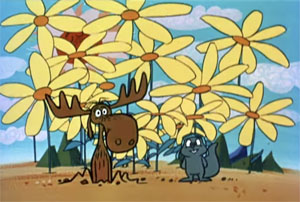 Bullwinkle is not only convinced, but very sleepy – and passes out, for a short time losing his memory. Boris and Natasha then enter the tent to deal with squirrel and Captain Peachfuzz. They offer hospitality of the desert, announcing that our heroes can stay as long as they like – but if they desire to leave, they must pay – and Boris has the scimitar to back up his words. Boris turns down Peachfuzz’s large wads of cash (though Natasha thinks he’s crazy), aiming at the bigger game of the mine deed. But he discovers the deed is not on either the Captain or the squirrel – and the reviving Bullwinkle doesn’t recognize anybody. Boris realizes none of these three are going to get him any closer to locating the deed, so cuts the support ropes of the tent, trapping Rocky and Peachfuzz under the folds of canvas, while he and Natasha make their own escape across the desert. Fortunately, the last tent pole topples on Bullwinkle’s head, restoring his memory and allowing him to unveil his friends from under the canvas. And the deed is secure, hidden where Bullwinkle always keeps his valuables – behind his left antler.
One more peril faces the boys before getting out of the desert. They attempt to follow Boris and Natasha’s tracks, but a sandstorm erases the trail. Wandering about aimlessly, Peachfuzz stumbles on something startling. Train tracks – crossing the middle of the Sahara? Bullwinkle has an explanation – it’s just another of those mira-gee things. He tries to prove it by kicking the tracks – surprised at just how hard one of these mira-gees can stub your toe. A train whistle is heard from down the line. While Rocky attempts to warn the moose, Bullwinkle remains determined to prove it is all imaginary, standing directly upon the tracks with intent to stay there until the phantom image passes. The squirrel is not convinced, and at the last possible second, zooms to push Bullwinkle from a crushing fate. Then with a hurl of the squirrel into the air by mighty moose muscle, Rocky catches up with the engine and stops the train, allowing them and Peachfuzz to board as passengers and proceed in comfort, on to their next peril.
The desert chapters of the story arc may be found in the embedded video starting at 36:00 through 47:00.
 For those of you wondering at the avoidance of the Rocky and Bullwinkle story arc, The Ruby Yacht of Omar Khayam, geographically it’s confusing, as there are too many allusions to the story taking place on the fringes of India, though the poet lampooned in the title was Persian. Again I’ll maintain deference to the writers’ visual depiction of the kingdom as north of India, or in Pakistan, depending upon which of its episodes you believe, and exclude same from discussion. It was actually a weak script anyway – Bullwinkle finds a ruby-encrusted miniature dhow in the sand of Frostbite Falls, runs a want ad by mistake offering it for sale, and is kidnapped when the deal isn’t closed, by a Vizir and troops to bring the yacht back to its homeland. No Boris, not much in the way of death traps (excepting a cobra pit which is never actually entered). And hardly any strange plot twists. Only six installments long, this one came late in the game, and simply wasn’t such a much.
The Fisherman’s Wishes (Fractured Fairy Tales – from Rocky and his Friends/The Bullwinkle Show – broadcast date unknown) – Not to be confused with the earlier “The Fisherman and His Wife”, though based upon the same fairy tale. A humble fisherman lives in a small, shabby houseboat with his wife – “Shabby, but neat”, he and his wife pride themselves upon. They are comfortably happy, until one day the fisherman’s shabby net pulls in a live mermaid. She claims she will die of a broken heart if taken from the sea to be put on display, so the fisherman cuts his net and lets her go. But she returns to the small fishing boat’s side to repay his kindness, offering to fulfill any wish he desires. The fisherman makes the simple wish that his net was mended – and receives a brand new net in its place. Rushing to tell his wife, he asks her if there’s anything she’d wish for. Unsure of what she might want, she proposes a new apron to replace her neat but torn one. “I’ll do more than that”, says the mermaid, happily granting the request next day. Everyone may soon learn to regret her generosity.
 Instead of a mere apron, the wife is seen by the fisherman upon his arrival home, wearing a golden gown studded in diamonds. Everything she could ever want – she thinks. Next day, she just can’t sit for wearing a fine gown, but having to wash a pile of dirty dishes in the sink – or living in this shabby houseboat. The answer is, a bigger boat. The mermaid again offers “more than that”, and that night, in place of the houseboat stands a yacht that is more like an ocean liner, with gold and diamond fittings, and a twice life-sized figurehead of his wife. As for dishes, a crew of servants will take care of those. The Fisherman, escorted to dinner by a butler, remarks that his wife must now be happy, living like a queen. But the missus is still unsatisfied. Why merely live like a queen, if she can BE a queen? Another wish is demanded to be communicated to the mermaid. The mermaid is by now beginning to wonder if this will ever stop, but grants the latest wish. The fisherman returns home to find the yacht replaced by an Egyptian royal barge, and pyramids and a temple erected along the shore, at the top of which rests his wife on a couch, in the role of Cleopatra. “But her name is Gertrude”, complains the fisherman to a palace guard who makes him bow before her. Still the wife is not happy. If she can be queen of te Nile, why not queen of the universe? Command the mermaid to make her a goddess! The fisherman can hardly repeat the wish when he calls for the mermaid again, and she guesses the wish without further clues. Greed is getting out of hand. Instead of granting the wish, the mermaid observes that nearly all of the wishes she has granted were his wife’s – has he no wishes of his own? All the fisherman really wants is for his “honey bunch” to be happy. “I’ll do more than that. Go, that was your last wish.” The fisherman returns home, to his old houseboat, the way it used to be, and wife, the way she used to be. Happy, shabby, “but neat.” Moral: “It takes more than wishes to do the dishes.”
The Teeth of Baghdad (Fractured Fairy Tales) – “Iraq isn’t something you have when your ear hurts – It’s a kingdom in Southwestern Asia”, begins narrator Edward Everett Horton (who even gets mentioned by name by one of the characters, referring to his narration in this episode). We visit same in the good old days of the Arabian Nights, happening upon a Sultan who takes pleasure in inflicting a capital punishment of spanking upon every citizen at the slightest provocation – the effendis, those who try not to effend, and even the officers who are supposed to enforce the punishment are not immune. And everyone gets his paddy-whacking on the annual holiday of Spanky MacFarland Day. (Hal Roach, you remain remembered.) But this reign of happiness (for the Sultan, at least, who is the only one who doesn’t get spanked) is about to come to an end, for an earthquake topples a small building, revealing a cornerstone upon which stands a set of false teeth. Inscription on the cornerstone reads, “He who wears these dentures is the rightful ruler of Baghdad.” (How Arthurian can you get?) Someone asks who wrote such an inscription, while another guesses, “A guy named Dr. Beauchamp?” (A famous early “credit” dentist.)
 The Sultan already has a full set of choppers, but isn’t going to let that stop him from avoiding being challenged as rightful ruler. He proceeds to walk out of a four-story tower, knocking every tooth out of his head. When he is well enough to walk, he approaches the stone, and reaches for the teeth. They come to life, and snap at him, breaking his finger. They do the same to lines of Arabians who try the same trick when they discover the throne has a vacancy. Arabian attorneys can’t point an accusing finger due to their bandages, and telephone operators can’t dial to complete calls. Mob rule seems to be about to take place – with rumor of its coming spread by one of the mob. But amidst this scene of chaos, a quiet, humble cow strolls up to the stone, and easily takes the dentures into her own mouth. “That’s the rightful ruler of Baghdad?”, shouts one of the citizens. Indeed, the cow soon finds herself comfortably settled upon the throne, in velvet robes and smoking a hookah. Some still question her authority and ability to rule, but as a test, a question is posed to her to solve a crisis among women in one section of the kingdom as to the proper garments to wear. The cow finally speaks: “Moo. Moo.” And so, the women happily shift their garb to Muumuus. But can the cow rule in a crisis? A Phoenecian army attacks the kingdom, scaling the city walls and marching their troops down the main street. The citizens gather behind their bovine Sultan to make a desperate stand in the advancing army’s path. The Sultan raises her voice to speak once again, letting out a long “Mooooo!” Had she only known, that in Phoenecian, such word translates as “Drop dead!” Within seconds, the enemy charges in rage, conquering the kingdom in an easy victory. The cow barely escapes the battle with her skin, all her fine trappings gone, and, in a back alley, she spits out the teeth, and vows to herself never to talk again. A new ruler is put on the throne – actually the old ruler, toothless, but happy to be back, and pays off the Phoenecians with a hefty financial tribute. He is so happy that he has no hard feelings for the cow, and, finding her no longer willing to speak, installs her as a mascot in the palace and treats her royally. “She’s the only female around here who keeps her mouth shut.” Once again decked in fine robes, the cow turns around to display upon the back of her robe the old Baghdadian proverb that serves as moral to the story: “No moos is good moos.”
The Flying Carpet (Fractured Fairy Tales) – An unnamed Middle Eastern land, and a Sultan’s birthday. All the people flock to the palace, bearing gifts for the Sultan, as is the custom. A traveling rug salesman commits the sin of Meredith Wilson’s “The Music Man”, as he “doesn’t know the territory” – arriving at the city gates unaware of the day or of the gift-giving custom. Passing the palace, he is instantly mistaken as another bearing gifts, and has the misfortune of the Sultan taking one of his rugs as his gift offering – a secondhand rug, with a large hole in it. The Sultan is outraged at this impudence – and even more so when the confused salesman tries to clinch a sale by offering the rug at half-price. As the Sultan turns red with fury, the young salesman finally catches on that he was expecting something free. Faking it, he states that he knows the Sultan can take a joke, and attempts to excuse his choice of rug by boasting that it has special powers, which he makes up from the top of his head – like, it can fly. Hole or no hole, the impressed ruler says it’s the nicest gift anyone’s ever given him, and promises to reward the youg man handsomely – AFTER he’s taken his first flight. Before the young man can stop him, the Sultan has run to the highest tower of the palace, and pushed himself and the rug over the edge. Within a few seconds, the Sultan and rug are submerged neck-deep in sand. The salesman is ordered thrown in the dungeon.
 The Sultan’s daughter chances to spy the salesman through a cellar window of the palace, awaiting execution in his cell. She falls instantly in love and wants to marry him (“Am I rushing things?”). She thus helps him escape (by baking him a cake with a pick-axe in it), so that he can find a real flying carpet to make Daddy happy. The salesman flees into the marketplace, looking for anyone selling flying carpets. He finds one that can crawl, two that can bounce, and one that swim – but no flying carpets. In desperation, he turns to a fortune teller, asking him to gaze into his crystal ball for any sign of a flying carpet. Instead, the mystic points out a rug laying upon his own floor, and asks the salesman to try it out for size. It seats the salesman fine, but no amount of commands will make the carpet budge off the ground. “What are you, a spy from Hanna-Barbera?”, asks the salesman, in what must be one of the most direct gags ever scored by Ward against the competition. The fortune teller acts like, what did you expect – “You don’t believe in that magic jazz, do you?” He states that all you have to do is “put a little something in it”, then produces a large jar of bumblebees (just the kind of thing a fortune teller keeps around for emergencies). Sew the insects into the lining, and the carpet will fly. With no other alternatives, the salesman closes a deal for the rug and bees, returns to his cell, and spends the night sewing bees into the carpet. Next day, the Sultan’s beheading sword is halted by his daughter, who points out (hopefully) that the young man now has a carpet which will really fly. Fortunately, the idea works, as the rug soars around the throne room – with considerable buzzing. The Sultan is overjoyed, grants the salesman his freedom, and the salesman and the princess are soon married. As for the Sultan, he rides his new gift proudly everyday around the land. True, he gets stung every day by the bees in the lining. But it was a gift, and narrator Horton states he was aware of the old adage, “The Bee Stings In Life Are Free”. “Oooh, oooh, oooh…” Horton moans, at the bad pun on the old song title, as we fade out.
 The French Foreign Legion (Peabody’s Improbable History – from “Rocky and His Friends/The Bullwinkle Show” – broadcast date unknown – possibly from season 1 or 2) – March 9, 1831 is the target date for the marvelous WABAC machine (after Peabody does a little tinkering on the machine to adjust the “points”, letting Sherman awkwardly make the introductions to the audience, stumbling on his lines). The event – establishment of the Foreign Legion. However, the troops they encounter don’t seem to have yet caught on to the idea that they are supposed to defend lonely posts against Arab attacks. Instead, while 20,000 hostile Arabs gather to surround the fort, led by Sheik Abdul Fanook, a mere two Legionnaires spend their time inside the fort, engaged in a hotly contested game of horseshoes. Peabody attempts to alert them to the imminent danger, but the two are under the impression that the Sheik is “in Arabee”, and go right on with their game. To put them wise that the Sheik is not so far away, Peabody and Sherman visit the Sheik’s tent, posing as guides to a daily free tour of the fort, offering interesting sidelights about the construction and so forth. The Sheik accompanies them to the fort for the tour, allowing Peabody to display the Sheik to the Legionnaires as within their midst. The Legionnaires, however, react with no dismay at this development, cordially greeting him: “Bonjour, Sheik. I thought you were out of town.” They even invite him to join the horseshoe game.
Peabody and Sherman begin to wonder themselves if their worries were unfounded, and if everyone is friends now. But as the Sheik is joined by a small group of his men to escort him back to his tent at the end of the day, and announces he will return after dinner to continue the game, our heroes overhear an exchange of words between the Shiek and a henchman in the native tongue – “Diddam daddum waddum choo” (a nonsense line from the lyric of the 1930’s novelty hit, “Three Little Fishies”). Peabody whispers this to the Legionnaires – translating as “We have left a bomb in the fort”. The Legionnaires still can’t believe it, as to blow up the fort would mean the Sheik would forfeit the game. But the fort’s flag, now seen lowered to half-mast, foretells an omen of disaster. A search of the fort by the Legionnaires turns up nothing – only Peabody knows there’s one place they haven’t looked. He asks the Legionnaire sergeant for the time. Looking at a watch on his wrist, the sergeant responds “A quarter to explosion…” The startled Legionnaire discovers that the watch, slipped to him by the Sheik during the game as a good will gift, is in fact the hidden bomb. Peabody grabs the timepiece, hurls it over the fort wall, and makes a perfect direct hit upon the Sultan’s tent, 200 yards away. The blasted Sheik quietly folds what is left of his tent (a handkerchief), and steals away into the night. Our heroes watch the Legionnaires resume their horseshoe game, while Peabody remarks that their other main pastime is ducking from sandstorms, just as one hits. Peabody notes the storm’s odd aroma – due to its “Foreign Legion Air.”
Lawrence of Arabia (Peabody’s Improbable History) – 1917, and a trip to British Secret Service in Cairo. Turkey is planning to declare war on Britain, having cut off the nation’s supply of Thanksgiving Turkeys. Someone needs to infiltrate enemy lines and obtain the secret battle plans. The room empties of potential volunteers, but Peabody calls the Colonel’s attention to an eager young clarke in the outer office – Lawrence. He is anxious to try his hand at secret servicing, but not up on the local customs. His ideas of an Arab disguise are a Santa Claus suit, and then a Pilgrim outfit. A few well-placed bedsheets applied by Peabody and Sherman, and Lawrence is an acceptable Bedouin.
 Acquiring their own Arab garb to join Lawrence in assist of his mission, the boys and Lawrence join up with a Sultan’s caravan. Peabody warns not to do anything suspicious, as the caravan is likely crawling with enemy agents. “You can count on me”, responds Lawrence – but at the first oasis, announces it’s “Tea Time! Anyone for crumpets?” That’s all it takes to land them staked out on the burning sands, with appealing sun tan oil intentionally placed just out of their reach. Sherman always carries a candy bar in his back pocket, so Peabody has him wriggle to retrieve it, then rub chocolate on the ropes. A camel with a sweet tooth soon is gnawing away at their bonds. Now free, Peabody sneaks into the Sultan’s tent in search of the plans. Just as he is about to make off with a valise appropriately marked as containing same, Lawrence barges in, asking aloud if, while looking for the secret plans, Peabody can see if he can find a tea cozy. The boys make a run for it, and Peabody asks Lawrence to find a camel to saddle. Lawrence instead saddles the Sultan. Surrounded by the Arabs once again, Peabody reaches into Lawrence’s pocket, and pulls out a grenade, threatening the Arabs to desist, or he’ll blow all of them right off the Rocky Show! They are held at bay, and ultimately surrender to the British. Lawrence tries to tell Peabody that the grenade was merely an apple, and if he had pulled the stem “like this”, nothing would have happened. Lawrence is wrong once again, as the “apple” immediately starts ticking, and blows up both Lawrence and secret service headquarters, for which Lawrence spends the next 60 days in solitary confinement in a hospital bed. The Sultan and his troops are meanwhile jailed in, of all places, barn haylofts. Why? Someone must like his “Turkey in the Straw.”
Cleopatra (Peabody’s Improbable History) – Where do Egyptians deposit their money? The Banks of the Nile. On that typical bad-pun note, the WABAC machine is set for 42 B.C. to visit Cleopatra. However, the throne is occupied by someone getting a shave. It is Prince Ptolemy, who has stolen the throne, and send the Queen adrift, tied to a raft on the Nile surrounded by crocodiles. In a stretch even for Peabody, he notes than Nile crocodiles are frustrated actors. So Peabody dons a costume of Simon Legree (though calling himself Uncle Tom!), while Sherman dresses as Little Eva (though playing the role of Eliza!). Peabody cracks a whip, and Sherman announces intention to cross the river on ice floes. The crocs all abandon their stalking of Cleopatra, and line up from one bank of the river to the other, assuming the roles of the ice blocks. The boys retrieve Cleo at mid-river.
 Cleo is sultry and seductive, but a little lacking in her knowledge of pop culture. She asks Sherman why he’s not marching to the sea. Peabody responds, “That was General Sherman – this one’s only a second lieutenant.” When a legion of Caesar’s armies is spotted in a valley below, Cleopatra asks “Sid?” “No, Julius”, Peabody corrects again. The sight of troops give Peabody the idea to use them to overthrow Ptolemy – if Cleo’s natural appeal can with Caesar over. “Are you kiddin’?”, replies Cleo confidently, as if there was any doubt in the matter. Cleo thus keeps popping up in odd places to draw Caesar’s attention. Offering salt for his Caesar salad – and a little pepper. (Caesar is first heard criticizing the salad with the words “Ars Gratia Artis” – the banner slogan of the MGM lion, meaning “Art For the Sake of Art”.) Showing up amidst his line of troops (right after Caesar orders a soldier to clean his dirty spear with spearmint). And as a reflection in a mirror with no glass in it. Caesar goes ga-ga every time, and by the time Cleo finally reveals who she is, Caesar will do anything for her.
An assault begins on Ptolemy’s palace, with waves of spear throwers and rock-launching catapults. But Ptolemy has erected a large pop-up rubberized screen, which merely bounces the weapons back upon their senders. Caesar fears they will be victorious losers. But Peabody as usual comes to the rescue. Grabbing some bandages from a first-aid tent, Peabody wraps himself up as a sacred dog-mummy so he will be immune from interference, then pole vaults across the moat over the palace wall. An hour later, he returns, instructing Caesar to continue the battle. Much easier to do now, since Peabody has cut a gaping hole in the protective screen during his palace visit. The walls come tumbling down, Ptolemy with them. Cleo gets her throne, and Ceasar gets Cleopatra. The boys do some final sightseeing in the bazaar, and observe a vendor selling barometers shaped like Pharaohs. “I didn’t know they could predict the weather”, remarks Sherman. “Haven’t you ever heard of, ‘Pharaoh and warmer’?”, quips Peabody.
 Oil’s Well At Oasis Gardens (Hoppity Hooper, air dates unknown – final season) – Sullivan’s Swamp, a piece of land owned lock, stock and barrel by Waldo Wigglesworth, is such an undesirable piece of real estate, even the Indians can’t be paid to take it. “Red man want country back, but not that bad.” After fruitless efforts to ditch himself of the property, Waldo finally manages a trade with a short dark stranger – a trade in which he has to toss in a bonus extra of the deed to Hoppity’s house, leaving our heroes with no choice but to hit the open road. The trade is for a piece of desert land known as Oasis Gardens. We know there is trouble in the works, when it is revealed that the stranger with whom Waldo made the trade is none other than Boris Badenov, unable to resist a juicy cameo for nefarious evil-doing!
Oasis Gardens doesn’t exactly match the picture of an attractive resort handed to Waldo by Boris – in fact, the image of the resort is printed on the picture with disappearing ink, so that the picture below reveals the property for what it is – a square mile of empty sand, with an occasional cactus, rattlesnake, scorpion – no, scratch the scorpions: the rattlesnakes ate them. Waldo rattles his brains for any idea to turn this place into a money-maker – even a side trip to Washington, first to obtain a farm subsidy for not growing wheat, pigs, or cotton (getting him booted out the door of the senate), then to have the place declared the #2 Federal Disaster Area (Washington D.C. is already #1). No luck, as the place is so small, the feds can’t even locate it on a map, and have never taxed it – proving it doesn’t exist.
Back at their property, Waldo is about to admit defeat, when Fillmore the bear makes a startling discovery – a thick, gooey black puddle, that seems to be coming up right off of the ground. Oil! Waldo is so fixated upon the news, his thoughts and speech stick on the word like a broken record, until Fillmore rattles his brains back in gear by toppling a cactus upon his head. Since the government lays no claim to this spot, why not, thinks Waldo, declare a state of independence? – become a new, oil-rich nation called Boondockia! Waldo appoints himself Sheik, Caliph, and what have you, while Fillmore becomes Vice President, Supreme Court Justice, and Trash Collector. Word of the country’s foundation is leaked to the press, and soon the good-will gifts are pouring in by the vanload – but with strings attached, such as a solid gold fountain pen, tied to a yet-unsigned oil contract with a hanging array of built in loopholes. Waldo lets the goodies pile up, but makes no commitments for his sole potential export. That’s when the board of an oil conglomerate decides to stop playing Mr. Nice Guy and to send in their best secret operative to take control of the new nation – a sheik known as Sahara Vaughn (jazz and blues fans will get the pun instantly – think about it), and his henchman Ali. When Hoppity first meets them, Sahara is shocked that Hoppity claims to have never heard of him, yet thinks he’s heard of Ali. The error becomes apparent when Hoppity innocently asks Ali what happened to Kukla and Fran. (Score one pun for puppetry fans.)
While attempting to appear both helpful and dazzled by Waldo’s country and faux-Arabic fez and outfit, Sahara sets various evil schemes in motion. First, an attempt to take Fillmore’s picture in his new military-finery uniform, with an old-fashioned flash camera in which is concealed a miniature cannon. But, like most amateur photographers, Sahara forgets to take the lens cap off, causing the gunpowder-filled camera to blow up in his face, and land him atop a cactus. “Too much flash powder”, he claims. Next, Sahara asks for a light for an Arabian cigar. Waldo shows off, by lighting it with a flaming ten-dollar bill. Hoppity thinks Waldo’s fez must be too tight for him, affecting his thinking. Fillmore asks if the headband is shrinking, but Hoppity replies no – Waldo’s head is swelling. Waldo tosses the bill away, but Ali blows several gusts of his own breath under it, guiding it to land right in the oil pool, setting it afire. Hoppity rushes to douse the flames with a shovel full of sand, but Sahara insists that’s not the high-class way to do it. He insists Hoppity play it out like in an old Chester Morris picture – carrying dynamite to the flames to blow the fuel source apart. Of course, Sahara holds the plunger to the dynamite, ready to depress it before Hoppity reaches the pool.
Waldo and Fillmore watch the brave Hoppity approach the fire, backing their medicine-show truck to a safe distance from where the explosion will take place. But Fillmore again makes a startling discovery. Where the truck had been parked – another twin to the oil pool Hoppity is approaching. It’s not coming up out of the ground at all – but sourced from the truck’s leaky crankcase! The two try to call to Hoppity that he’s risking his life over a worthless gallon of motor oil – but Sahara pushes the plunger. Nothing happens! Hoppity returns to Sahara with the dynamite, and suggests Sahara may have gotten his detonation wires crossed. Sahara refuses to take advice from an amateur, as he is supposed to be the explosives expert, angrily casting the wires away. Ali picks them up, asking, “So its perfectly safe to attach this wire here, and this wire there…” KA-BOOM!!! The two villains are last seen rising above the clouds, not so concerned as to where they will come down, but when. Waldo and Fillmore are relieved to find that Hoppity was not in the massive crater left by the explosion, but concede that their bonanza is just another flop. That is, until the ground begins to shake – the signal that a gusher is about to come in. Out from the ground rises a massive fountain – but not black, nor gooey. Plain old water. But in the middle of a burning desert? That’s even rarer than oil. People flock from everywhere to bask in the cooling pool growing from the never-stopping fountain. So our heroes find themselves the proud owners of the oasis resort they set out for in the first place, which is renamed Hoppity Springs. On a TV set back at Hoppity’s old house, Boris Badenov watches this upsetting turn of events, and turns to the camera, claiming that he will still have the last laugh. Hoppity appears in the TV screen, stating that Boris will have to make it quick, as it’s the end of the story. The camera closes in on the screen, as Boris now appears within the TV image with Hoppity, uttering an evil laugh, and taking swipes at Hoppity with a stick. Hoppity brings the proceedings to a close, by reaching one hand out of the TV screen, to turn the control knob of the set to off position, quickly fading-out everything to black with a “Click”.
The Sneaky Sheik (Tom Slick – from “George of the Jungle” – 12/2/67) – Daws Butler gets to pull his old Hokey Wolf/Phil Silvers voice out of moth balls for a new villain in this one. A dune buggy race is scheduled in Northern Africa’s Hotfoot Desert. Tom as usual has made conversions to the Thunderbolt Grease Slapper to enter her in the race – but two feet sticking out under the rear of the car are not part of the extra accessories he installed. They belong to Howya Bin Boobi, aka the Sneaky Sheik – a little Arab who wears black-framed spectacles like the comedian he is lampooning. The Sheik claims he was only under the car taking a rest, to shield his sensitive eyes from the desert sun. Of course, his mission was really sabotage, being an entry himself in the race to follow. Marigold wonders why the Sheik’s hands were so oily as he departs for his own car. “So was his manner”, says the unsuspecting Tom.
 The race begins, with Tom trailing behind dead last, leaving a trail of oil in his wake, as Marigold discovers the plug to Tom’s crankcase on the ground. She and Gertie Growler take an oil drum “and beat it” (Gertie can’t resist saying it) to catch up with Tom, also bringing him back the plug. Meanwhile, thinking that Tom, the favorite, is safely out of the way, the Sheik turns his attentions to the other racers. He tows behind his car a wide rake with its pointed teeth facing down, creating a sandstorm to obscure the other drivers’ view. When no one else can see, the Sheik flips the rake point-side up and jettisons it in the path of the other racers. Instant spike strip, and a desert full of blow-outs. Tom meanwhile is all oiled again, with a long way to catch up. Discovering Tom is rolling, the Sheik is still not worried – as his plan 2 kicks into action, with Tom’s car running out of gas, due to a hole punched in the gas tank. Fortunately, just ahead of Tom appears a last chance gas station. Tom asks the elderly attendant to fill ‘er up, but the attendant points out the hole in the tank the size of a half dollar. Tom wants it plugged, but doesn’t have a half-dollar on hand – two quarters will have to do. Don’t ask me how, but the helpful attendant does make do, and Tom is refueled and roaring to catch the Sheik. Then, the whole station begins to disappear! Just before becoming invisible himself, the attendant informs the narrator that this was only “a mirage garage”. No explanation is offered how the repair and the gasoline were real.
Tom miraculously pulls up alongside the Sheik’s car (who must have been taking it easy, thinking the race was in the bag). The Sheik is forced to resort to his secret weapon – a box of instant quicksand pills. Dropping them one-by-one before the Grease Slapper’s bumper, they soften the ground. “The narrator declares that the Grease Slapper is “slowing down”, “slowing down”, then “going down.” Gertie and Marigold to the rescue again, with a helicopter and a rifle that fires a plunger with a rope tied to it onto Tom’s head. The helicopter hauls upwards, while Tom hangs onto the steering wheel. Quite a stretch for Tom’s neck, but the car is out of the muck. Charging “like an avenging aardvaark” (so says the narrator), Tom again pulls up even with the Sheik. It’s a neck-and-neck dash to the finish line, and somehow out of the cloud of dust, Tom wins by a nose. But that doesn’t stop the Sheik from swiping his trophy and driving off with it. Before Tom can even give chase, fate steps in to bring about final jutice. A brick wall is spotted, blocking the Sheik’s route of escape. The Sheik doesn’t even slow down, reacting, “A brick wall in the middle of the desert? I know a mirage when I see one.” WHAM!!, as the lights go out for the Sheik. Tom and Marigold stand witness in confusion. How could such a brick wall appear in the desert? “Let’s just call it a desert mystery” declares Tom. But on the other side of the wall, Gertie Growler is revealed by the camera, with piles of bricks, a mix of mortar, and a trowel. “On second thought, let’s just call it a heck of a lot of hard work!”, she says.
The Jay Ward archive is so rich, and so full of little hidden plot twists, that it’s always hard to know if you’ve caught every reference to any particular subject. If there’s more I’ve overlooked, feel free to supply same in your comments. We’ll move on to another studio (or maybe more) next time.
 Charles Gardner is an animation enthusiast who toils by day as a member of LA Law – but by nights and weekends indulges in classic jazz and ragtime as a performer; and studies classic Hollywood cartoons… maybe a little too much.







I trust you’ll look at Hanna-Barbara’s The Arabian Knights from The Banana Splits Show.
‘The shape of a rhinoceros!’
I think fractured fairy tales covered the magic lamp story of aladdin like two times back in season 2 and 3. One of them featured a guy who discovered a lamp and it turns out there are girls who are stuck in the lamp for years. The other one is about two rivals who tries to grant wishes and ends up in the money ruins or something.
I’m wondering if future installments will include the Beagles “Foreign Legion Flops” and from the Alvin show “Clyde Crashcup Invents Egypt”??
Another 60s H-B series I trust you’ll also look at is Shazzan.
WHEW! I’m exhausted just reading all these plots to J Ward cartoons. What a great post! And a great reference. Liking these J award cartoons as I do, I’m very familiar with all of them.
Gotta love that Mae West take on Cleopatra.